
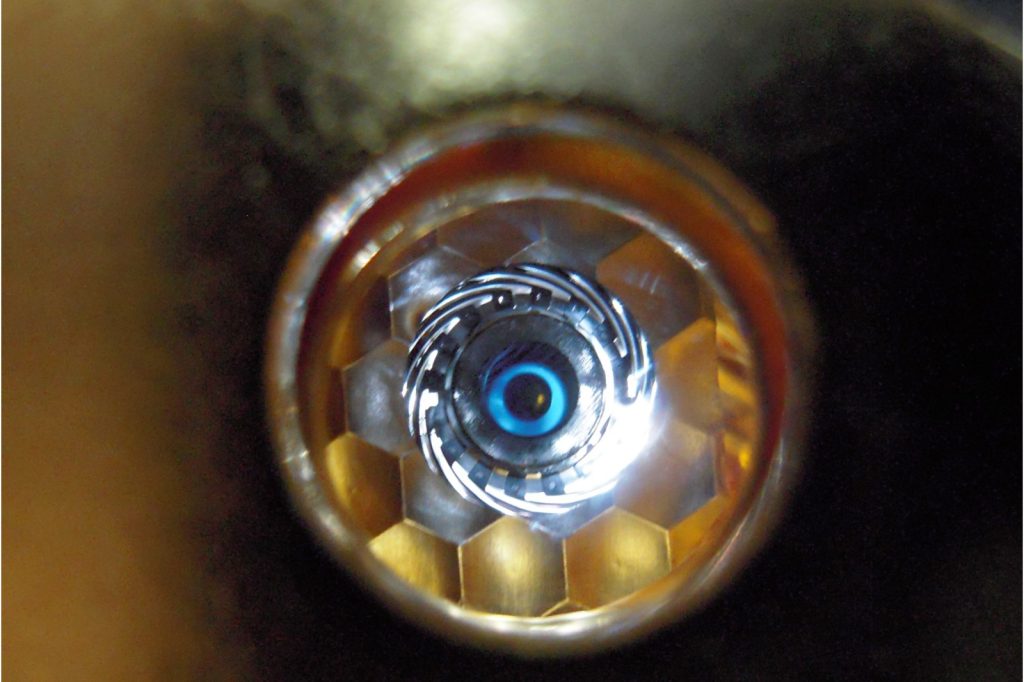
“A fusion breakthrough that will go down in the history books.” That was how Energy Secretary Jennifer Granholm described it to reporters on a Tuesday morning in December 2022, after scientists at Lawrence Livermore National Laboratory in California said they had finally pulled more energy out of a fusion reaction than the lasers put in.
The shot itself happened on Dec. 5. Inside the National Ignition Facility, 192 laser beams converged on a tiny fuel pellet of hydrogen atoms. For a split second the fuel turned to plasma and fused. The beams delivered 2.05 megajoules to the target, and the reaction gave back 3.15 megajoules. That works out to roughly 1.5 times the energy that went in. The Financial Times was first to report the result before the official announcement.
Sixty years to a split second
Lab director Kim Budil told reporters it had taken 60 years of work to get here, toward a goal many people had said “was not possible.” She called ignition a first step that sets up what she described as a transformational decade for fusion research and high-energy-density science. Granholm, speaking from Washington, put it in national terms: “This is what it looks like for America to lead, and we’re just getting started.”
Fusion is the process that powers the sun. Hydrogen nuclei are forced together so hard that they combine into helium and shed a huge amount of heat. Unlike conventional nuclear reactions, it leaves no radioactive waste behind. No group had managed to get more out than it put in, because the temperatures and pressures involved are brutally hard to control.
The catch in the arithmetic
Read the headline number carefully and the picture shifts. The 2.05 megajoules counted only the light that hit the target. Budil laid out the full bill herself, using rounded figures: “The laser requires about 300 megajoules of energy from the wall, to drive two megajoules of laser energy which drove three megajoules of fusion yield.” Measured against what the facility drew from the grid, the overall efficiency is under one percent. The reaction produced a net gain inside the experiment, but not nearly enough to run the machine, let alone feed a power line.
Budil did not pretend otherwise. Her team’s calculations suggest that a laser system at scale could reach hundreds of megajoules of yield. “So there’s a pathway to a target that produces enough yield,” she said, “but we’re very distant from that right now.”
Mashable compared the earlier attempts to matches struck against a matchbox that threw sparks. This one, it said, was the first time the match head actually produced a flame, though the flame is still too short-lived to light anything else. Laser compression is also only one road. A rival approach holds the superheated fuel in place with magnetic fields instead of blasting it with beams.
Researchers who weighed in agreed on the timeline. Powering homes and businesses with fusion is still decades off. What changed in December 2022 is that the physics, long a question mark, now had a measured result behind it.
Sources
- Nuclear fusion breakthrough: Here's what achieving 'ignition' at Lawrence Livermore National Laboratory actually means | Mashable
- US scientists produce first successful nuclear fusion reaction resulting in net energy gain | Fox News




