
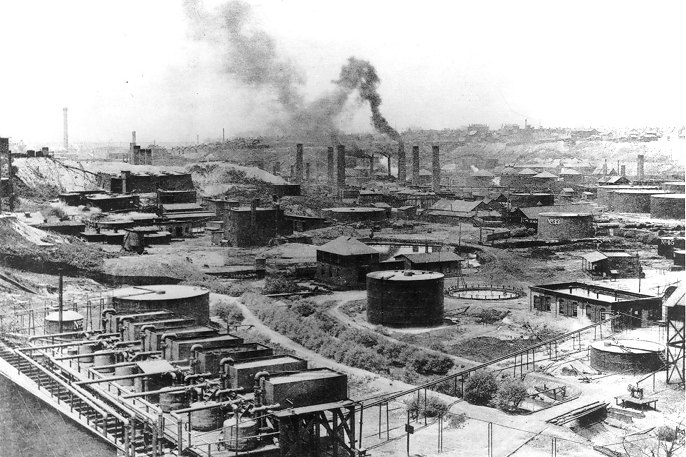
The figure that matters: 69.5 feet. On August 27, 1859, Edwin Drake’s drill reached that depth outside Titusville, Pennsylvania, and struck oil for the Seneca Oil Company. The well flowed at about 25 barrels a day, roughly 21 meters down, and it was the first commercially viable oil well anywhere. The bottom line: the modern petroleum industry starts at that hole in the ground.
By the Numbers
The crowd arrived fast. Titusville counted 250 residents the year Drake drilled; by 1865 it held 10,000. Nearby Pithole, a ghost town today, ran 50 hotels at the area’s oil peak around 1866. The boom was short: rival drillers flooded in, excess output cut prices, and companies moved on almost as quickly as they had come. Investors will note the pattern anyway; the rush, not the well, set the template.
The Man and the Method
Drake was a former railroad conductor with no formal training in geology or engineering, hired by Seneca Oil to test whether oil could be pulled from beneath the surface. He worked with a steam-powered drill and invented his way past the flooding: a drive pipe, cast-iron sections hammered into the shaft to keep water and cave-ins away from the drill bit. Oil itself was nothing new. It came up as an unwanted byproduct of salt wells, was skimmed from surface seeps, and was dosed out as a folk medicine for respiratory diseases, epilepsy and scabies.
The business case was lighting. The point of the well was oil refined into kerosene for lamps, an alternative to the whale oil then illuminating homes and workplaces. Demand then outgrew the lamp: petroleum spread into lubricants for engines, distributed heating, and fuel for motorized vehicles, with two world wars and the 1950s population boom compounding the growth, and offshore platforms opening oceans to drilling in the century’s latter half. By 2016 the world was burning more than 97 million barrels a day.
The Ledger
The costs were booked later. Carbon emissions came to 33 gigatons in 2019, thickening the greenhouse “blanket” around the earth. The original resource had owners, too: the Seneca Nation, one of the Six Nations of the Haudenosaunee, had long gathered petroleum by skimming slicks from local waters, was removed from its lands across the 1700s, 1800s and 1900s, and saw no benefit from the company that took its name. The geology underneath ran deep: between roughly 490 and 360 million years ago the region lay under an ocean, and heat and pressure compacted its oxygen-free ooze into rock and cooked the trapped organics into petroleum.
Downstream of Drake came the corporate age, including John D. Rockefeller’s incorporation of Standard Oil in Ohio in 1870, an outfit on its way to becoming the world’s largest refining firm by the century’s end. Drake himself lived a hard life after his discovery, though he is still considered “the father of the modern petroleum practices and industry”. The well site outside Titusville is now a museum, and the number on the plaque is still 69.5 feet.
Sources
- The Story of Oil in Western Pennsylvania: What, How, and Why?
- Titusville, 1859: The Oil Well That Changed Everything




