
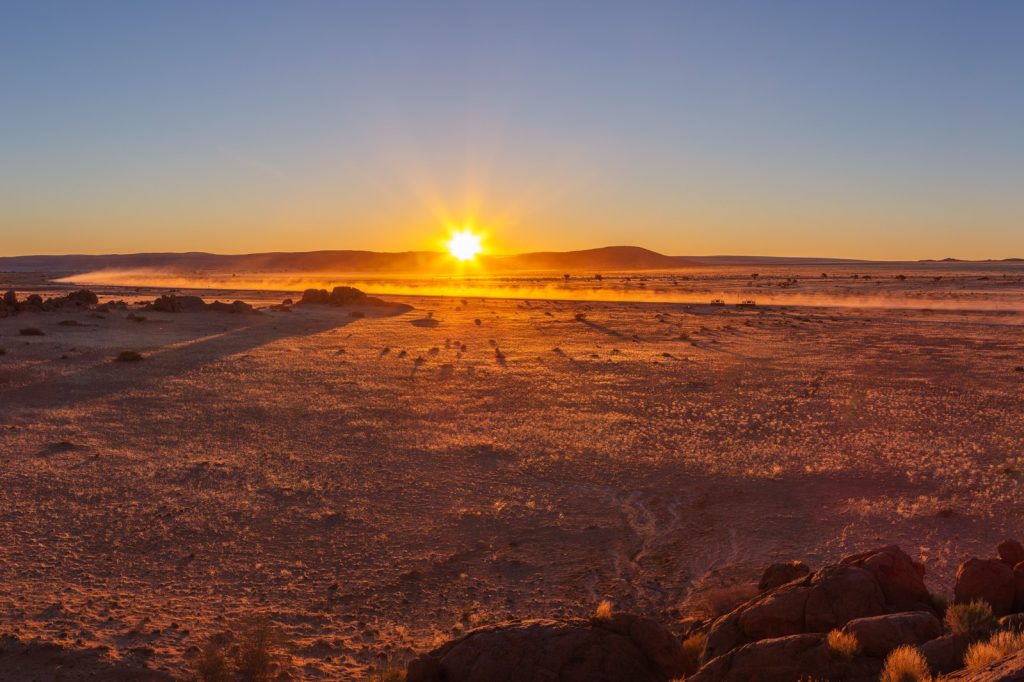
Soil samples from a new prospect in Namibia have returned gold values of up to 730ppb Au, and the zone they sit in stretches over 5km. Ongwe Minerals Inc. (TSXV: OGW) announced the find on June 9, 2026, naming it the Nguni prospect, part of its Omatjete Gold Project.
Chief executive Dave Underwood did not hold back. “The newly discovered Nguni prospect is the biggest gold in soil anomaly I have seen in Namibia since first embarking on exploration here in 2008,” he said.
Where it sits
Nguni lies 17km from Ongwe’s Manga gold discovery and 55km from the Kokoseb project owned by Wia Gold, which carries 2.93Moz of gold. All three follow the same structural trend, the Okondeka Fault Zone. The anomaly is still open to the north, east and west, so its full size is not yet known.
Twenty-eight samples have assayed above 300ppb Au, and eight above 500ppb Au. Multi-kilometer trends run above 100ppb Au. Ongwe says the size and grade resemble the soil anomaly at Kokoseb when that discovery was announced in September 2021.
Underwood added a caution: soil grades do not necessarily indicate what grade lies in the rock below. Still, he called the setting “textbook”, describing a regional fault that bends around brittle granitic intrusions and so opens space and pathways for hydrothermal fluids.
How the geology looks
The mineralization appears to sit in deformed metasediments of the Kuiseb Formation, hemmed in by late-to-syn-tectonic leucogranites. The company says the contacts of these brittle granites look more prospective than the older, foliated biotite granites. The highest-grade, northwesterly part of the anomaly wraps around a granite dome. To the east, the trend follows the granite contact toward a small outcrop called “Gossan Hill”, made of highly altered, iron-oxidized schist.
A thin cover of alluvial scree limits mapping over the area. The company found the anomaly through a regional soil campaign on a 200 x 200m grid, using its in-house detectORE system, and then tightened the spacing to 100 x 100m. Fire assay was done at MSALABS in Omaruru. A 50 x 50m infill grid is now being sampled.
Next steps
Ongwe plans a drill program in the second half of 2026 once mapping and sampling define the footprint. A drone magnetic survey is coming shortly with the company’s own drone. Land access is being finalized so crews can explore the unexplored 17km corridor between Manga and Nguni, as well as ground east of Nguni.
“This discovery validates our faith in the Omatjete Gold Project,” Underwood said.
Omatjete covers 151,800ha. Ongwe also holds the Khorixas Gold Project (154,000ha) and the Outjo Gold Project (46,000 ha), all in the Northwest Damara Gold Belt. Carl Joone, the company’s President and Co-Founder and a Qualified Person under National Instrument 43-101, verified the data and noted no errors or omissions.
The company also said that on June 9, 2026, its 51% subsidiary Belmont Minerals Exploration (Pty) Ltd. amended an agreement to buy a 90% interest in a 36,000 ha license area next to Omatjete. Ongwe will issue 175,000 shares to the seller, on top of C$50,000 in cash already paid. Milestone payments of up to C$4,000,000 could follow if significant mineral resources are established.




