
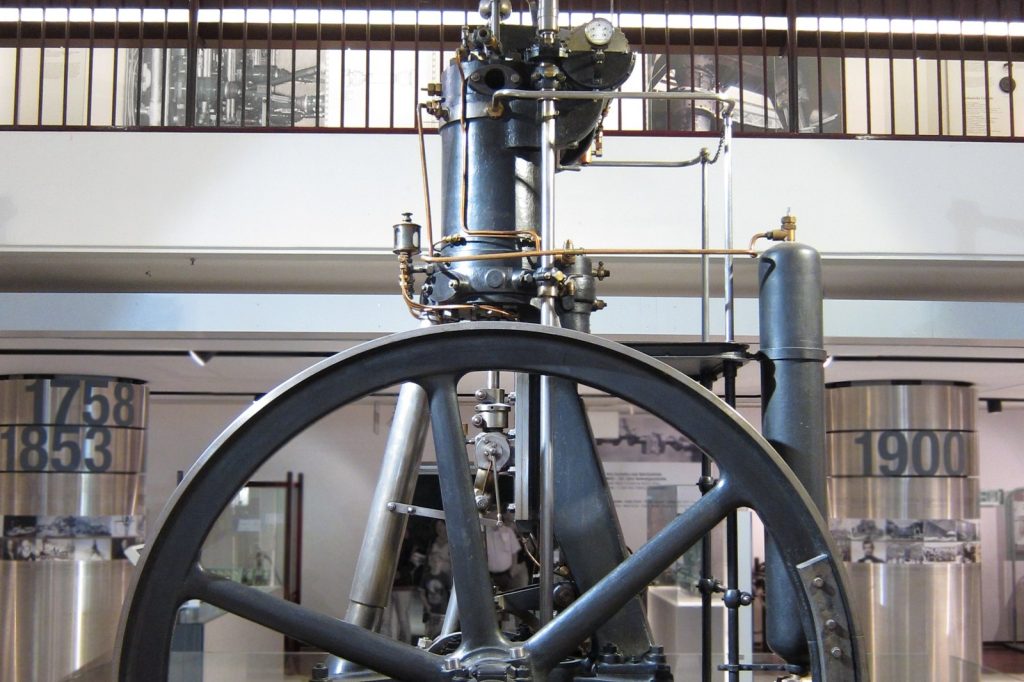
The claim dates to 1892, when Rudolf Diesel patented an idea that read like a rebuke to steam: compress air alone inside a cylinder until its temperature climbs, inject fuel, and let it ignite with no spark at all. Heavier, cheaper fuel could burn this way, and the payoff showed up five years later in Augsburg. At the acceptance test on 17 February 1897, his engine returned 26.2% efficiency under load against roughly 10 percent for the steam plants of the day. That gap was the entire business case, and Diesel knew it.
The path there was long and unglamorous. Born in Paris in 1858 to Bavarian immigrants, he moved back to Germany with his family in 1870, studied at the Industrial School in Augsburg and then the Royal Bavarian Polytechnic in Munich under Carl von Linde, and spent years supervising refrigeration installations across Europe for Linde’s company. In 1885 he opened his first Paris workshop to chase compression ignition; the hunt ran 13 years. Patents stacked up through the 1890s, Maschinenfabrik-Augsburg, later MAN, hosted the development from 1893 to 1897, and Sulzer Brothers of Switzerland bought rights in 1893. The first prototype, tested on 10 August 1893, failed outright.
The catch is that the engine was not ready for the market Diesel pushed it into. Early diesels were big and slow, hemmed in by their compressed air-assisted fuel injection, and they competed against the hot-bulb engine of Akroyd-Stuart. Licensing made Diesel extraordinarily wealthy for a stretch, then some early engines failed, disputes and lawsuits followed, and feuds with rival engineers wore at him; promoting a half-finished machine ended in a nervous breakdown.
Then the strange ending. September 1913 found him boarding the Dresden at Antwerp, bound for London to open a diesel factory and meet British naval officials interested in diesel submarines. He dined with fellow passengers on the night of 29 September, went back to his cabin, and that was the last anyone saw of him. The bed stayed untouched; his hat and folded coat waited by a railing. Ten days on, the North Sea gave up a body too damaged to recognize, identified through items his son confirmed. Suicide over money and health, an accident on a dark deck, or foul play to keep diesel know-how from the Royal Navy on the eve of war: the file never closed.
The invention outlived the uncertainty. Once the patents lapsed, other firms industrialized the design; the first Sulzer-built unit had already run in June 1898. High-speed versions reached commercial vehicles in the 1920s and passenger cars in the 1930s, and compression ignition became the default for industry, shipping and road freight. The economics, not the mystery, did the rest.




