
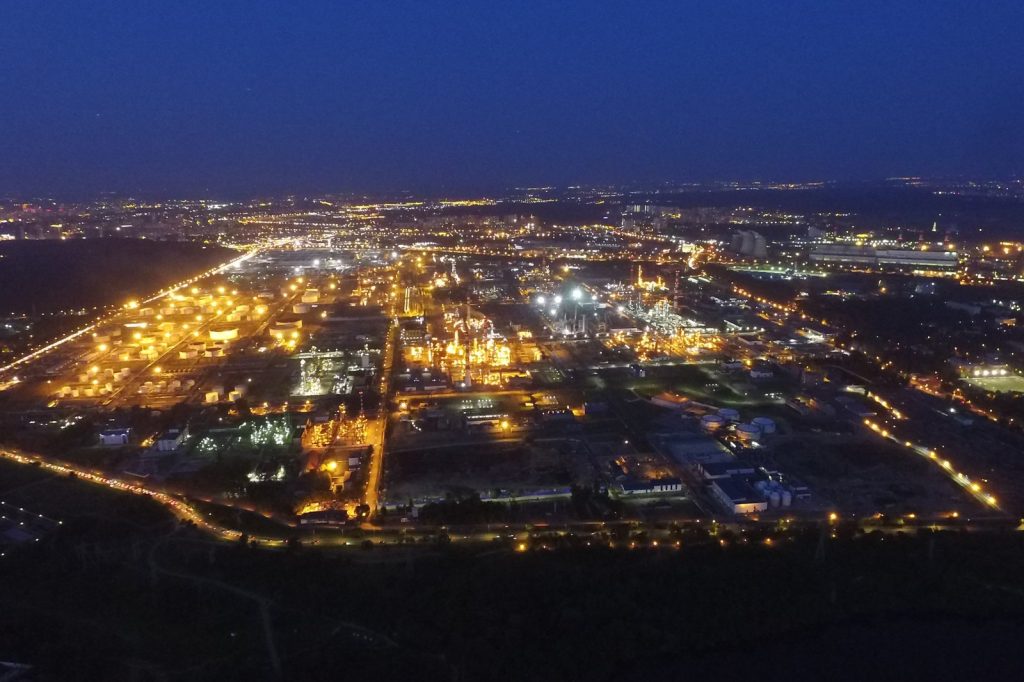
The salient point, before the noise: Russia still sells millions of barrels of oil every day, and the money those barrels earn is thinning all the same. Two slow pressures are at work — Western sanctions that have reshaped the economics of the trade since 2014, and since 2025 a Ukrainian drone campaign aimed at the machinery that turns crude into cash.
The decline starts underground. The mature fields of Western Siberia, the traditional backbone of Russian output, were developed in the late Soviet years with short-term production prioritized over reservoir care; today rising water production and falling reservoir pressure are the bill coming due. Moscow’s answer has been to drill more wells, with diminishing returns. Crude output has slid from 10,4 million barrels per day in 2019 to a little over 9 million now, sitting under Russia’s OPEC+ quota of 9,7. Technology sanctions bite hardest where geology is hardest: shale expertise and equipment are now unobtainable, and remote conventional projects such as the Vostok developments in northern Siberia have been delayed by financing costs and uncertainty over future demand. Russia’s oil reserves remain the ninth largest in the world; gas, where Russia leads globally, mostly powers the domestic economy at regulated prices. Oil is the external financial power — historically the largest source of foreign currency and government revenue.
The sanctions record is one of adaptation at a price. After the full-scale invasion in 2022, the European Union and G7 restricted imports and capped the price of Russian crude moved by Western-linked shipping. Russia redirected flows to China, India and others, assembled a so-called shadow fleet of older tankers and built alternative insurance and trading arrangements. Exports did not collapse; they got dearer and thinner. Selling at discounts, paying more to move the oil and funding the shadow fleet has cut Russia’s oil-export income by roughly 25%, on the reckoning of energy-tracking analysts at CREA.
Notably, the drone war has added a front that trade rules cannot touch. Ukrainian long-range strikes since 2025 have concentrated on refineries rather than storage or pipelines, and the targets are well chosen: catalytic crackers and desulphurization units are hard to replace and slow to repair, so repeated hits keep plants running below capacity and impose a permanent maintenance burden — attrition rather than a single decisive blow, as the Oxford Institute for Energy Studies frames it. Numbers of cheap drones can overwhelm air defences; even when most are intercepted, the few that get through do economic work. At various points, outages covering 20-30 percent of refining capacity have been reported.
The fiscal logic is plain. Russia earns more from diesel and gasoline than from crude, so lost refining shrinks margins, raises logistical costs and drags the state deeper into domestic fuel management; Moscow has banned or restricted gasoline and diesel exports to keep supplies at home. Crude exports stay resilient — what cannot be refined can be shipped raw — but that is selling the cheaper version of the same barrel.
For all the noise, no collapse is in evidence; the pressure is cumulative. It would seem the honest summary is the one energy analysts at HCSS and the Kiel Institute circle: the open question is not Russia’s ability to sell oil — it is whether sales stay profitable enough to carry both the budget and the war. High prices buy a reprieve, and only a temporary one. Ukraine, for its part, lost most of its own refining early in the war and runs on road-borne fuel imports from Poland and Romania; its grid, hammered for years, has survived on fast repairs, European interconnection and better air defence. Resources on one side, adaptability on the other. The erosion, for now, favors neither quickly — it simply continues.
Sources
- Expert Analysis | From Sanctions to Drone Warfare: The Slow Erosion of Russia’s Oil Sector – HCSS
- Russia’s energy revenues plummet despite surging global oil prices amid drone attacks




