
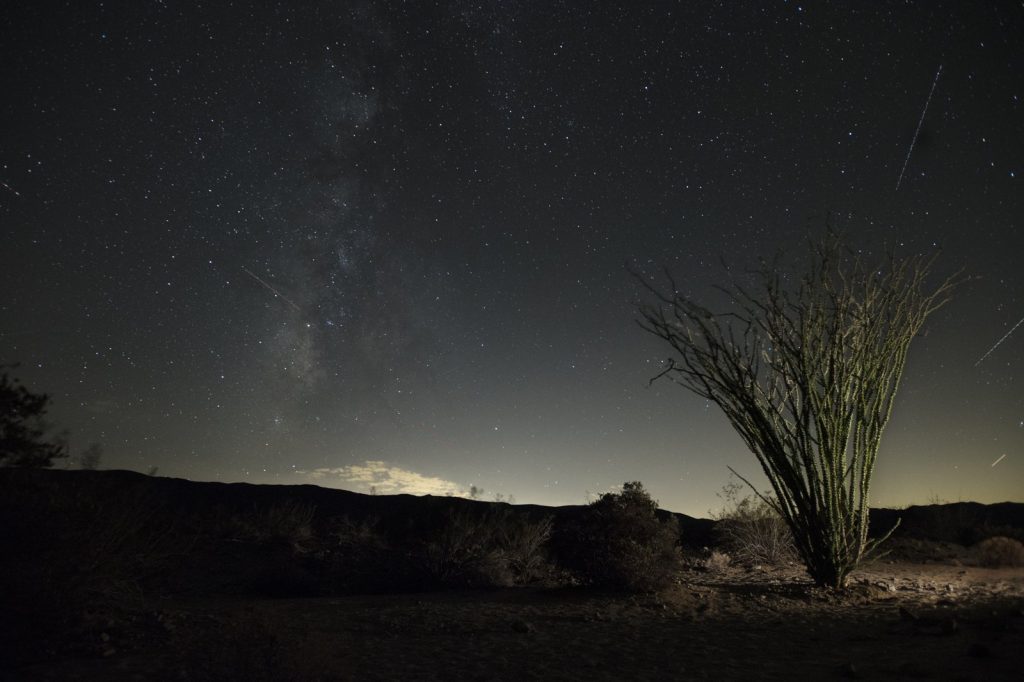
A Falcon 9 upper stage tore across the European sky on February 19, 2025, disintegrating over central Europe and scattering metal fragments, including a fuel tank that landed near Poznań, Poland. The visible fireball lasted eight minutes. Twenty hours later, 1,600 kilometers away, a laser in Germany recorded a tenfold rise in lithium atoms at an altitude of 96 kilometers.
That signal, captured by a resonance fluorescence lidar at Kühlungsborn, was the first direct measurement of upper-atmosphere pollution from a reentering piece of space debris. It turns a theoretical concern into an observed one: satellites are not just falling; they are leaving behind materials that natural meteor showers never delivered in such forms.
A chemical signature in the sky
The detection came from a ground-based instrument watching a narrow band of the mesosphere and lower thermosphere, between 50 and 150 kilometers up. Lithium was chosen as a tracer because natural lithium is extraordinarily scarce. The daily natural input is about 80 grams. A single Falcon 9 upper stage carries roughly 30 kilograms of lithium in its aluminum-lithium alloy tank walls. When the stage ablated, that lithium vaporized and drifted eastward.
The Kühlungsborn lidar measured lithium density below 3 atoms per cubic centimeter through most of the night. Just after midnight UTC on February 20, the reading jumped to a peak of 31 atoms per cubic centimeter at 96.1 kilometers. The plume stayed between 94.5 and 96.8 kilometers and lasted about 40 minutes. Backward trajectories from a high-resolution atmospheric model pinpointed the source: the air had passed through the Falcon 9 reentry path west of Ireland, at 52.5 degrees north, 12.38 degrees west, at 03:42 UTC on February 19. The match was within 2 kilometers vertically and 10 kilometers horizontally.
Natural explanations were ruled out. An ionosonde 116 kilometers away showed no unusual electron activity. Wind shear patterns were the opposite of what would concentrate metal ions. Geomagnetic conditions were quiet. The narrow vertical extent of the plume also pointed to an injection, not a natural layer.
A growing traffic problem above
The measurement lands as low Earth orbit fills. Starlink alone plans more than 40,000 satellites, with individual masses from 305 to 960 kilograms and a combined mass above 10,000 tonnes. With operational lifetimes around five years and deorbit requirements, these craft will reenter steadily. Within decades, the mass flux from artificial satellite reentries could exceed 40 percent of the natural meteoroid influx.
That comparison obscures a sharper difference. Natural meteoroids are mostly silicates with small amounts of iron, magnesium, and sodium. Spacecraft bring aluminum alloys, titanium, rare earth elements, copper wiring, and lithium batteries. The upper atmosphere, which evolved to process rock and ice, now has to handle aluminum oxide particles, battery chemicals, and composites built for strength, not atmospheric compatibility.
The Falcon 9 event shows that the tools exist to watch this happen. Identifying pollutants and tracing them to their sources is achievable from the ground. The observation ended when the prepared laser dye ran out, not when the plume disappeared, so the enhancement may have persisted longer than detected.




