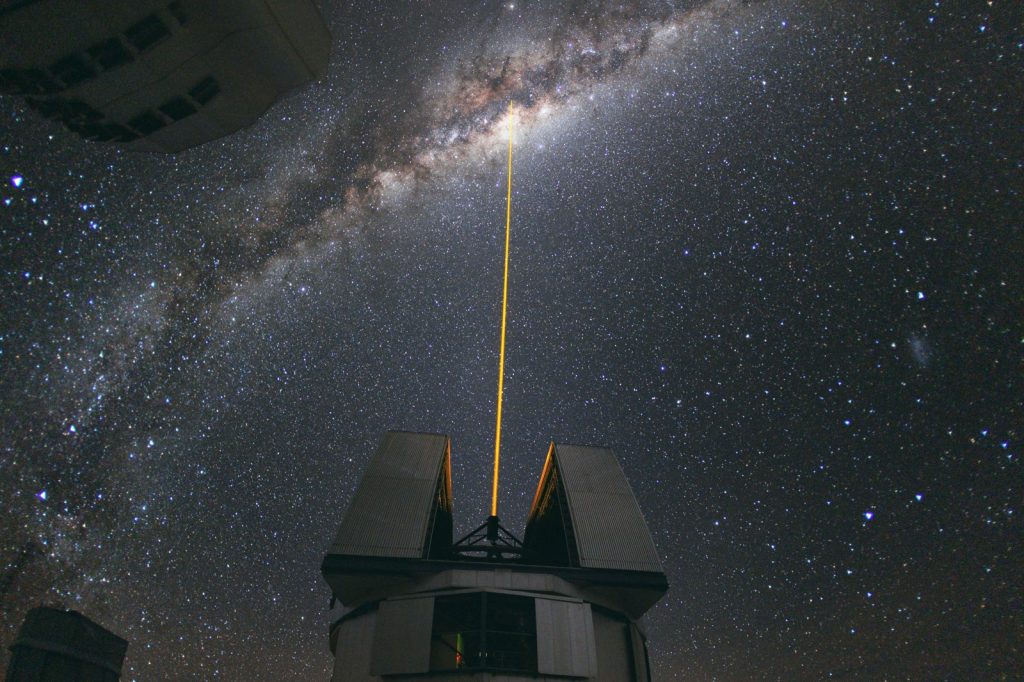
The concern is real, and for once it is measurable from a backyard as easily as from an observatory. Low Earth orbit holds more than 8,000 working satellites today; projections sketch a population that could swell to 60,000 by 2030, and the University of Surrey researchers behind a new study count more than 1.7 million spacecraft in the proposals now on file, if every one of them proceeds. Each of those machines is a small mirror tossing sunlight back down, into eyepieces, survey sensors and the eyes of anyone outside after dusk. Early findings suggest the problem is not hypothetical: mega-constellations could push the night sky up to 1% brighter in the regions hit hardest, and individual satellites can outshine the ceilings the IAU recommends by a factor of ten to 100.
The study, from the University of Surrey and published by the Royal Astronomical Society in its Monthly Notices, tests a disarmingly low-tech countermeasure: make the satellites black. The black in question is Vantablack 310, a paint that throws back only about 2% of the light that strikes it. Vantablack began as a materials-science curiosity, a forest of upright carbon nanotubes absorbing nearly everything that falls on it; the 310 version, from Surrey NanoSystems, the university spinout that created the original in 2014, is engineered to be applied by customers and to survive the temperature swings and radiation of orbit. Keiran Clifford, a Surrey NanoSystems senior technologist who leads the coating work, credits it with “super-black performance across a wide range of viewing angles, while remaining robust to the challenging LEO environment”, which matters because satellites tumble, and a paint that only worked face-on would be useless.
In the team’s simulations, the coating pushed a satellite’s brightness close to the ceiling the International Astronomical Union recommends for protecting observations. The IAU set those ceilings for good reason, pushing for brightness caps precisely so the problem does not spiral as constellations scale, and images from Chile’s Vera C. Rubin Observatory have already made clear how exposed wide-field surveys are. Astha Chaturvedi, the study’s lead author and a Surrey postgraduate researcher, put the appeal plainly: “Our results show that relatively simple material choices could make a meaningful difference to how satellites affect astronomical observations without requiring major changes to mission design.”
A simulation is not orbit, and the team knows it. The first real-world test rides on Jovian-1, a CubeSat the size of a shoebox and the debut mission of JUPITER, a joint university programme for training, education and in-orbit research, built with the universities of Portsmouth and Southampton and slated to launch in 2026. The plan is to coat just one side of the hull, so a treated face and an untreated one can be compared aboard a single craft, riding one orbit under one sun; the coating also scatters such light as it reflects more diffusely, softening the sharp flashes that flat panels and antennas throw when the angles line up. Study co-author James Whitfield, an applications scientist at Surrey NanoSystems, is candid about the stakes: “Satellite constellations offer enormous benefits, but their growing brightness presents a challenge for ground-based astronomy.” His remedy is the product itself: “Vantablack® 310 combines ultra-black performance across a wide range of viewing angles with the durability needed for low-Earth orbit.”
The encouraging part, in the words of the astronomers themselves, is that the work has moved past complaint into engineering. “What is encouraging about this research is that it moves us beyond simply identifying the problem and towards developing practical, evidence-based solutions”, said astrophysicist Noelia Noël, a senior lecturer at Surrey and a co-author, who added that she is “particularly proud that a potential solution to this astronomical challenge has emerged from pioneering materials research at our own university”. Chaturvedi, who takes the work to a United Nations dark-and-quiet-skies workshop in Vienna, frames the study as “fundamentally about addressing an important challenge for astronomy through an evidence-based approach”. The lead author’s larger point is the one stargazers will recognize: “The night sky is one of humanity’s oldest windows into the Universe, but it is becoming increasingly difficult to see things”.
Caution is still warranted. The in-orbit test has not flown, real radiation and real thermal cycling are not a laboratory, and a coating that dims satellites does nothing about launch cadence, orbital crowding or the broader collision risk. But the balance on offer here is a rare one: no operator is asked to launch less, and no astronomer is asked to accept a noisier sky. If Jovian-1 confirms what the simulations show, the fix could be painted onto production lines relatively cheaply, and the oldest window humanity has could stay open a little longer. For a problem that has read mostly as inevitability, that is genuinely hopeful news, and it is the careful kind: measured, published and waiting on one small black satellite to prove it.
Sources
- An Ultra-Black Coating Could Save Astronomy From 60,000 Satellites
- Ultra-Black Coating Could Mitigate Light Pollution Caused by Satellites – Universe Today