
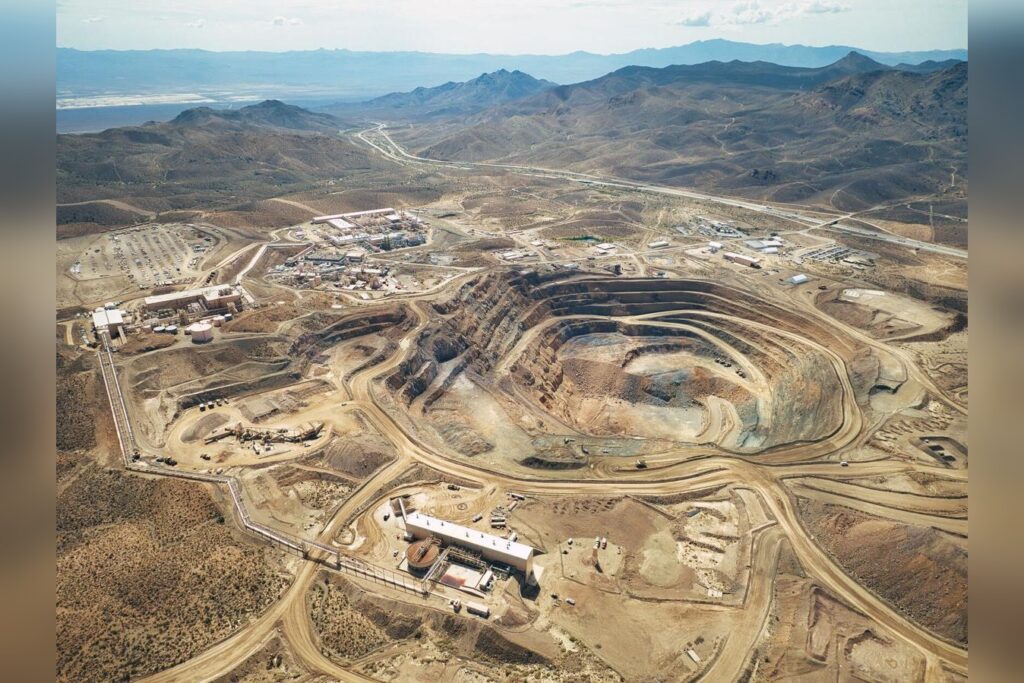
Thirty million gallons of groundwater had collected at the bottom of the Mountain Pass mine in California when James Litinsky and Michael Rosenthal took charge in 2017. China had flooded the rare earth market and pushed prices down. The pit was underwater, in the literal sense and in the financial one, and it had shut down even though the previous owner, Molycorp, had spent $2 billion upgrading it and making it cleaner.
About a decade after buying it, Litinsky is CEO of MP Materials, and the company now sits at the center of US national security policy, according to a CBS News report for 60 Minutes.
How the mine fell
Geologists found rare earths at Mountain Pass in 1949. By the 1960s the individual elements were being mined, separated and used, and the mine was considered the world’s main source for decades. Then the work moved offshore because China could do it more cheaply. Low levels of radioactive water and residue leaked into the Mojave Desert in the 1990s, and US environmental regulators stepped in.
Molycorp tried to revive the business and compete with China. It failed and filed for bankruptcy in 2015.
Litinsky came to it from a Chicago hedge fund, looking for value in distressed companies. He heard about Molycorp’s struggles, ended up owning the mine and refinery, and brought in Rosenthal, a friend who also worked in hedge funds. They started with eight employees. Mountain Pass alone now employs more than 700.
“The mining is the easy part,” Rosenthal said. Separating the rare earths from the rock, and then from each other, is the hard part. In 2023, after investing nearly a billion dollars more in the site, MP refined neodymium and praseodymium to 99.9% purity.
Mine to magnet
The last link was the magnets themselves. At a facility in Fort Worth, Texas, pure rare earth oxide from Mountain Pass is melted, cooled, compressed and diced before it becomes a magnet. MP says that makes it the only company anywhere to control the whole chain from mine to magnet. It hopes to reach a million magnets a day as it scales up, and Litinsky says its first customer, General Motors, will start using MP magnets in vehicles later this year.
The stakes are plain from where Litinsky sits. “As it stands today, we need permission from the Chinese government to make things,” he said. “We need permission from the Chinese government to make military things. The practical reality is, that is not an acceptable condition.” He put the share of the world’s rare earth magnets made in China at “well north of 90%.”
Washington steps in
Trump announced global tariffs in April 2025. China answered by restricting sales of some rare earth elements and magnets to the US and requiring detailed disclosures of how they would be used. One automaker, left without a reliable source of magnets, had to pause production of its Explorer SUVs. After a series of trade truces, China resumed shipments with restrictions, and the current truce is set to expire in eight months.
Senior Trump administration officials summoned Litinsky and Rosenthal to Washington that April. “The Pentagon wanted a Manhattan-style project to accelerate the entire supply chain of rare earth magnetics in the country,” Litinsky said.
The deal that followed was unusual. The Pentagon agreed to put $400 million into MP Materials, plus another $150 million toward a refinery for “heavy” rare earths, and the US government took a 15% ownership stake. The agreement guarantees a 10-year price floor of $110,000 a ton for MP’s rare earth oxide. If prices fall below that, Washington pays the difference. If they rise above it, the government shares the profit.
The government also asked MP to raise magnet output tenfold. Litinsky is building a larger magnet factory in Northlake, Texas, a plant called “10X” that is expected to be complete by 2028.
Interior Secretary Doug Burgum defended the arrangement, even though it departs from strict market capitalism. “I’d certainly call it pragmatism,” he said, “because free markets work, but they don’t work if you have an adversary that controls a monopoly that control[s] the prices.”




