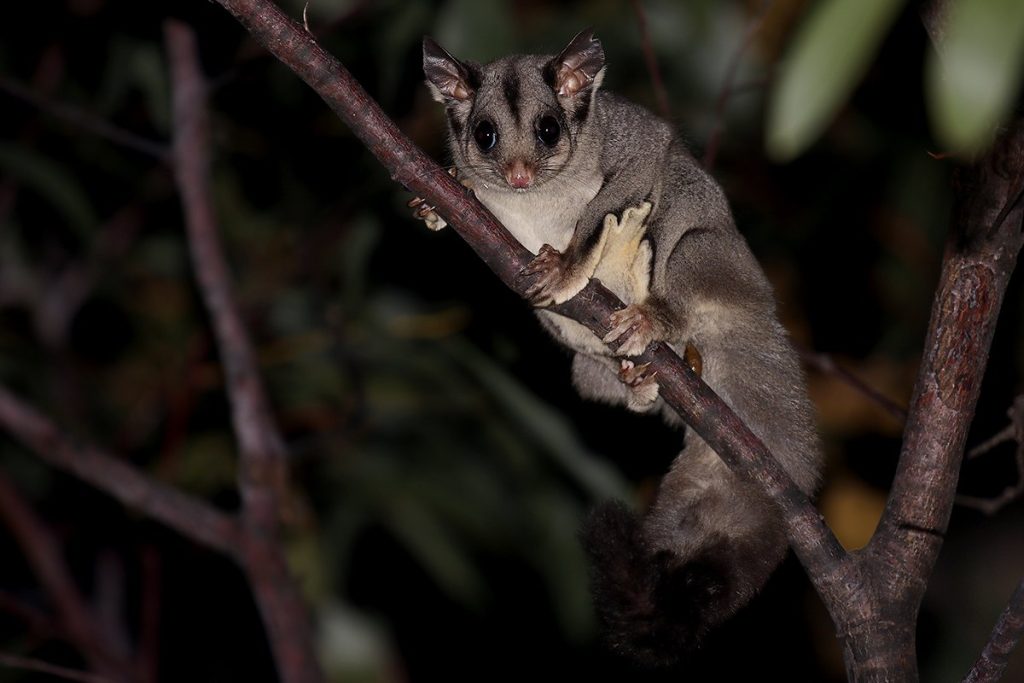
The sugar glider carries one of the more misleading names in the animal kingdom, and the distinction buried in that name matters more than pedantry. A marsupial native to the forests of Australia and New Guinea, it does not fly, and it does not merely jump: what it performs is a controlled glide, a piece of arboreal engineering that moves it between trees with an accuracy most animals its size cannot match. The broader stakes are survival itself. On the forest floor, among owls, snakes and feral cats, a sugar glider is prey; up in the air between branches, it is largely untouchable.
The hardware is a membrane called the patagium, a thin sheet of furred skin built of two layers joined by muscle and connective tissue. On each side it runs between the fifth finger of the hand and the first toe of the foot, and when the animal spreads its limbs the membrane opens into a rectangle of skin that works as an airfoil. The rest of the body is arranged around the same job: a lightweight frame, a long flat tail employed as a rudder, and large eyes for judging distances in low light, since the species works the night shift. Naturalists reach for the flying squirrel of other continents as the comparison, an animal carrying the same wrist-to-ankle rig; the Australian version simply arrived at the design by a different reproductive route.
The flight plan is economical. A glider pushes off with its strong hind legs, aims along a downward trajectory so that gravity pays the fare, and spreads the membrane as it leaves the branch. Once airborne, the patagium produces lift and drag, and the animal spends both: wrists, ankles and tail make constant small adjustments to the membrane’s tension and shape, steering, trading height for distance, even correcting course in mid-air. The tail keeps things stable and manages pitch. Against the wind or with it, a glide can stretch 50 meters, about 164 feet, with typical trips landing in the 30-50 meter range, and a practiced glider can even claw back some altitude by riding updrafts. What it cannot do is start from level ground: “sugar gliders cannot glide from the ground”, because the whole system needs launch height to buy airtime.
What elevates the behavior from falling with style to strategy is the arithmetic done before the leap. “The decision to glide is deliberate and calculated”, and the tell is visible to anyone who has kept one: the head bob. Locked onto a landing zone, the glider bobs its head up and down, reading the scene from slightly different positions, which is range-finding, not nerves. In one keeper’s description: “This head-bobbing is the glider calculating distance and angle using parallax, essentially triangulating the landing zone”. The payoff for all that measurement is a striking success rate, because gliders “rarely miscalculate when the environment provides clear sight lines and appropriate distances”. Even the skill set is built rather than born: joeys start with short hops, watching and imitating their mothers, and stretch their range as coordination and confidence arrive.
The arrival is as deliberate as the departure. Nearing the target the glider angles its body upward to bleed off speed, reaches forward with its forelegs, and lands claws-first, sharp hooks gripping bark on contact. In the wild the entire routine exists to keep the animal out of reach: gliding between feeding trees skips the energy cost of climbing down and back up, and an airborne route is one no owl can follow. That calculus, not the romance of flight, is what the membrane actually buys. What it signals is how evolution answers the same question from several directions at once; the flying squirrel of the northern hemisphere and the sugar glider of the south, strangers to each other, carry the same sheet of skin between the same joints. The sugar glider cannot fly. It does something more practical: it plans.
Sources
- Sugar Glider Gliding – Small Mammal Articles | Furry Critter Network
- How do sugar gliders jump? – EWASH