
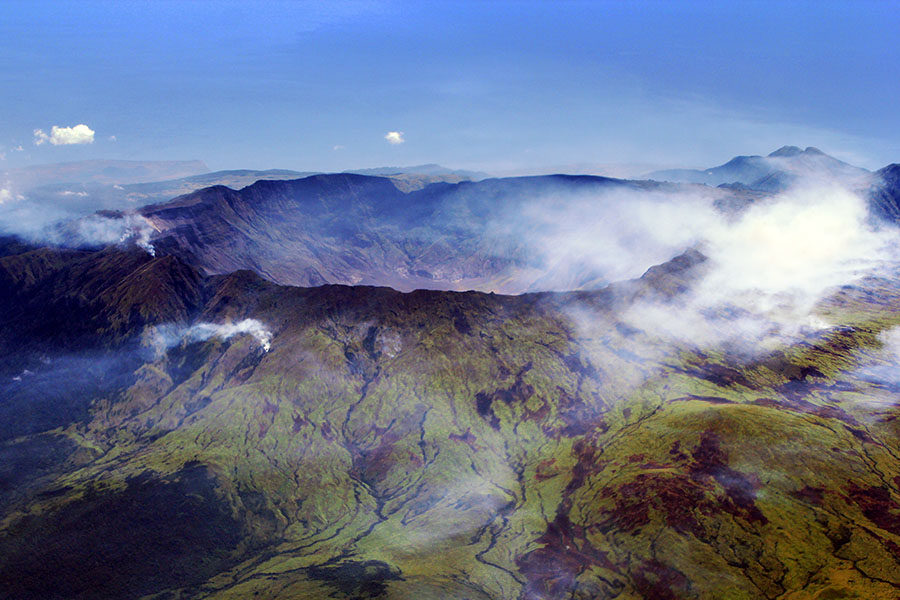
The record opens on April 5, 1815, when Mount Tambora, a giant volcano on the Indonesian island of Sumbawa, came abruptly to life. Days of intensifying activity ended in the April 10 cataclysm, which hurled roughly 100 cubic kilometers of mountaintop skyward, five times Krakatoa’s 1883 output. Pyroclastic flows incinerated everything downslope, tsunamis struck Lombok, Bali and Sulawesi, and eruptions ran into July 1815; it ranks as the most violent volcanic outburst of the past 10,000 years. The toll is told two ways: one account puts 10,000 dead on the island; the other counts upward of 40,000 killed outright, plus an estimated 107,000 lost to hunger and sickness across Sumbawa, Lombok and Bali.
Ash and sulfur dioxide rose more than 25 kilometers and formed sulfate aerosols that circled the globe, cutting incoming solar radiation; 1815 brought spectacular sunsets and dirty snow to Europe and North America. One reconstruction puts the average global drop at 3°C, a volcanic winter amplified by an unidentified 1809 tropical eruption read from snow cores, Mayon in the Philippines in 1814, and smaller 1812-1813 eruptions in the Caribbean, Indonesia and the Ryukyu Islands.
Then came 1816, the “Year Without a Summer.” May was unusually cold on both continents, delaying planting; frosts in June, July, August and September killed northeastern crops with every replanting. In northern and Central Europe, cold and rain depressed cereal yields and stopped the hay harvest, a blow to economies running on animal power. Post-Napoleonic Europe saw scarcity and riots; Ireland’s failed wheat, oat and potato crops met a typhus outbreak blamed for over 40,000 deaths. New England snow and frozen soil pushed families west to Indiana and Illinois; the hardship spurred the Erie Canal; inland America went hungry despite adequate food in the South; and the disruption fed the Panic of 1819, America’s first great depression.
Asia absorbed its own share: a disrupted monsoon, a three-year famine in China’s Yunnan from 1815 to 1818, and a later switch to poppies that made the province a major opium producer. Shifting conditions in the Bay of Bengal favored a cholera mutation that ran as a pandemic until 1823, killing tens of millions. In the Arctic, disturbed winds and currents broke up sea ice; whalers found clear water, Britain hunted the Northwest Passage into the 1840s, and the HMS Investigator wrecked there in 1851.
Writers shuttered indoors in 1816 held a contest that produced Frankenstein (1818), Polidori’s The Vampyre and Byron’s July 1816 Darkness. Contemporaries blamed conspicuous sunspots; one Italian scientist foresaw the sun failing, though Benjamin Franklin had proposed a volcano-climate link earlier. The encouraging part: even so large an eruption, absent reinforcing factors, was unlikely to produce long-lasting climatic disruption, the research concludes. Tambora is less prophecy than case study: how fast climate can be knocked sideways, and how fully it recovers.
Sources
- The Eruption of Mount Tambora (1815-1818) – Climate in Arts and History
- Environmental Impact of Mount Tambora Eruption | Science | Research Starters | EBSCOhost




