
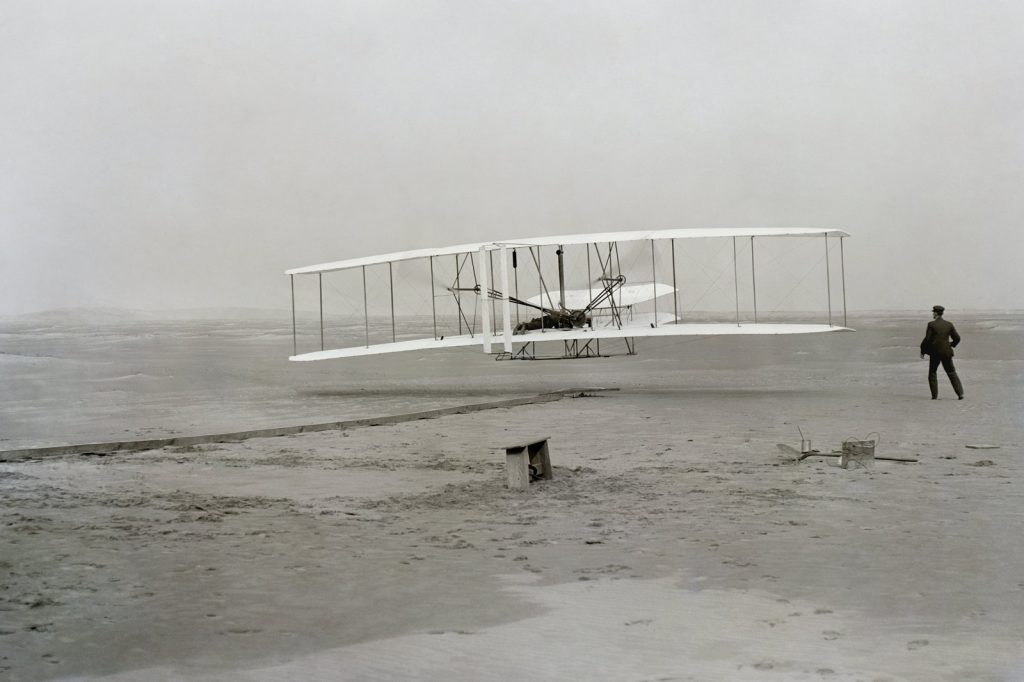
The wind is the first thing everyone mentions about that stretch of the North Carolina coast, and on the morning of 17 December 1903 it was blowing the way it always did over the sand at Kill Devil Hills, near the fishing village of Kitty Hawk. Five witnesses stood around a wooden rail laid flat on the sand. At 10:35 a.m. a gasoline engine coughed, two propellers turned, and a flimsy biplane ran down its monorail and lifted off with Orville Wright at the controls. Twelve seconds later it was down, 120 feet from the start. By any modern measure it was nothing, a hop. It was the first time in history a machine had carried a person into the air under its own power, flown under control, and landed intact, and everyone present knew the age that opened in those twelve seconds.
The two men responsible looked like anything but inventors of a new era. Orville and Wilbur Wright were bicycle mechanics from Dayton, Ohio, neither one a college graduate, running a shop they had opened in 1892 after years of building printing presses. What they brought to the problem was a craftsman’s patience. The spark had been news of the German engineer Otto Lilienthal, whose glider flights in the 1890s ended in his death but proved a human could ride the air. The brothers wrote to the U.S. Weather Bureau asking where to find steady wind and soft ground, and the answer pointed them to the Outer Banks, isolated, windy, and cushioned with sand.
The scene on the dunes the previous three years had been pure workshop. Their first glider, in 1900, barely worked; the 1901 version flew better but left them doubting the published data on lift. So they built their own wind tunnel and put close to 200 wing and airframe shapes through it, correcting the science themselves. The 1902 glider that came out of those tests made hundreds of flights and, with a movable rudder linked to the wings’ warping, finally cracked controlled flight, the piece that had killed every predecessor. Back in Dayton, with machinist Charles Taylor, they built a 12-horsepower engine light enough to fly, crated the new machine, and shipped it south in the autumn of 1903. The first try, on 14 December, ended at once: the engine stalled on take-off, the aircraft was damaged, and they spent three days putting it back together before trying again.
On the day itself, they flew four times, the brothers trading places at the controls, each flight longer than the last. Wilbur took the final turn and held the machine aloft for 59 seconds over 852 feet of sand, the distance of a long home run. What followed was less cinematic and more telling: years of quiet refinement away from the press, patents secured, public flights in France in 1908 that stunned crowds who had dismissed the reports, a plane sold to the U.S. Army Signal Corps in 1909, and the Wright Company to build the machines. By 1905, their aircraft could circle and stay up for 39 minutes. Wilbur died of typhoid fever in 1912, having seen the sky claimed; Orville lived until 1948, long enough to watch jets. The 1903 flyer itself hangs today in the Smithsonian’s air and space museum at Washington, D.C., twelve seconds of December still inside it.
Sources
- First airplane flies | December 17, 1903 | HISTORY
- Orville and Wilbur wright kitty hawk flight when? – Answers




