The paper is in Monthly Notices of the Royal Astronomical Society, and its claim is narrow: a coating called Vantablack 310 reflects around two per cent of incoming light, and in simulation that is enough to bring a satellite’s brightness close to the International Astronomical Union’s recommended limit. The work was led by astrophysicists at the University of Surrey. Surrey NanoSystems, a university spinout that developed the coating, is a co-author.
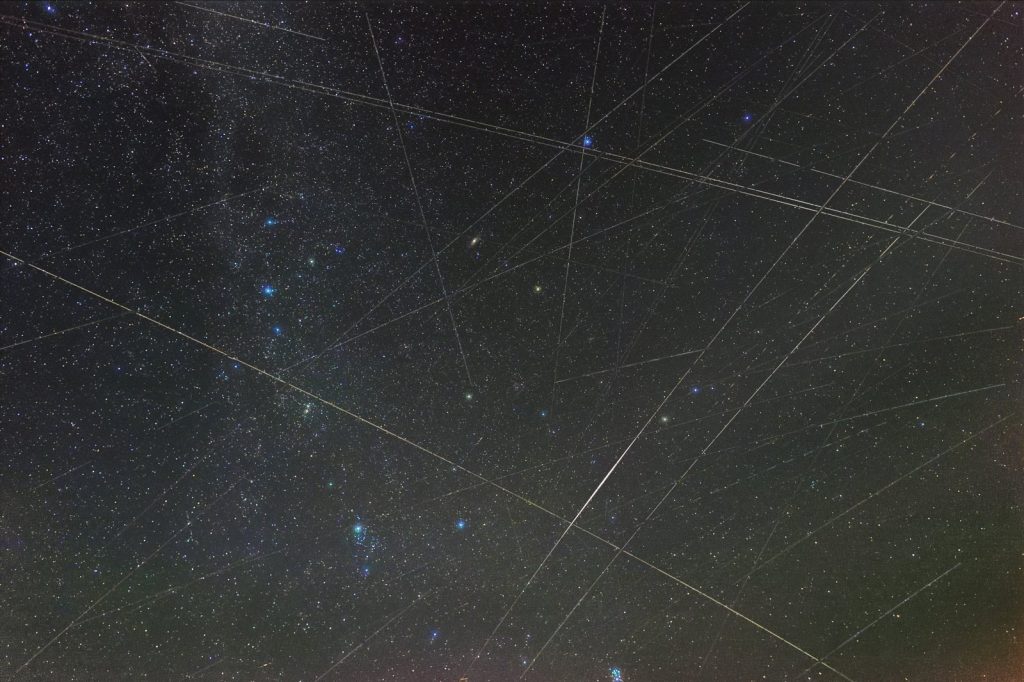
The concern behind it is the number of spacecraft overhead. As many as 60,000 satellites are projected to orbit Earth by 2030. Sunlight bouncing off them can leave bright streaks and flares across telescope images and large sky surveys, which makes faint targets such as asteroids and distant galaxies harder to detect.
What the team did
The method has two steps. First, researchers measured how Vantablack 310 reflects light across a range of illumination and viewing conditions. Then they fed those laboratory figures into a simulation of how a coated satellite surface would look from the ground.
The result: significantly fainter surfaces. The authors conclude that ultra-black coatings could offer a practical way to limit the effect of future satellites on astronomy. They also note that the light the coating does reflect is scattered more diffusely, which reduces the bright flashes that reflective satellite surfaces commonly produce.
James Whitfield, an applications scientist at Surrey NanoSystems and a co-author, said the coating “combines ultra-black performance across a wide range of viewing angles with the durability needed for low Earth orbit.” He added that the company is proud to work with Surrey on protecting the night sky.
What is still untested
Everything so far comes from lab measurements and modelling. The team is now preparing an in-orbit demonstration on the Jovian-1 CubeSat, a student-led programme involving the universities of Surrey, Portsmouth and Southampton. That flight is meant to show how the coating holds up in the space environment, and whether the change in brightness can be measured from the ground.
The wider Light Pollution and Sustainable Space initiative, led by Dr Noelia Noël, won Best Sustainable Project at the University of Surrey’s 2026 Sustainability Awards. The university credited its systematic approach to cutting satellite brightness through material design.
Lead author Astha Chaturvedi has been invited to present the research at the United Nations Workshop on Dark and Quiet Skies in Vienna. Noël has spoken about satellite light pollution and the need to protect the night sky in a TEDx talk.