
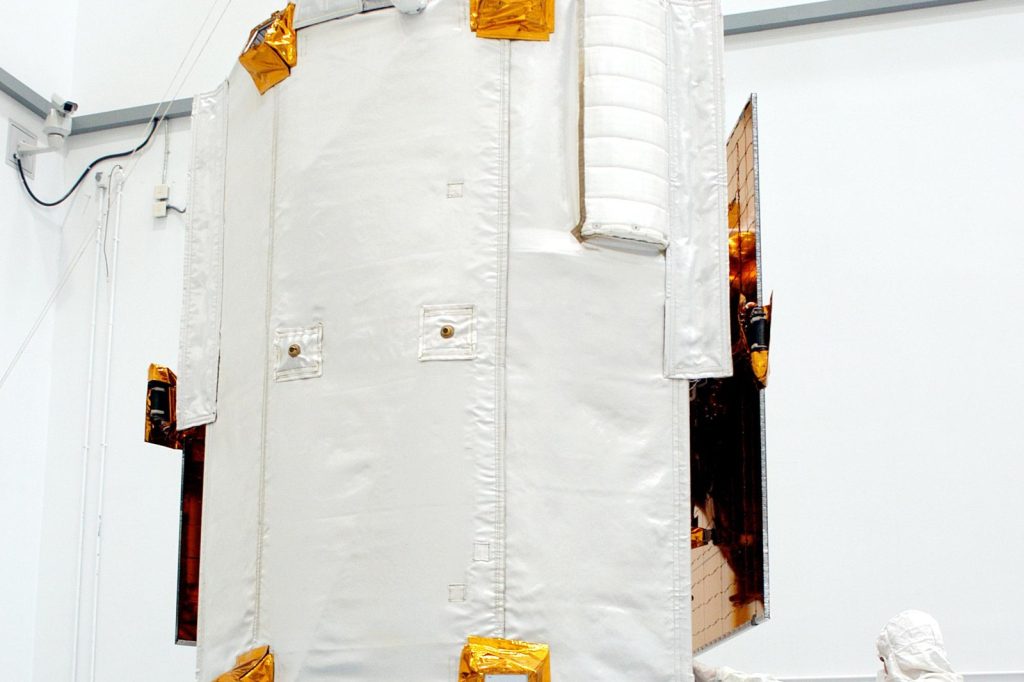
Every long-exposure photograph of the night sky now risks being crossed by a bright line from a passing satellite. Astronomers who spend months waiting for a clear night know the frustration, and researchers at the University of Surrey think paint might help.
Their study, published in Monthly Notices of the Royal Astronomical Society, tests Vantablack 310, a coating that reflects only about 2% of the light striking it. The team measured how it reflects light under a range of illumination and viewing conditions, then used those lab readings to simulate how a coated satellite would look from the ground. In the simulations, satellite brightness fell close to the limit the International Astronomical Union recommends for protecting astronomical observations.
A crowded and shiny orbit
More than 8,000 satellites now circle Earth in low Earth orbit. Projections suggest that could grow toward 60,000 by 2030, and the Surrey researchers say proposals already on file would put more than 1.7 million into orbit if every one went ahead. Each is a small mirror, scattering sunlight toward telescopes and sky surveys.
Satellites in low orbit can be ten to 100 times brighter than the IAU limits, according to the report. Studies cited by the team show mega-constellations could raise sky brightness by as much as 1% in the worst-hit regions. That sounds small, but astronomy depends on spotting very faint things: an exoplanet crossing its star, a supernova in a distant galaxy, a lensed quasar. Images from the Vera C. Rubin Observatory in Chile have already shown how easily wide-field surveys pick up satellite streaks.
How the coating works
Vantablack is a surface of vertical carbon nanotubes that absorbs nearly all the light reaching it. Surrey NanoSystems, a University of Surrey spinout, first created it in 2014. Version 310 is a “handleable” variant that customers can apply themselves, without specialized deposition equipment, and it is built to survive the temperature swings and cosmic radiation of low Earth orbit.
The small amount of light it does reflect is spread out more diffusely, which cuts down the sharp flashes that flat panels and antennas produce. Dr. Keiran Clifford of Surrey NanoSystems said the coating delivers “super-black performance across a wide range of viewing angles, while remaining robust to the challenging LEO environment.” Angle matters because satellites tumble relative to observers below.
Astha Chaturvedi, the postgraduate researcher who led the study, put it simply: “Our results show that relatively simple material choices could make a meaningful difference to how satellites affect astronomical observations without requiring major changes to mission design.”
Next stop, orbit
Simulations are one thing. The first real test comes aboard Jovian-1, a shoebox-sized CubeSat scheduled to launch in 2026. It is the first mission under JUPITER, the Joint Universities Programme for In-Orbit Training, Education and Research, and a collaboration of the Universities of Surrey, Portsmouth and Southampton. Researchers plan to coat just one side of the spacecraft, so they can compare treated and untreated surfaces on the same platform, in the same orbit.
Chaturvedi has been invited to present the work at a United Nations workshop.
Sources
- Vantablack satellite coating could reduce orbital light poll
- An Ultra-Black Coating Could Save Astronomy From 60,000 Satellites




