A magnitude 7.2 earthquake struck near Vanuatu on Friday afternoon, and Hawaii was told there was no tsunami threat. Island News reported that the quake was recorded 200 kilometers west of Sola at 4:31 p.m. Hawaii time on October 23, at a depth of 10 kilometers, according to the U.S. Geological Survey. The National Weather Service confirmed that the state was not under a tsunami watch.
A small volcanic nation with a large revenue line
Vanuatu is an archipelago of volcanic origin in the South Pacific, 1,750 kilometers east of northern Australia and 540 kilometers northeast of New Caledonia. Its neighbors are New Guinea to the west, the Solomon Islands to the northwest and Fiji to the east. The government has a lively source of money that has nothing to do with the land. In the first half of 2026 it collected about VT11.4 billion, roughly $95.5 million, from its citizenship program, Time reported. That was about 39 percent of government revenue excluding donor funding, and more than any other line in the mid-year figures, value-added tax included.
The program works by investment. Applicants must meet eligibility rules and pass government due diligence before they put money in. One route is a contribution to a state fund: at least $130,000 for a single applicant, starting at $150,000 for a married couple and rising with each family member, and not refundable. The other is tied to the Cocoa Sustainable Development Fund, at $165,000 for a family of up to four, with part of the sum redeemable after five years. Processing typically takes two to four months.
The revenue has held up despite a setback. The European Union permanently ended visa-free access for Vanuatu citizens after raising concerns about the country’s investor citizenship schemes. Citizenship income still reached record levels in the first half of the year, Time said.
How the country got here
The Spanish expedition of Portuguese navigator Fernandes de Queirós reached the largest island, Espíritu Santo, in 1606 and claimed the archipelago for Spain. James Cook named the islands the New Hebrides in 1774, after the Hebrides of Scotland. France and Britain both laid claim in the 1880s, and in 1906 they agreed to run the islands jointly as an Anglo-French condominium. An independence movement grew in the 1970s, and the Republic of Vanuatu was founded in July 1980. Its first prime minister, Walter Lini, said the new name, built from the words for “land” and “to stand,” was meant to describe a country that “has stood alone and will continue to stand alone.”
Vanuatu has since joined the United Nations, the Commonwealth, the Francophonie and the Pacific Islands Forum.
Sources
- Vanuatu
- No tsunami threat to Hawaii after 7.2M earthquake in Vanuatu in Melanesia
- Here’s how Vanuatu made $95 million from citizenship in 6 months.
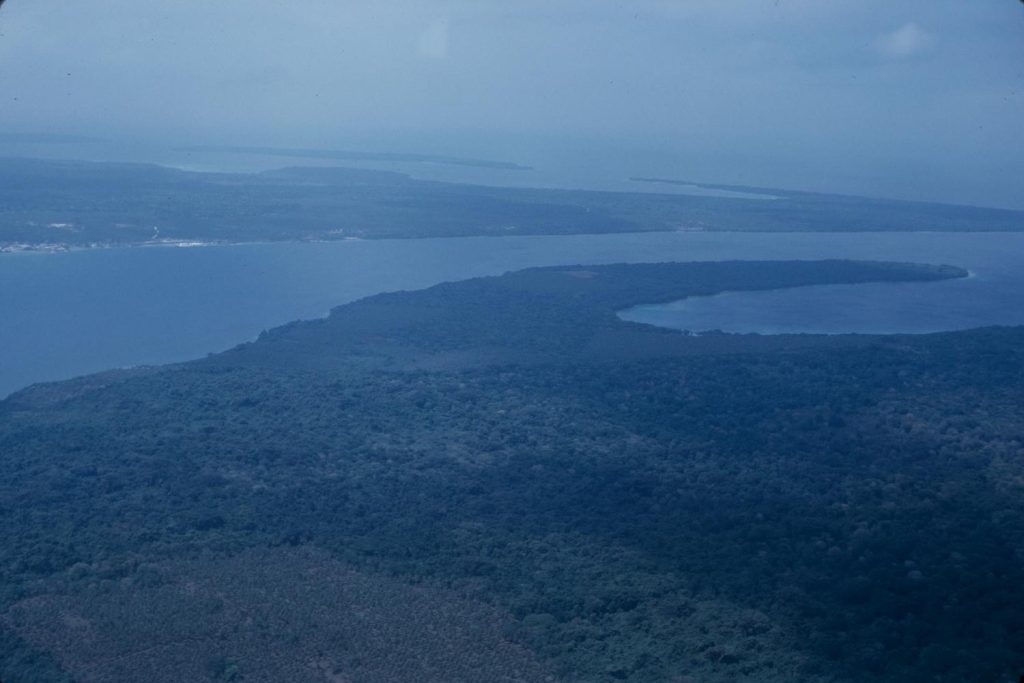
Photo: Carlquist, Sherwin John, 1930-2021 (CC BY 4.0)