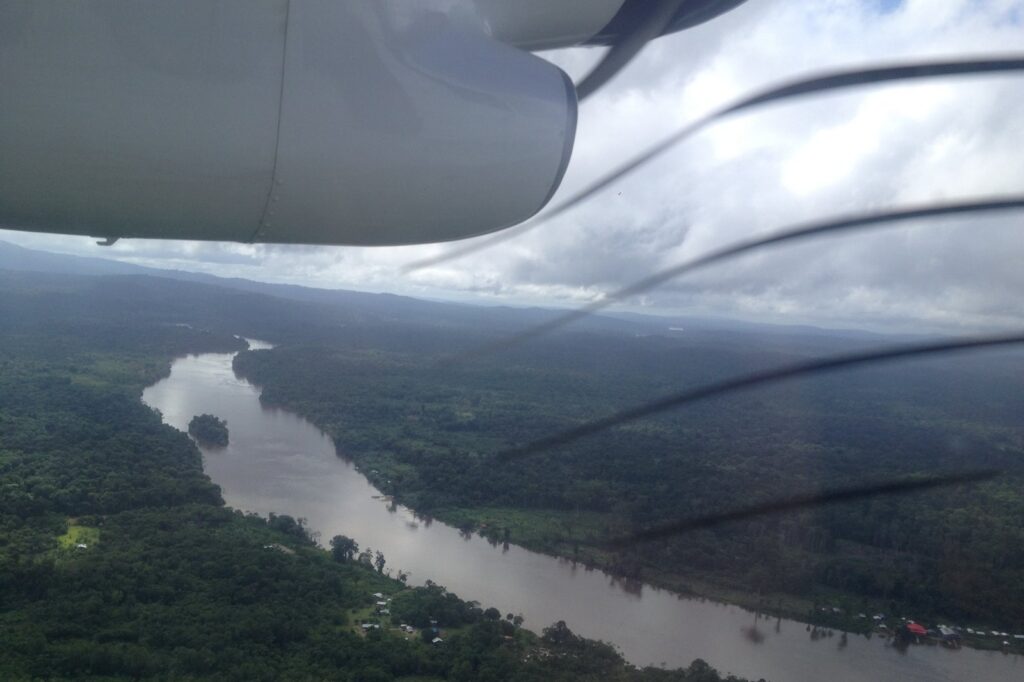
Beneath the rainforest around Kawemhakan, in Suriname, lie vast deposits of gold and other minerals. Around a million ounces are extracted legally every year, and much more remains buried across the Amazon. In the villages along the Lawa River, which marks the border with French Guiana, the people who live above it hold an unusual card: the only airstrip for kilometers around.
The airstrip as leverage
The dirt strip lies in the middle of one of the Wayana villages and is the main practical link to the capital, Paramaribo. A single-engine aircraft carrying about 10 passengers leaves the capital three times a week and lands after roughly 1.5 hours. There are no roads, only the river. Miners and traders who do not want to spend days in a boat have good reason to stay on friendly terms with the community, residents say.
The man who holds that leverage is Ipomadi Toko Pelenapïn, 53, the Wayana chief of the Lawa River area. Setting up a new mining operation near Kawemhakan without his permission would be very hard. Pelenapïn has required miners to show they are legally permitted to work in Suriname and hold a formal concession. In some cases he has barred them from mining and kept them off flights in and out. His father Anapaikë, the chief before him, first granted miners permission around the 1960s, though miners have worked the area for over a century. Chinese traders need permission before opening stores on ancestral land, and like miners they pay the chief a share. One group of Brazilian miners told the reporters who visited that they hand over 10 grams of every 100.
The arrangement has limits. Far more miners have arrived than Pelenapïn could have imagined, and they outnumber residents and tend to have more firearms and money. Officials in the capital sometimes grant concessions in sensitive parts of ancestral territory without visiting or consulting the community. “I have no power against the government,” he said through an interpreter. “The government sends the people here.” Officials have also asked him to stop using the airstrip as leverage.
Gold, supply and the damage
The border with French Guiana has become a hotspot of gold mining in Suriname. An analysis by the Monitoring of the Andean Amazon Project found around 25,000 hectares lost between 2021 and 2024, plus at least 2,800 hectares last year. Miners, including locals and Brazilians, clear forest and pollute rivers with mercury, and Wayana families on both sides of the Lawa face mercury-related health problems and shrinking game. Upriver, about 25 kilometers away, the French Guianese town of Maripasoula supports a cross-border economy largely free of customs checks. Riverbank shops, many owned by Chinese families, sell generators, pumps and fuel to miners and weigh gold on scales behind the counter, paying in euros and dollars. Buyers carry the metal to Paramaribo. Much of it passes through Kaloti Suriname Mint House, jointly owned by the government, local gold dealers and a United Arab Emirates conglomerate.
Suriname pledged in 2025 to combat illegal mining and mercury use, keep 90 percent national forest cover and remain one of the few countries that absorb more CO2 than they emit. In places like Kawemhakan, community members say, little has been done and the state is almost absent. Marciano Pelenapïn, the chief’s son, put it simply: “I would like to stop the situation because they destroy our area.”
A family that overreached
One clash tested the chief’s authority. The Spence family, once allies who helped map areas and plan the airstrip, allegedly began arming themselves after the pandemic and recruiting young Wayana to extort other operations, demanding up to half of what workers extracted. After miners complained, a meeting was held in 2023. The Spences have not been seen on the Lawa since, and their house in the village is boarded up. Records show the family registered several mining companies. One, Mine Rehab, held a 10,000-hectare concession and was bought in 2025 by Canada-based Founders Metals, which says it is at the earliest stage of exploration with no mining on the property. Andre Verhoogt of the Mulokot Foundation worries about “a Canadian company that’s officially active in our territory and reorganizing everything and expanding.”
Land rights and a buried past
The Wayana have lived here for generations but hold no official land title. Suriname is the only country in South America that has not granted ancestral land rights to Indigenous communities, despite a 2007 ruling by the Inter-American Court of Human Rights. The Mulokot Foundation is helping the Wayana map their territory, track mining and forest loss by satellite, and revive schooling, likely online. Many Wayana are technically unemployed and live on hunting and fishing.
Archaeologist Renzo Duin argues that mapping also has a conservation payoff. On a 2004 expedition to the tri-border area, he found pottery fragments and a ditched site in what botanists were surveying as pristine forest. Wayana villages, he says, are almost without exception built on archaeological sites that appear on no national map. Suriname has pledged to protect 90 percent of its forests permanently, yet Duin says that approach ignores Indigenous stewardship and that the country lacks legislation requiring preventive archaeology before large projects.
Sources
- Wayana
- In Suriname’s Amazon, the Wayana community struggling to keep gold miners at bay
- Suriname’s rich archaeological history may hold keys to conservation
Photo: AlexCad (CC BY-SA 3.0)