
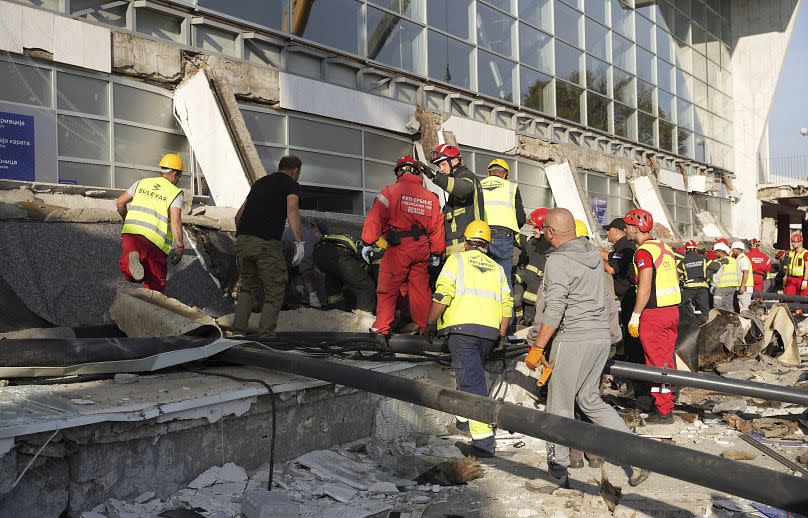
On November 1, a concrete canopy at the entrance of Novi Sad’s railway station gave way, resulting in the deaths of fourteen people and injuries to three others. The structure fell onto Jaše Tomića Boulevard, striking individuals who were at the station for routine purposes such as boarding trains, greeting arriving passengers, or simply moving through the entryway.
The station, which opened in 1964, replaced an earlier building dating back to 1883 that once stood where the Liman fresh market now operates. For six decades the current facility functioned as a regional transport hub without experiencing a major structural failure. Then, in a matter of seconds, a portion of its main overhang — a concrete shelter intended to protect passengers from weather — collapsed. Investigators have not yet determined how many individuals were beneath the canopy at the moment of failure.
The injured are receiving medical care, though their conditions have not been disclosed. Novi Sad, Serbia’s second‑largest city, hosts a station situated on a vital rail corridor.
High‑speed services linking Novi Sad and Belgrade operate several times each day, covering the seventy‑kilometre distance in roughly thirty‑six minutes. This route forms part of the broader Budapest–Belgrade railway project, an international initiative aimed at enhancing regional connections, reducing travel times, and expanding freight capacity. The tragedy has prompted scrutiny of the infrastructure supporting that project.
Authorities are examining the canopy’s design, its age, and maintenance history. They are also assessing whether any recent work associated with the Budapest–Belgrade upgrade may have influenced the station’s structural integrity.
Interviews with staff and a review of maintenance records are underway. Since the incident the station has remained closed. Train services have been rerouted or cancelled, and the area around the entrance is cordoned off while debris is cleared for analysis.
Remaining sections of the canopy are being inspected for stability. The collapse has intensified public debate in Serbia about the safety and upkeep of public works.
Prior to the accident the station served thousands of passengers daily, and its canopy was a conspicuous feature visible from the street, used by everyone entering the building. Its sudden failure raises questions about inspection regimes and maintenance practices for similar structures nationwide. The Budapest–Belgrade undertaking itself is extensive, involving the modernization of hundreds of kilometres of track, the construction of new stations, and the upgrading of signalling systems.
Financed partly by Chinese loans and carried out by a mix of Chinese and European contractors, the project relies on existing nodes such as Novi Sad station, which was not newly built as part of the initiative but now accommodates the upgraded line. Officials have pledged a thorough investigation and stated that those found responsible will be held accountable.
No timetable for the inquiry’s completion has been provided. The city is in mourning; fourteen families are grieving the loss of loved ones, while three others await news about the condition of injured relatives. The community remains shaken by the unexpected failure of a structure that had stood safely for decades.
Investigators continue their work, the cause remains unknown, and the demand for answers persists.




