
Three thousand colour photographs, one temperature spike lasting three minutes, and a ship full of geologists who had not brought a single biologist. That was the haul from a February night in 1977 over the Galápagos Rift, and it changed what scientists thought a living planet needs.
The Galápagos Hydrothermal Expedition, funded by the National Science Foundation, left the Panama Canal on February 8 aboard Woods Hole’s research vessel Knorr. The target lay about 640 kilometres west of Ecuador, a likely hot spot flagged a year earlier by another expedition. The US Navy had already mapped the seafloor there with sonar. On board were geologists, geochemists and geophysicists, among them Robert Ballard, Jack Corliss, John Edmond and Tanya Atwater. Nobody had planned for the life they found.
A spike in the dark
On the evening of February 15, the crew lowered ANGUS, a two-tonne steel cage packed with cameras, strobe lights and a sensor that picked up temperature shifts as small as 0.005°C. It was towed 4.5 metres above the bottom, taking a frame every ten seconds, with the Knorr fighting a current to stay on station. The watch was, by all accounts, tiring and dull.
Near midnight the sensor flagged a spike. It lasted three minutes, then the water dropped back to a near-freezing 2°C. The film ran out after 12 hours, 16 kilometres of track and 3,000 pictures. The team went through them frame by frame until they hit the moment of the spike.
Ballard later described what the photographs showed. For thirteen frames, he wrote, “the lava flow was covered with hundreds of white clams and brown mussel shells”. Before and after, bare lava.
Down in Alvin
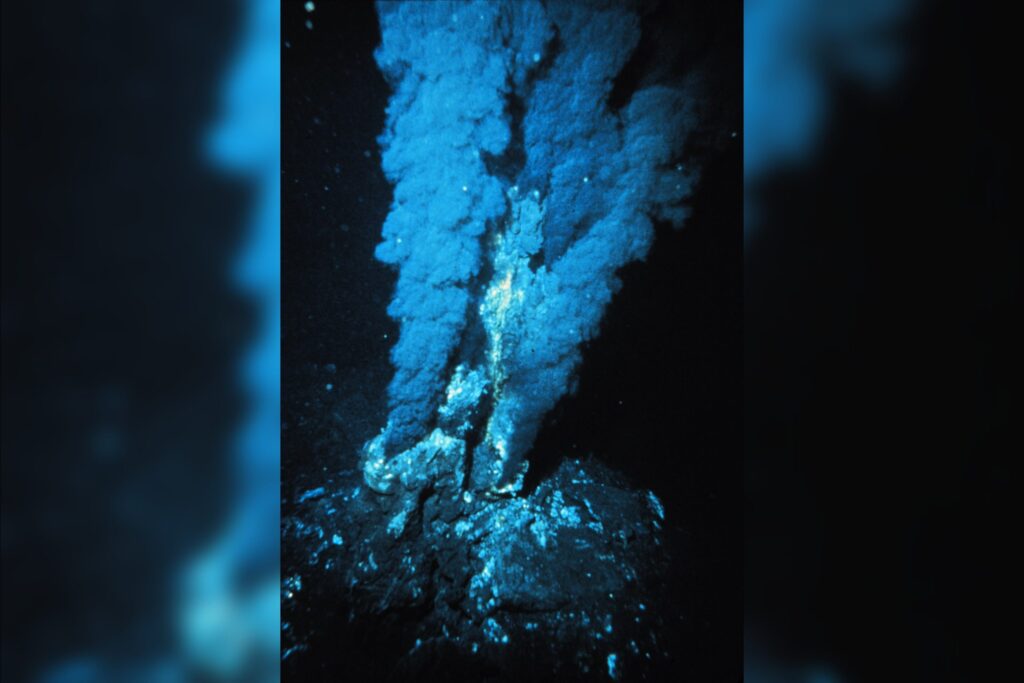
The submersible Alvin dived at sunrise on February 17, dive 713, with Jack Donnelly piloting and Corliss and Tjeerd van Andel as observers. Cracks in the lava were releasing shimmering water at 8°C, which clouded as dissolved minerals dropped out and left brown stains on the rock. Clams up to 30 centimetres long crowded an area about 50 metres across.
Over the radio link, Corliss asked his student Debra Stakes aboard the support ship whether the deep ocean was not supposed to be a desert. Yes, she said. “Well, there’s all these animals down here,” he answered.
Later dives found more sites, named with a geologist’s humour: the Dandelion Patch, an Oyster Bed with no oysters, and the Garden of Eden, where white-stalked tubeworms with red tips stood about a foot and a half tall in water of 17°C.
What fed them
The first water sample from the vents filled the lab with a rotten-egg smell. Hydrogen sulfide. Bacteria use it to live, and larger animals feed on the bacteria. That food chain needs neither sunlight nor photosynthesis, which most life on Earth depends on. Edmond, the MIT geochemist, recalled the mood on board: “It was a discovery cruise. It was like Columbus.”
The ship was not set up for biology. Specimens went into a small supply of formaldehyde that one student had brought, then into strong Russian vodka bought in Panama. It was not enough.
One reporter was aboard, David Perlman of the San Francisco Chronicle, who typed his stories on a portable Olivetti and had them sent by radio to Woods Hole. His March 9, 1977 piece carried the headline “Astounding Undersea Discoveries”. It was accurate.




