
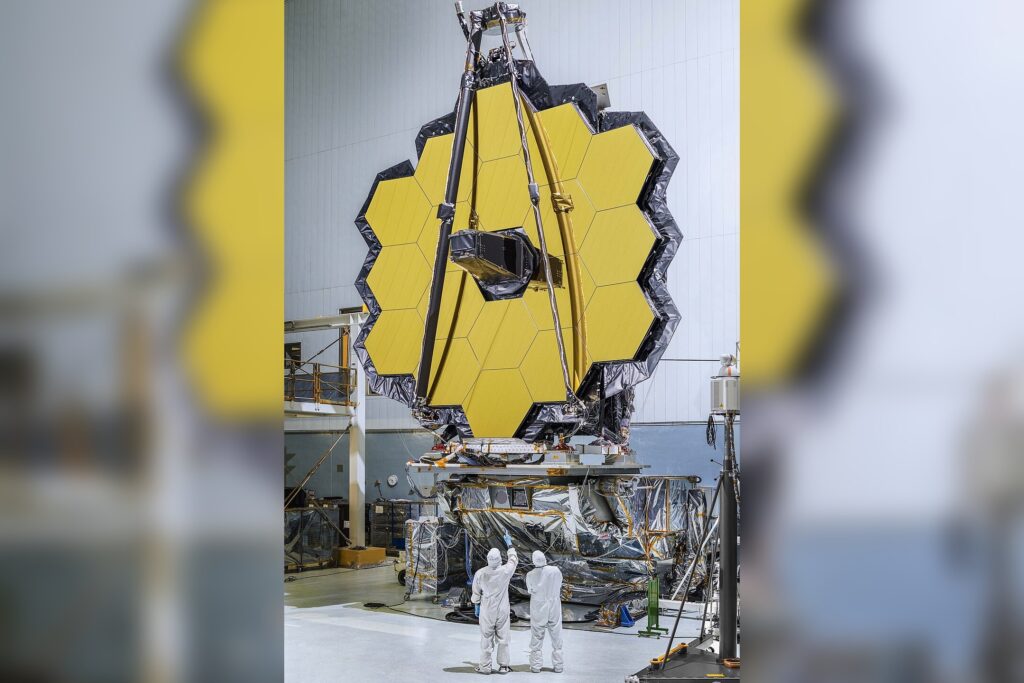
One galaxy the James Webb Space Telescope spotted contains more stars than the Milky Way, and it formed only 800 million years into a universe that is 13.8 billion years old. The study’s authors say it “shouldn’t exist.” Their paper appeared in Nature on Feb. 14.
The galaxy is called ZF-UDS-7329. Webb saw it as it was roughly 11.5 billion years ago, and the light from its stars suggests they were born about 1.5 billion years before that, around 13 billion years ago. It also shut down abruptly. After a sudden burst of star formation, its star making stopped.
Here is why that bothers cosmologists. The standard picture says dark matter halos pulled in gas and seeded the first galaxies, and that large dark matter structures needed time to form. This galaxy seems to have appeared without that head start. “Having these extremely massive galaxies so early in the universe is posing significant challenges to our standard model of cosmology,” said co-author Claudia Lagos of the International Centre for Radio Astronomy Research. Themiya Nanayakkara, an astronomer at Swinburne University of Technology in Australia, put the open question this way: how did such galaxies form so fast, “and what mysterious mechanisms lead to stopping them forming stars abruptly when the rest of the universe is doing so.”
The team’s next job is to hunt for more of them.
Too big, too soon
This is not a one-off. Since its launch in December 2021, Webb has kept turning up bright galaxies from the early universe, in numbers nobody expected. Brightness stands in for stellar mass, and these galaxies look too hefty for their age. Think of arriving in a new country and finding toddlers who weigh as much as teenagers. You would wonder whether something was in the water or whether your assumptions about growth were off.
Hubble’s record-holder, GN-z11, is seen as it was about 400 million years after the Big Bang. Webb has since gone past it and now studies galaxies at least 320 million years after the Big Bang. The oldest ones it found were brighter and more active than expected. Their star formation rates matched the Milky Way’s roughly one star per year today, yet they were squeezed into regions around a thousandth of our galaxy’s size. A later group, seen up to about 750 million years after the Big Bang, was around a thirtieth of the Milky Way’s size. Their star formation must have run 1,000 times higher. Scientists call them ultramassive galaxies.
Maybe the physics is fine
Scientific American reported that several recent studies lean toward ordinary astrophysics rather than a rewrite of cosmology. “Most people would put their money on the astrophysical explanation right now,” said Mike Boylan-Kolchin of the University of Texas at Austin.
Nashwan Sabti of Johns Hopkins University and colleagues used Hubble’s ultraviolet data on hundreds of galaxies from 450 million to 750 million years after the Big Bang. They found the ultramassive galaxies fit the standard Lambda-CDM model. “Hubble really doesn’t give you much wiggle room to play around with cosmology,” Sabti said. Boylan-Kolchin called it a great point but not airtight, since Webb and Hubble may not be seeing the same galaxies. Some shine in infrared yet stay invisible to Hubble.
Joseph Silk of Johns Hopkins and Sorbonne University suggests black holes formed first, within 50 million years of the Big Bang, and their outflows triggered a flurry of star formation. He says Webb is finding “far more black holes than we expected,” in galaxies barely 300 light-years across, against the Milky Way’s 100,000. Fabio Pacucci of the Center for Astrophysics | Harvard & Smithsonian found some galaxies seen 750 million to 1.5 billion years after the Big Bang may host a black hole as massive as all their stars, or more. In the Milky Way the ratio is 1,000 to 1 in favor of stars. If heavy seed black holes were common, the LISA observatory, set for launch in 2035, should see many mergers.
Guochao Sun of Northwestern University offers a third route. Bursts of supernovae could have lifted star formation 10 to 100 times above normal for about 10 million years, so Webb may only be seeing the brightest peaks of fluctuating galaxies while dimmer ones go unnoticed.
“The fact that cosmology could be at play here means it’s really worth following it up until it’s excluded,” Boylan-Kolchin said.
Sources
- James Webb telescope finds ancient galaxy larger than our Milky Way, and it's threatening to upend cosmology
- JWST’s Puzzling Early Galaxies Bend Astrophysics




