
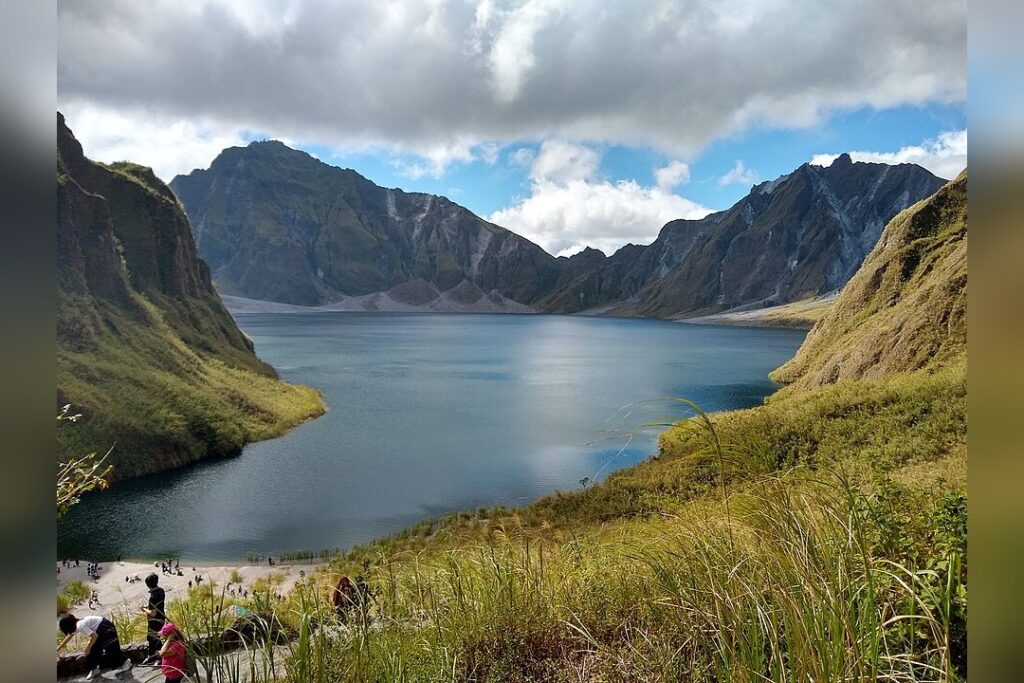
On 3 April 1991, a missionary named Sister Emma Fondevilla led villagers from an Aeta community on the slopes of Mount Pinatubo to meet scientists at the Philippine Institute of Volcanology and Seismology (PHIVOLCS). They reported a series of steam eruptions on the mountain’s northwestern side. Within weeks, one of the most successful volcanic evacuations on record was under way.
Learning a volcano in a few weeks
The scientists had almost no baseline. Geologist John Ewert, a member of the US Geological Survey (USGS) team sent to help, said the only prior data was a single carbon date from a 1980s study of the area as a possible nuclear plant site. Pinatubo was not even listed in the Smithsonian’s catalog of active volcanoes.
PHIVOLCS put three seismometers on the northwestern flank. When the USGS Volcano Disaster Assistance Program team arrived on 23 April, it added a network of seven stations between 1 and 19 kilometers from the summit. Through May the instruments logged at least 200 small earthquakes a day. A helicopter-mounted spectrometer, originally built to measure smokestack emissions, showed sulfur dioxide climbing from the vents.
The team studied old pyroclastic flow and lahar deposits on every side of the mountain, dated charcoal samples and flew the terrain. Volcanologist Chris Newhall told Eos that flow deposits sat high on ridges, or over ridges that would have stopped all but the biggest flows. That showed how large the coming eruption could be. The volcano, they concluded, had erupted in at least six periods over 5,000 years, the last about 500 years earlier. Nearby villages stood on those old deposits.
Convincing people to leave
In early June, sulfur dioxide output fell sharply to around 250 tons a day, which the scientists read as magma sealing the vents. Earthquake clusters moved beneath the summit. A lava dome began to surface on 7 June. On 10 June, sulfur dioxide jumped past 13,000 tons a day, and explosions sent ash columns up to 24 kilometers high.
The stakes were plain. Six years earlier, Nevado del Ruiz in Colombia had killed more than 23,000 people, and Ewert said a breakdown in communication between scientists and local authorities was partly to blame. The warning scheme here had to be simple enough for tens of thousands of people who spoke different dialects and languages. Many locals did not believe Pinatubo was a volcano at all. Some accused the scientists of lying for money or political reasons.
The team gathered local leaders and showed footage from the Nevado del Ruiz disaster. They worried about overstating the danger, but later wrote that they “judged then (and still judge) that strong images were needed to awaken the population.” Ewert put it more bluntly: showing people what had happened elsewhere worked far better than a scientist trying to explain it with “interpretive dance and hand gestures.”
Officials first called for 25,000 people to leave, including Americans at Clark Air Base and the US Naval Station at Subic Bay. By 14 June the recommended evacuation radius was 30 kilometers, which Newhall said could have applied to perhaps 400,000 people. No evacuation that wide had been attempted before an eruption.
The eruption
Pinatubo blew at about 1:42 p.m. local time on 15 June, the largest eruption since Alaska’s Novarupta in 1912. The ash cloud held 5 cubic kilometers of material and reached 40 kilometers high. A typhoon passing at the same moment brought heavy rain, and lahars rushed downhill, flattening towns and smothering rice paddies and sugarcane fields. Wet ash turned cement-like, and many roofs collapsed under it. More than 350 people died, most of them under collapsing roofs.
More than 65,000 people had left by then. USGS and PHIVOLCS estimate the evacuation saved between 5,000 and 20,000 lives.
Communication in 1991 was crude. Scientists looked things up in books and faxed one another, and there was no GPS or satellite data link. Rumors spread, including one of a 3-mile fissure and an imminent blast toward Olongapo. Only on 16 June could scientists tell the country that a caldera had formed and the climax had probably passed.
What the rocks revealed
Lava studied afterward showed the eruption involved mixed magmas. Newhall explained that hot, water-rich basalt had entered a cooler dacite reservoir and crystallized, squeezing its gases into the remaining melt. Tiny bubbles made it buoyant enough to rise into the dacite and mix. That mixing coincided with deep long-period earthquakes, rarely observed before Pinatubo. Ewert said they are now “something we look for if we have a volcano that’s waking up.”
Direct gas measurements added another surprise. Far more sulfur gas reached the atmosphere than studies of crystals could account for, which meant rock analysis alone understated what a volcano emits.




