
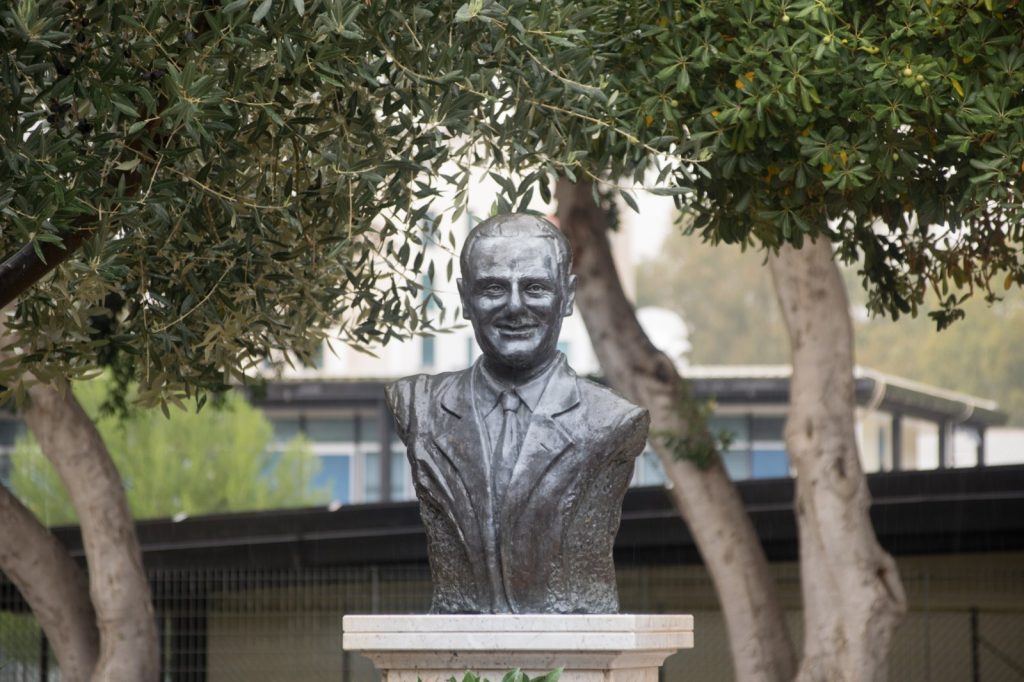
Strategically, the story of 20th century oil is a story of cartel management. The phrase “Seven Sisters” was coined in the 1950s by Enrico Mattei, the chief of Italy’s state oil company ENI, and he meant it as an insult: a jab at “the seven Anglo-American oil companies that had formed the “Consortium for Iran” cartel”. The seven were Standard Oil of New Jersey, Royal Dutch Shell, the Anglo-Persian Oil Company that became BP, Standard Oil of New York, Standard Oil of California, Gulf Oil and Texaco. Between the mid 1940s and the early 1970s they ran the worldwide petroleum industry, and by one account they entered the 1970s controlling “85 percent of the global oil reserves”.
The consortium that gave the group its name was itself a piece of statecraft. Iran nationalized its foreign-dominated oil industry in 1951, seizing the reserves held by the Anglo-Iranian Oil Company, and the international community answered with an embargo. When Iran was let back into world markets, it was the U.S. State Department that suggested the oil majors form a consortium; several of them were heirs to John D. Rockefeller’s original Standard Oil monopoly. The “Consortium for Iran” brought seven majors onto the project. Notably, ENI itself asked to join and was turned away by what the record calls the Anglo-Saxon controlled group, a snub with a long memory.
How did the calculus of control actually work? Vertical integration, for a start: the Sisters held concessions, wells, refineries and distribution at once, and with reserves across the Middle East they operated as a “de facto cartel”, coordinating production and pricing to hold their position. The broader stakes ran beyond commerce. Because they were well funded and well organized, the seven exercised, in one history’s phrasing, real power over the politics, markets and resources of Third World oil producers. “These seven companies went on to dominate the oil production of the Middle East following the Second World War”, the same account notes, and the phrase entered the mainstream when the British author Anthony Sampson made it the title of a 1975 book exposing what he called “the shadowy world oil cartel that had attempted to crush its competition and to dominate control of the global oil and gas resources”.
What signals the end of an empire is usually who takes its share. The counterforce came from the producers themselves: OPEC, established in 1960, and the nationalization waves that ran through the 1950s and 1960s, followed by the oil shocks of 1973 and 1979 that exposed the fault lines. Reserve ownership swung from the majors toward the OPEC states and toward state companies such as Saudi Aramco, Gazprom of Russia, China National Petroleum Corporation, Petrobras of Brazil, Petronas of Malaysia, Venezuela’s PDVSA and the National Iranian Oil Company.
The genealogy of the survivors reads like a merger ledger. Anglo-Persian became Anglo-Iranian, then British Petroleum, then BP in 2000 after absorbing Amoco and the Gulf brand. Standard Oil of California took most of Gulf in 1984 and renamed itself Chevron, which absorbed Texaco in 2001. Standard Oil of New Jersey traded as Esso, renamed itself Exxon, and bought its consortium partner Mobil, the former Socony, in 1999 to form ExxonMobil. Four of the original seven remain as BP, ExxonMobil, Chevron and Royal Dutch Shell, now counted among the seven or eight super-majors known as Big Oil.
The firm analytical close: the Sisters were “a powerful oligopoly that controlled global oil production and pricing for much of the 20th century”, and their fall did not end concentration in oil, it transferred it. Power moved from private boardrooms in London and New York to state ministries in Riyadh, Moscow and Caracas, and the commodity that shaped the century’s geopolitics simply changed hands. What the Seven Sisters built, OPEC and the national companies inherited; the game stayed the same.
Sources
- The Seven Sisters / Big Oil | SeaVoyage.com
- Seven Sisters Oil Companies – OBLONG MEDIA GLOBAL INTELLIGENCE




