
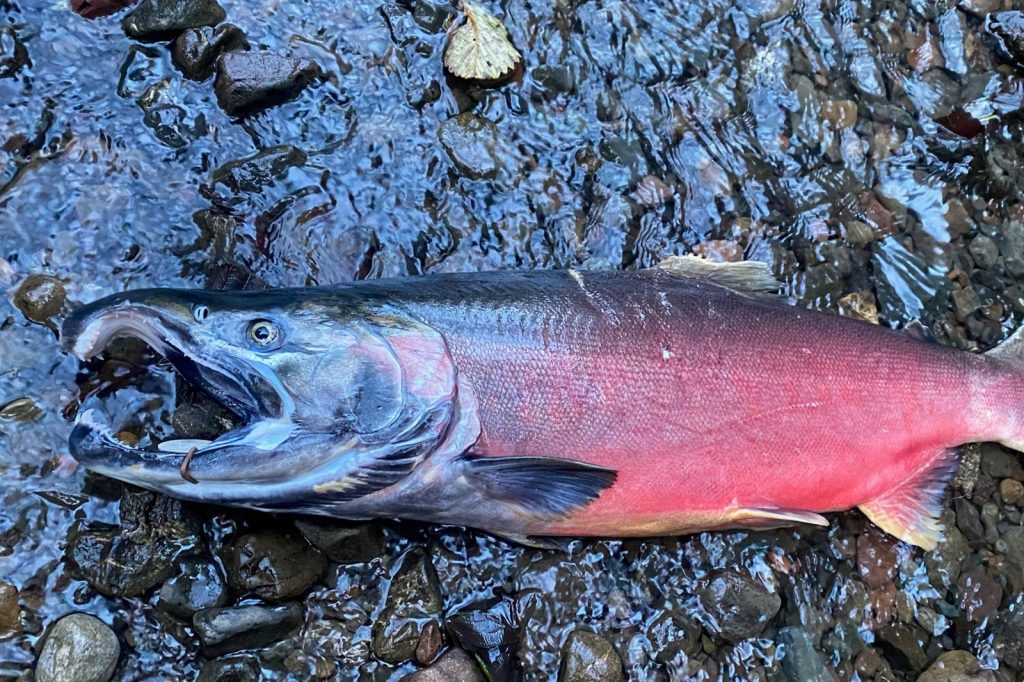
SEATTLE, July 7 — The figure that matters: 0.8 micrograms per liter. That is the lethal concentration of a chemical called 6PPD-quinone for coho salmon, a concentration so low it barely registers in a standard water sample. The bottom line: Researchers at the University of Washington have identified the exact chemical compound that has been killing coho salmon in Pacific Northwest urban streams for decades.
The study, published in 2020 in the journal Science, traced the culprit to tire wear particles washed into waterways by stormwater runoff. For years, fisheries biologists had watched a grim pattern.
In urban streams, up to 90% of returning adult coho salmon would die before they could spawn. The phenomenon, known as pre-spawn mortality, had no clear cause. The discovery of 6PPD-quinone changed that picture.
The chemical forms when a common tire antioxidant, 6PPD, reacts with ozone. Rain then flushes the ground-up tire particles from roads into streams.
For coho salmon, the result is acute toxicity at concentrations that are almost vanishingly small. Investors will note a key detail: the source is ubiquitous. Every car on the road sheds tire wear.
In the Seattle metropolitan area, where the research was centered, that means a continuous input of the chemical into urban watersheds. The study specifically named stormwater runoff as the transport mechanism. The science is straightforward. 6PPD-quinone is the compound, coho salmon are the species most acutely affected, and the concentration that kills them is 0.8 micrograms per liter.
Those three data points now anchor a growing body of research into what this chemical does to other organisms.
The Urban Stream Puzzle
The University of Washington team did not set out to find a tire chemical. They were investigating why coho salmon in urban waterways were dying at such high rates. For decades, the mortality was a known but unsolved problem.
What they found was a specific chemical reaction. The tire antioxidant 6PPD protects rubber from cracking.
When it hits the air, it transforms into 6PPD-quinone. Rain carries that transformed chemical off roads and into the nearest stream. The timing matters.
Coho salmon return to freshwater in the fall, precisely when the first heavy rains of the season wash months of accumulated tire particles off pavement. That pulse of stormwater is what kills them.
By the numbers, the effect is stark. In some urban streams, up to 90% of returning adults die before spawning. That is not a gradual decline.
It is a near-total loss in a single season for some watersheds. The study in Science gave fisheries managers a target. Before 2020, they knew stormwater was toxic but did not know why.
Now they know the molecule, the source, and the lethal dose.
What Comes Next
The research does not stop with coho salmon. The discovery of 6PPD-quinone as a potent aquatic toxicant has prompted investigation into its effects on other species, including humans. That work is ongoing.
For the Pacific Northwest, the implications are immediate. Coho salmon are a species in the region, economically and ecologically.
Their pre-spawn mortality in urban streams represents a direct hit to wild runs that are already under pressure from habitat loss and hatchery competition. The chemical’s concentration threshold — 0.8 micrograms per liter — sets a benchmark. Water quality regulators now have a number to measure against.
Stormwater treatment systems, road design, and tire formulations all become relevant variables. What to watch next: whether other salmon species show similar sensitivity, how regulators respond to the new data, and whether tire manufacturers can alter the chemistry of 6PPD without compromising tire safety.
The research pipeline from that 2020 Science paper is still producing answers.




