
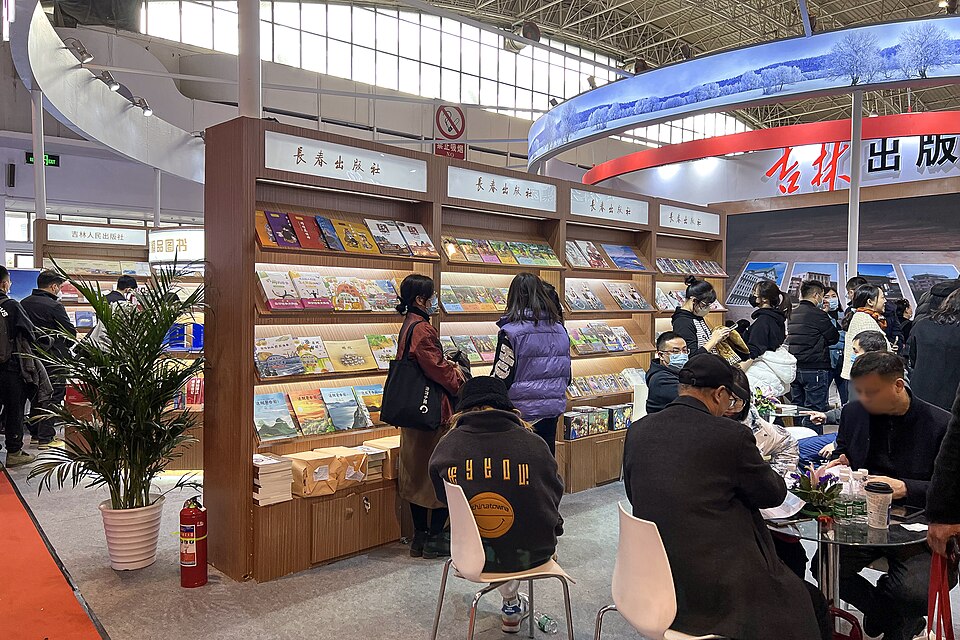
BEIJING — The 32nd Beijing International Book Fair closed on June 21 with 2,835 copyright agreements signed. But the numbers tell only part of the story. The real shift at BIBF 2026 was about who holds the power now.
China’s digital content giants — Tencent, NetEase Games, Douyin Group, 37 Interactive Entertainment, and Yuewen Group — took over a section of the China National Convention Center. They anchored the new Digital Publishing Joint Pavilion.
That pavilion was the fair’s structural center of gravity. Rights trading, once the main currency of such events, is giving way to IP licensing deals that span books, games, and streaming. The fair’s director, Xie Xiaocheng (Sean), put it bluntly: “In China, we simply have a shorter time to make decisions.
If it doesn’t work, we stop. In the West, you debate before you try.” That remark crystallized the divergence in publishing cultures.
It also revealed the distance China has traveled since the fair last drew a full international cohort. Nearly 300,000 people visited. More than 1,700 exhibitors displayed 220,000 titles.
Children’s books, social sciences, and science & technology led the rights categories. For the first time, participants from Hungary, Moldova, and South Africa joined. The UAE served as Country of Honor, splitting its presence between a public-facing cultural pavilion and a dedicated rights-trading booth.
That spatial arrangement signaled the fair’s dual ambition: consumer spectacle and B2B deal-making. But the Digital Publishing Joint Pavilion was the real signal.
It turned a section of the convention center into a hub for cross-media licensing. Tencent and Douyin are not traditional publishers. They are platforms.
They control distribution, data, and attention. Their presence on the show floor means the book fair is no longer just about selling rights to print.
It is about selling the underlying intellectual property — the story, the character, the world — for adaptation across formats. A children’s book becomes a mobile game. A social science title becomes a streaming series.
The speed of that pipeline is what Xie was talking about. The fair recorded 2,835 copyright agreements across 82 countries. That headline figure masks a deeper transformation.
China’s publishing industry is rebuilding itself around streaming commerce, AI-assisted editorial workflows, and transmedia IP. The old model — a publisher acquires translation rights, prints a book, sells it in stores — is not dead.
But it is no longer the main event. The main event is the IP deal. The book is just one entry point.
This is not a subtle shift. It is a structural one.
The fair’s director did not hedge. He described a market where debate is a luxury China cannot afford. “In the West, you debate before you try,” he said.
The implication was clear: China tries first. It decides fast, moves fast, and cuts losses fast. That approach has turned the Beijing International Book Fair into something different from its Western counterparts.
It is less a marketplace for literary rights and more a launchpad for transmedia franchises. The 82 countries present, including first-timers Hungary, Moldova, and South Africa, saw it.
The UAE’s dual-booth arrangement showed they understood the new rules. The public pavilion drew crowds. The rights booth closed deals.
Both were necessary. That is the model now.
Consumer spectacle and B2B deal-making, side by side. The book fair has not abandoned its roots. It has outgrown them.




