
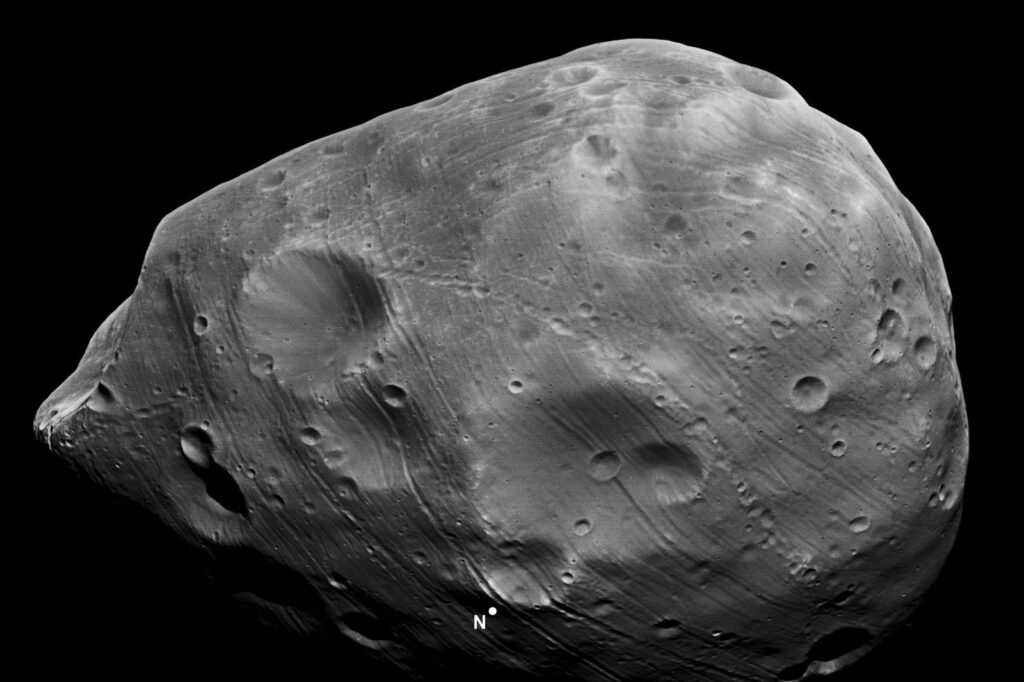
Mars has two moons, and nobody knows where they came from. Japan hopes to find out by fetching a scoop of soil from the bigger one, Phobos. The Martian Moons Exploration mission, MMX, lifts off from Tanegashima Space Center at 3:41 p.m. ET on October 19, or early Tuesday morning in Japan, and it is the first spacecraft meant to travel to the Mars system and return.
Two ideas about the moons
Intriguingly, the moons offer clues that point in two directions. In visible light, Phobos and Deimos look like asteroids from the outer part of the main belt, which suggests Mars captured them as they passed. But both follow nearly circular orbits lined up with Mars’ equator, which is what debris from a giant collision would do. In that picture, something large struck Mars and the ejected material clumped into moons.
Phobos is a lumpy body about 17 by 14 by 11 miles, often compared to a potato. It circles Mars three times a day at roughly 6,000 kilometers. That closeness matters: the moon should have collected material thrown off the planet, and Japan’s space agency, JAXA, expects about 0.1% of the sample to be Martian. Project lead Kiyoshi Kuramoto is confident. “We can almost certainly come to a conclusion by analysing soil samples,” he said.
How it works
MMX has three modules, for propulsion, exploration and return, and only the last one comes home. It should reach Mars in August 2027 and settle into a quasi-satellite orbit. That means it appears to circle Phobos while really orbiting Mars and tracking along with the moon.
A rover called Idefix, built by the French and German space agencies and weighing 55 pounds, goes down first for a roughly 100-day stay around 2029. It will help pick a smooth, level landing site. Then the main craft touches down for about two and a half hours and uses two samplers. A NASA-supplied device from Honeybee Robotics blasts ultrapure nitrogen gas at the surface to blow grains into a container, much like a vacuum cleaner. “You blink, and it’s all done,” said Kris Zacny, the company’s vice president. The other sampler pushes a corer into the top couple of inches. The goal is at least 10 grams, about a third of an ounce.
The craft also carries Megane, Japanese for “eyeglasses,” a NASA instrument that reads gamma rays and neutrons to take the first chemical-element measurements of Phobos. A flyby of Deimos is planned on the way home.
A hard place to reach
The history is rough. The Soviet Union lost two probes in 1988 and 1989 before they reached Phobos, and Russia’s Phobos-Grunt, launched in 2011, never left Earth orbit. Phobos is easier to land on than Mars, though, with weak gravity and no air. JAXA calls MMX the largest international collaboration in lunar and planetary exploration it has ever led, with the European Space Agency providing scientific and operational support. NASA has put in about $87 million over 14 years and will keep at least 15% of the returned material.
“MMX will be the first spacecraft ever to return to Earth from the Mars system,” said Tom Statler, NASA’s program scientist for the mission. Project manager Yasuhiro Kawakatsu calls the Martian moons “the most important unclimbed mountains in the solar system.” The sample could also show whether a moon of Mars makes a sensible base for future human missions. The return capsule is due to land in Australia in 2031, and the soil will then go to Japan to be cataloged and shared with partners.
Sources
- JAXA's Martian Moons Exploration mission launch: how to watch live
- Japan prepares to launch sample return mission to Phobos
- Japan to launch world-first mission to collect samples from Martian moon
Photo: mars.nasa.gov (Public domain (government work))




