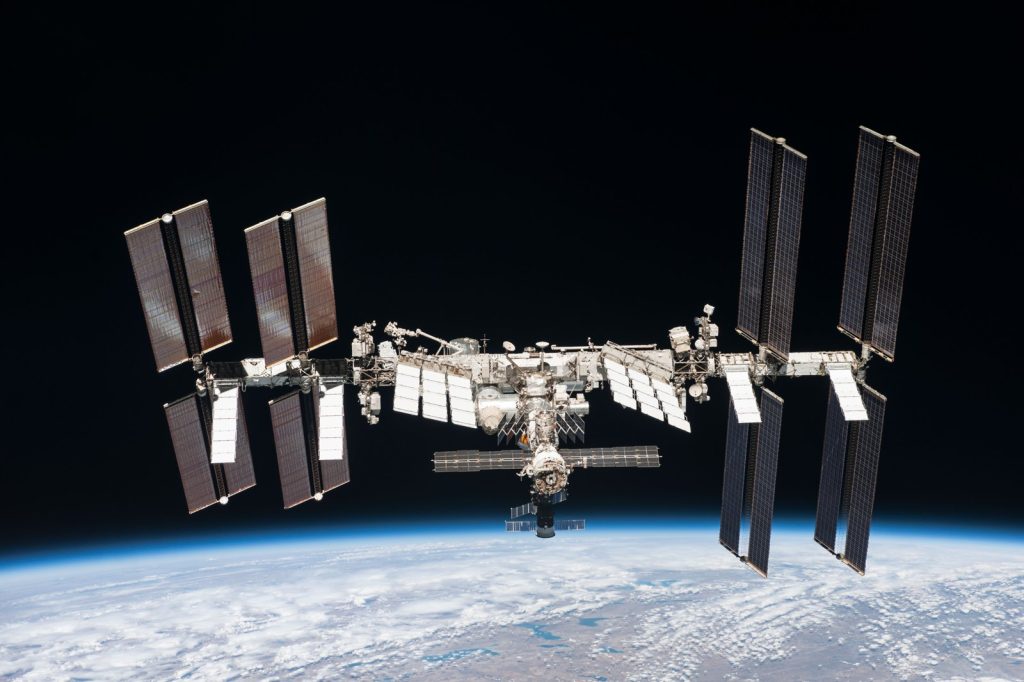
The retirement of the International Space Station now has a date, a vehicle and a price. According to the June 2026 Government Accountability Office report, which now serves as the plan of record, the final reentry burn is timed for late 2030 or early 2031, executed by a SpaceX-built deorbit craft NASA bought in June 2024 for up to $843 million. NASA has also reserved itself a decision point: in 2027 it will choose between launching the vehicle in 2029 or extending the station’s life. The broader stakes reach past engineering. The station is the last hardware on which Washington and Moscow still operate jointly, and its scheduled fall closes the one channel of cooperation that outlived every diplomatic rupture below it.
The partnership’s record is what makes the ending consequential. The first modules went up in 1998, and the outpost has been staffed continuously ever since, a venture binding the United States, Canada, Japan, 11 European countries and Russia that has weathered every terrestrial geopolitical storm so far without a scratch. In 2021 it passed 21 years of permanent human occupancy; a year earlier, SpaceX’s Crew Dragon restored America’s ability to launch its own people after nine years of buying seats from Russia. Moscow’s commitment is the moving piece. Moscow had committed itself only to 2028 before July 2026, when Roscosmos chief Dmitry Bakanov emerged from a meeting with NASA Administrator Jared Isaacman to say Russia would back operations through 2030; no formal agreement has been reported, and the GAO says NASA is still negotiating how much support Moscow will provide through retirement and the deorbit itself. NASA’s own bottom line, stated in its transition planning, is blunt: “While the ISS will not last forever, NASA expects to be able to operate it safely through 2030.”
The mechanics of the descent, as laid out in the GAO plan and NASA’s briefings, are mostly patience. Drag does the first work: from early to mid-2028 the atmosphere is allowed to pull the station down, helped along by burns from the Russian segment, saving propellant for the vehicle that must finish the job. That vehicle, a modified Dragon with a stretched trunk holding 30 of its 46 Draco thrusters and roughly 35,000 pounds of propellant, launches and docks in mid-2029. NASA’s Dana Weigel put the timing plainly at a 2024 briefing: “we’ll launch the U.S. DV about one-and-a-half years before the final re-entry burn.” The last crew departs once the outpost has descended to about 205 miles, roughly half a year out; near 140 miles the vehicle lines up the ground track, and days later comes the final burn, bringing the station down over a remote patch of ocean, most likely the South Pacific with the Indian Ocean as the alternative, trailing a debris footprint about 1,200 miles long. At 420 metric tons it will be the largest reentry ever attempted. The precedents are calmer than the scale suggests: Russia’s Mir, about 130 tons, was steered into the Pacific in 2001, Skylab scattered debris across western Australia in 1979, and no one has been injured in any station reentry to date.
Why not save it? NASA studied the alternatives in a 2024 analysis and rejected every one. Boosting the hulk to about 800 km would keep it aloft for roughly 700 years, but the average interval between damaging debris strikes would fall from about 51 years to under four, and the crew and cargo ships built for 415 km could not realistically serve a station parked that high. Pulling it apart, NASA found, would require a shuttle-class cargo bay and a spacewalk count to match the entire assembly campaign, and no feasible commercial reuse proposal ever arrived. An uncontrolled fall would violate the United States government’s 1-in-10,000 casualty risk standard, and the agency’s judgment on the controlled alternative reads like an epitaph: “the safest and only viable method to decommission this historic symbol of science, technology, and collaboration.” The operating calculus presses the same way. NASA spends about $3 billion a year to run the station, sealant has tamed the air leaks from the Russian transfer tunnel though the cracked structure beneath them remains, and the Smithsonian is in line to preserve the smaller artifacts.
The successor race is where the geopolitical ledger gets interesting. NASA’s Commercial LEO Destinations program has shifted approach twice in two years, and on July 6, 2026 the agency issued a draft request for proposals covering firm-fixed-price deals with at least two companies, with about $1 billion to $1.5 billion expected across the fiscal 2026 to 2031 window, money officials concede may fund only one station. The stated target is a crewed demonstration, four people for 30 days, no later than 2030, exactly when the old station is due to leave. Axiom Space’s sequence, as the GAO describes it, is attach-then-detach: the first module berths at the station, more follow, and the stack separates to fly free, a separation that must happen before the deorbit vehicle begins its work; anything still bolted aboard on reentry day goes into the ocean with the rest. Congress has pushed to keep the station flying until 2032, and the structure is certified through 2028, with NASA officials believing it could hold together into the late 2030s or about 2040. Strategically, the 2027 review is the move that matters. If a commercial station is clearly late, the default becomes a one- or two-year extension; if not, the last working symbol of post-Cold War cooperation burns on schedule, and low Earth orbit passes to whoever built its replacement. What this signals is the quiet shift underneath the whole plan: a capability America once shared as diplomacy is about to become a product it must simply buy.
Sources
- NASA Solidifies Planning to Deorbit ISS in 2031 – SpacePolicyOnline.com
- ISS Deorbit Plan, the 2030 Date and the SpaceX Vehicle – KeepTrack