
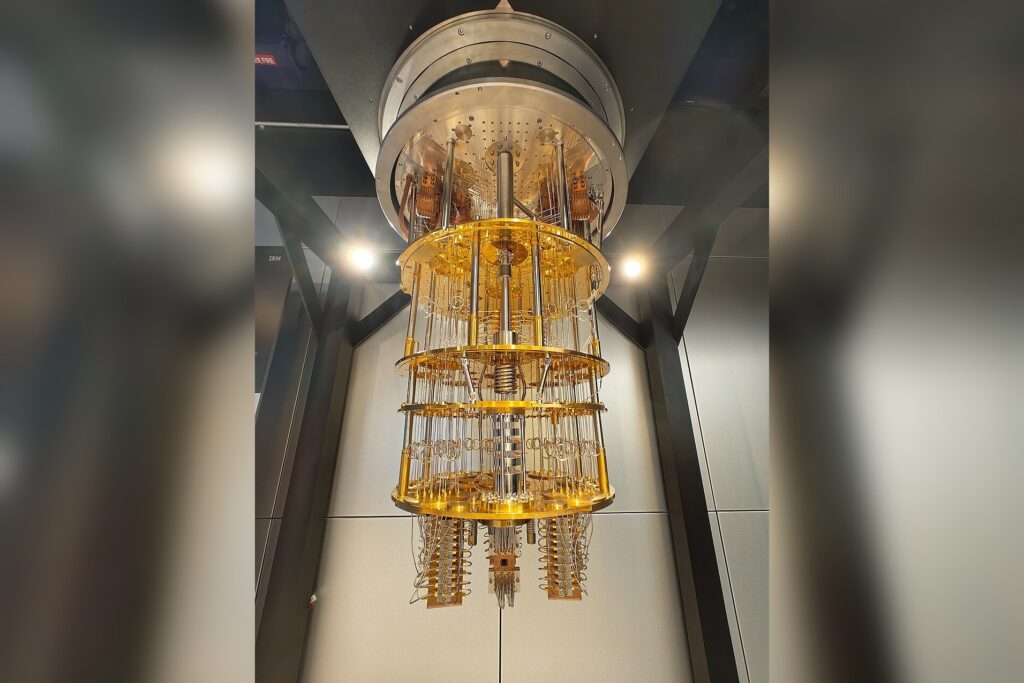
HEFEI, September 15 — China’s national quantum laboratory in Hefei anchors one of the largest state-backed quantum research efforts in the world, alongside programs in the United States, the European Union, the United Kingdom, Canada, Australia, Japan and Germany. The field it serves remains, by any honest measure, in its early stage: no large-scale, fault-tolerant quantum computer has yet been demonstrated. That gap between investment and machine is the defining fact of quantum computing in 2026.
The idea itself is more than four decades old. Physicist Paul Benioff described a quantum mechanical model of a Turing machine in 1980.
Richard Feynman argued in 1982 that quantum systems could not be efficiently simulated by classical computers. David Deutsch described a universal quantum computer in 1985.
The algorithms that made it matter
Two results turned a physics curiosity into a strategic technology. In 1994 Peter Shor published a quantum algorithm for integer factorization that could, in principle, break widely used public-key cryptosystems such as RSA. In 1996 Lov Grover introduced a quantum search algorithm offering a quadratic speedup for unstructured search problems.
The hardware rests on the qubit, the basic unit of quantum information. Unlike a classical bit, a qubit can exist in a superposition of 0 and 1, and qubits can be entangled — the state of one correlated with another in ways that have no classical analogue.
Quantum algorithms exploit superposition, entanglement and interference to solve certain problems faster than the best known classical methods. Qubits are fragile. They lose their quantum state through decoherence, and quantum error correction is required to build large-scale, fault-tolerant machines.
Shor and Andrew Steane independently proposed quantum error-correcting codes in 1995. The outstanding challenges today are the same ones: qubit coherence, gate fidelity, error correction overhead, and scaling.
Milestones and disputes
Google claimed quantum supremacy in 2019 with its Sycamore processor, performing a specific sampling task in about 200 seconds that it estimated would take a classical supercomputer thousands of years. IBM disputed the claim, arguing the task could be done classically in days. A year later, a team at the University of Science and Technology of China reported quantum supremacy using photonics with its Jiuzhang system.
In 2023, IBM unveiled its Condor processor with 1,121 qubits and its Heron processor with 133 qubits. Governments have put serious money behind the field.
The United States passed the National Quantum Initiative Act in 2018, authorizing more than US$1.2 billion over five years for quantum research. The European Union launched its Quantum Flagship in 2018 with a budget of €1 billion (about US$1.1 billion).
Encryption is the near-term pressure point
Quantum computers could threaten current encryption standards, which is why post-quantum cryptography has moved in parallel. The US National Institute of Standards and Technology announced in 2022 that it had selected its first group of post-quantum cryptographic algorithms and released draft standards in 2023, with final standards expected in 2024. Potential applications stretch across drug discovery, materials science, optimization, cryptography and machine learning.
The timeline for practical, broad quantum advantage remains uncertain, with estimates ranging from several years to more than a decade. Watch the error-correction benchmarks next — that is where the fault-tolerant machine will be won or lost.




