
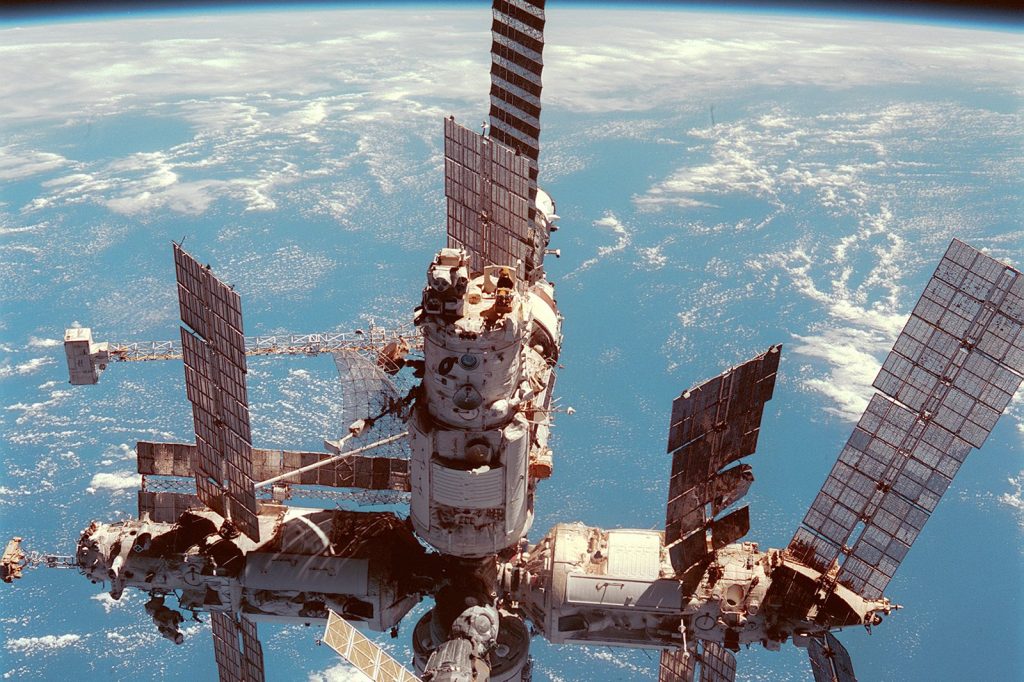
MOSCOW, July 14 — Against this backdrop of renewed interest in space-based solar reflection, a little-known chapter of Russian space engineering from the 1990s is drawing fresh attention from entrepreneurs and engineers alike. The Znamya project, conducted by the Russian Space Agency, sought to deploy enormous reflective films in orbit to beam sunlight down to Earth. It was the brainchild of Vladimir Syromyatnikov, the Russian engineer who also designed the docking systems for the historic Apollo-Soyuz mission.
The idea was audacious: a mirror in space that could illuminate cities, extend daylight, or even assist in disaster relief.
Proof of concept
On February 4, 1993, the Znamya 2 experiment launched aboard a Progress spacecraft. It deployed a 20-meter-diameter reflective film that successfully reflected sunlight onto a 5-kilometer-wide area of Europe. The beam of light was visible from the ground — a fleeting but real demonstration that the concept could work.
Six years later, the Znamya 2.5 experiment attempted to go further. A 25-meter mirror was to be deployed, but the mission ended in failure.
A deployment malfunction caused the film to become entangled, and it burned up in the atmosphere. The project was ultimately abandoned. Funding dried up, and concerns about light pollution — the unintended consequences of brightening the night sky — weighed against further development.
What is at stake now is whether those old ambitions can be revived with modern technology. Reflect Orbital’s CEO Ben Nowack has cited the Znamya experiments as a proof of concept for the current satellite.
The new satellite, he has indicated, uses modern materials and deployment mechanisms to avoid the failures of the 1990s.
The wider picture
In the corridors of space engineering, the Znamya story has long been viewed as a tantalising what-if. Syromyatnikov’s work on docking systems made him a legend in the field, but his mirror project remains far less known outside specialist circles. The failure of Znamya 2.5, in particular, underscored the difficulty of unfurling large, delicate structures in the vacuum of space.
Now, with advances in materials science and deployment technology, the idea is being revisited. The new satellite is designed to overcome the specific failure modes that doomed its predecessor.
Where the 1999 experiment saw its film become tangled and lost, the current iteration employs modern deployment mechanisms intended to ensure reliable operation. The wider picture is one of a technology that has waited decades for its moment. The Znamya experiments proved that sunlight could be reflected from orbit onto a measurable area of the Earth’s surface.
What remains to be seen is whether the engineering challenges that ultimately halted the Russian project can finally be solved.




