
The sky over Java turned yellow in June 1816, and no one knew why.
Farmers in New England watched frost form on their cornfields in July. In Switzerland, snow fell on the Alpine passes in August. In Ireland, a potato blight that would foreshadow a greater catastrophe two decades later began its slow creep through the fields. Across the Northern Hemisphere, crops failed. Rivers froze in summer. Birds dropped dead from the sky. And at the center of it all, half a world away, a mountain had torn itself apart.
On April 10, 1815, Mount Tambora, a 14,000-foot volcano on the Indonesian island of Sumbawa, erupted with a force that still defies easy comprehension. The explosion was heard 1,200 miles away. The sound, witnesses reported, resembled cannon fire so intense that British troops stationed in Sumatra mobilized for battle, convinced they were under attack. The eruption column rose 28 miles into the stratosphere, punching through the atmosphere’s protective layers and injecting an estimated 10 billion tons of ash, sulfur dioxide, and rock into the sky.
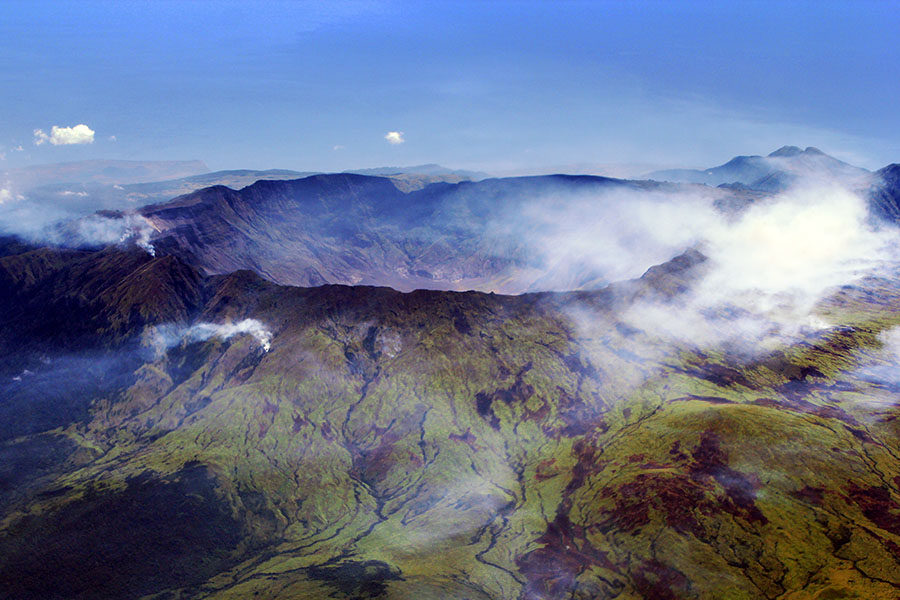
The mountain did not simply erupt. It collapsed. The explosion removed nearly a mile of the volcano’s height, carving a caldera four miles wide and 2,000 feet deep. On Sumbawa and neighboring Lombok, pyroclastic flows – superheated avalanches of gas and rock – raced down the slopes, incinerating everything in their path. The flows reached the sea, boiling the coastal waters and killing fish by the thousands. Ashfall buried villages under three feet of debris. Trees were torn from the ground and hurled into the ocean.
The immediate death toll was staggering. The eruption itself killed an estimated 10,000 people directly. But that was only the beginning. The ash that blanketed Sumbawa smothered crops and poisoned water sources. In the weeks that followed, disease and starvation swept through the islands. By the time the disaster had run its course, an estimated 80,000 to 90,000 people had died in Indonesia alone.
The eruption’s aftermath, however, was not confined to the archipelago. The sulfur dioxide that reached the stratosphere mixed with water vapor to form sulfate aerosols, microscopic particles that reflected sunlight back into space. These particles spread around the globe, carried by atmospheric currents, creating a veil that dimmed the sun. The effect was not immediate. It took months for the aerosols to circle the planet. But by the summer of 1816, the consequences were unmistakable.
In New England, the year became known as “Eighteen Hundred and Froze to Death.” Snow fell in June. Lakes remained frozen into July. Farmers planted corn three times, watching each crop die in the frost. In Vermont, the growing season lasted just a few weeks. The price of oats rose from 12 cents a bushel to 92 cents. Farmers sold their land, their livestock, their tools. Some simply abandoned their fields and moved west, hoping the Ohio Valley might be spared.
In Europe, the situation was worse. The continent was already reeling from the Napoleonic Wars, which had ended just months before the eruption. Food supplies were depleted. Armies had stripped the land. When the crops failed in 1816, famine swept across Britain, France, Switzerland, and Germany. In Switzerland, the government declared a national emergency. In Ireland, the potato harvest failed, and the price of bread doubled. Across Europe, food riots broke out. The summer never came.
The eruption’s legacy was not limited to famine. The atmospheric disruption altered weather patterns for years. In 1817, the monsoon failed in India, leading to a cholera outbreak that would eventually spread across Asia and into Europe. The disease, which had previously been confined to the Indian subcontinent, became a global pandemic, killing millions over the next decade.
But the disaster also had unexpected consequences. The strange, vivid sunsets that followed the eruption – caused by the scattering of light through the sulfate particles – captured the imagination of artists across Europe. The painter J.M.W. Turner, who witnessed these skies, began to experiment with the fiery, atmospheric effects that would define his later work. In Germany, a young composer named Richard Wagner would later cite the eruption as the inspiration for his apocalyptic opera “Gu00f6tterdu00e4mmerung.”
The eruption also spurred scientific inquiry. For centuries, volcanic eruptions had been seen as local events, isolated disasters that affected only the immediate region. Tambora changed that. The global scale of the catastrophe forced scientists to recognize that the Earth’s systems were interconnected in ways they had not understood. The eruption became a case study in how a single geological event could alter climate, agriculture, and human society across the planet.
Why did Tambora erupt with such force? The volcano sits on the Ring of Fire, the tectonic boundary where the Indo-Australian plate slides beneath the Eurasian plate. As the plate descends, it melts, creating magma that rises to the surface. Tambora’s magma chamber had been building pressure for centuries. When it finally gave way, the eruption was not a simple release. It was a detonation, driven by the rapid expansion of gases that had been trapped under immense pressure.
The volcano had been dormant for centuries before 1815. There were warning signs – small tremors and rumbles in the years before the eruption – but no one recognized them for what they were. The local population had no memory of volcanic activity. They had no reason to fear the mountain.
The lessons of Tambora are sobering. The eruption demonstrated that the Earth’s systems are fragile and interconnected in ways that defy easy prediction. It showed that a single event, occurring in a remote corner of the world, could reshape the lives of millions across the globe. And it raised questions that remain unanswered: What would happen if such an eruption occurred today? Would our globalized economy, with its complex supply chains and densely populated cities, be more resilient – or more vulnerable?
Mount Tambora still sits on Sumbawa, its caldera now a lake, its slopes covered in forest. It is not extinct. It is dormant. Scientists estimate that eruptions of Tambora’s magnitude occur once every 500 to 1,000 years. The next one is not a matter of if, but when. And when it comes, the sky will turn yellow again, and the world will remember what it means to lose a summer.




