
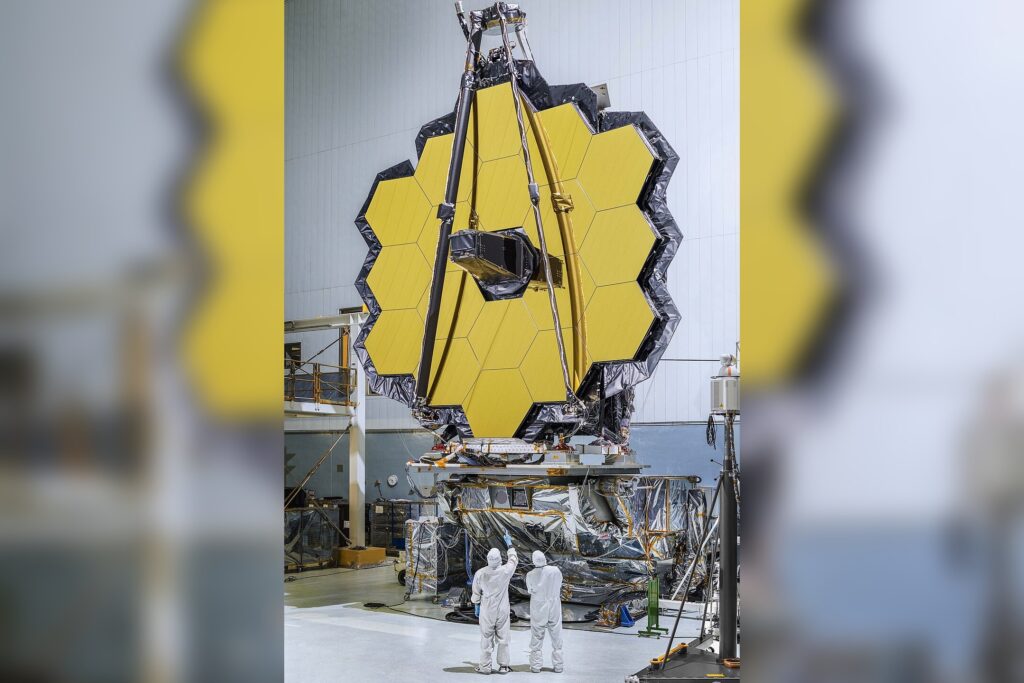
GREENBELT, August 3 — The universe’s oldest secrets are getting a fresh look, thanks to the incredible vision of the James Webb Space Telescope (JWST). Its recent observations are prompting astronomers to rethink some of our most established ideas about how the cosmos came to be, particularly the Lambda-Cold Dark Matter (ΛCDM) model, which currently describes the universe’s evolution.
Here’s what that means in plain terms: The ΛCDM model is our best blueprint for the universe, accounting for everything from the Big Bang to the present day, including the roles of dark energy (Lambda) and cold dark matter. Think of it like a meticulous instruction manual for building the universe, detailing how structures, like galaxies, should form and grow over billions of years.
But JWST’s early data, released in 2022 and 2023, is showing us some unexpected twists in that manual. The telescope has revealed galaxies in the very early universe that are far more massive, mature, and numerous than the ΛCDM model predicted.
For example, when JWST peered at galaxies with redshifts between 8 and 10 – which, in plain language, means we’re seeing them as they were when the universe was only 500-700 million years old – they appear to have stellar masses and star formation rates similar to galaxies observed much, much later in cosmic history. This is a big deal because the traditional “hierarchical model” of galaxy formation suggests galaxies grow gradually, like tiny towns merging to become cities over vast stretches of time.
Instead, the JWST data suggests some early galaxies popped up rapidly and efficiently, almost like fully formed metropolises appearing out of nowhere. The practical upshot of these findings is that they challenge fundamental assumptions about how quickly stars can form and the precise role of dark matter in the early universe. Dark matter, which accounts for approximately 27% of the universe’s total mass and energy, is believed to have acted as the gravitational scaffolding upon which the first galaxies were built.
However, the JWST’s observations suggest that the relationship between this invisible dark matter and the visible matter we see in early galaxies might be different from what we observe in our local cosmic neighborhood today. This isn’t a sign that the ΛCDM model is necessarily broken, but rather that it might need some significant adjustments. These findings have already spurred proposals for alternative models, including modified theories of gravity or new ideas about the properties of dark matter itself.
The scientific community is now deeply engaged in verifying and interpreting this groundbreaking JWST data. As of 2023, more than 1,000 peer-reviewed papers have been published based on its observations, showcasing the intense scrutiny and excitement surrounding these discoveries.
It’s an incredibly exciting time for cosmology. As astronomers continue to pour over JWST’s unprecedented views of the infant universe, we can expect to see our understanding of cosmic evolution continue to expand and refine, pushing the boundaries of what we thought was possible.
Sources
{“@context”: “https://schema.org”, “@type”: “NewsArticle”, “headline”: “JWST Finds Massive Early Galaxies, Challenges Cosmology”, “description”: “GREENBELT, August 3 — The universe’s oldest secrets are getting a fresh look, thanks to the incredible vision of the James Webb Space Telescope (JWST)….”, “datePublished”: “2026-08-03T09:30:00+00:00”, “author”: {“@type”: “Person”, “name”: “Erika Johnson”}, “publisher”: {“@type”: “Organization”, “name”: “InfoPulse Today”, “url”: “https://newsfeed.2bme.xyz/”}, “citation”: [{“@type”: “CreativeWork”, “url”: “https://en.wikipedia.org/wiki/Lambda-CDM_model”}]}




