
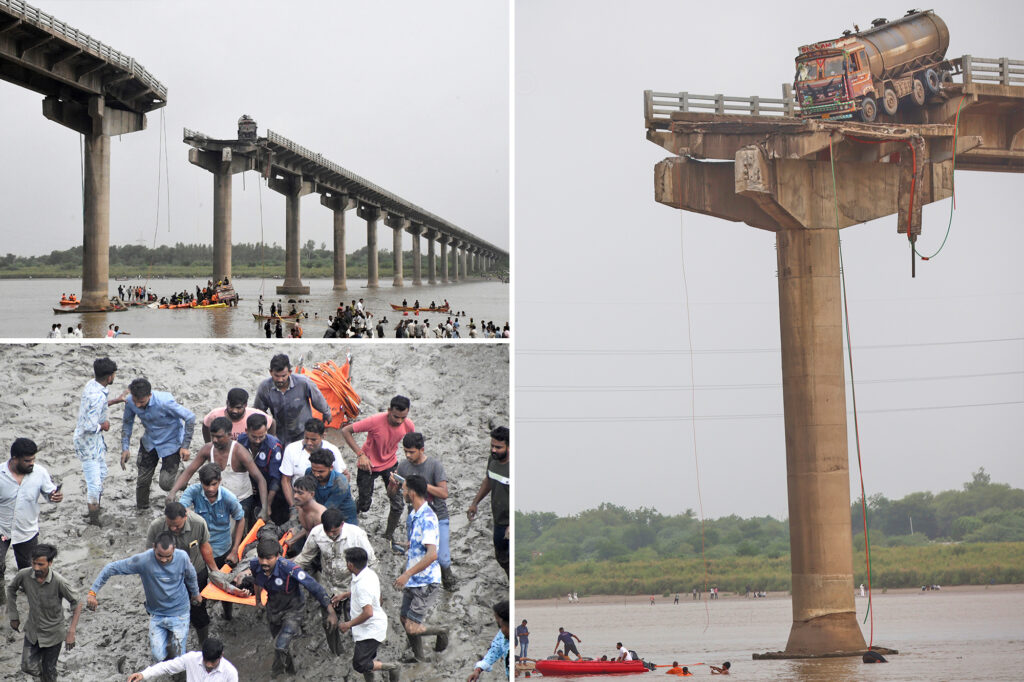
A section of the Gambhira Bridge in Gujarat collapsed during the Tuesday morning rush hour, killing thirteen people and injuring nine others. The partial failure sent both vehicles and pedestrians plunging into the water below.
Rescue teams remain at the scene, continuing their search and recovery operations. The cause of the collapse has not yet been determined. Investigators are expected to examine the bridge’s design, construction methods, and maintenance records.
This incident is not an isolated event in India, where infrastructure failures have occurred repeatedly, prompting scrutiny of the nation’s approach to building and maintaining critical public assets. The Gambhira Bridge served as a vital transportation link, heavily used by commuters traveling to work and children heading to school.
India’s rapid urbanization and growing population have placed increasing strain on roads and bridges that were constructed decades ago, often designed to handle far less traffic and weight than they currently bear. India has made notable progress in other sectors, particularly in renewable energy. The country has significantly expanded its solar and wind power capacity, reducing dependence on fossil fuels and improving energy security while lowering costs. However, this achievement in clean energy has not been matched by equivalent investment in basic infrastructure such as bridges, roads, and railways.
These structures, while less glamorous than renewable energy projects, are essential for daily life and economic activity. When they fail, the consequences are often fatal.
Emergency services and rescue teams responded swiftly to the collapse, working to pull survivors and victims from the wreckage. While this rapid response is commendable, it does not substitute for prevention. Effective prevention requires regular inspections, honest assessments, and timely spending on repairs before failures occur.
It also requires resisting political pressure to keep infrastructure open when it should be closed for maintenance. Bridges must be treated as life-or-death infrastructure, not as conveniences to be managed casually.
Thirteen people have died, and nine remain hospitalized. Those numbers may rise as rescue operations conclude. For the families of the victims, India’s renewable energy achievements offer no solace.
They are left to grapple with a bridge that was supposed to be safe but was not. The Gambhira Bridge was built to hold and to last.
It did neither. This represents a failure not only of engineering but also of the system governing inspection, maintenance, and eventual replacement. India has demonstrated the ability to build solar farms at scale and transform its energy grid.
It can also keep its bridges standing. These goals are not in competition.
Both require a willingness to invest in infrastructure that does not generate headlines until it fails. Investigators will provide answers in the coming weeks or months. The dead will remain dead.
The injured may recover or may not. The bridge may be rebuilt or may not.
The true measure of this tragedy will be whether the lessons learned lead to lasting change.




