
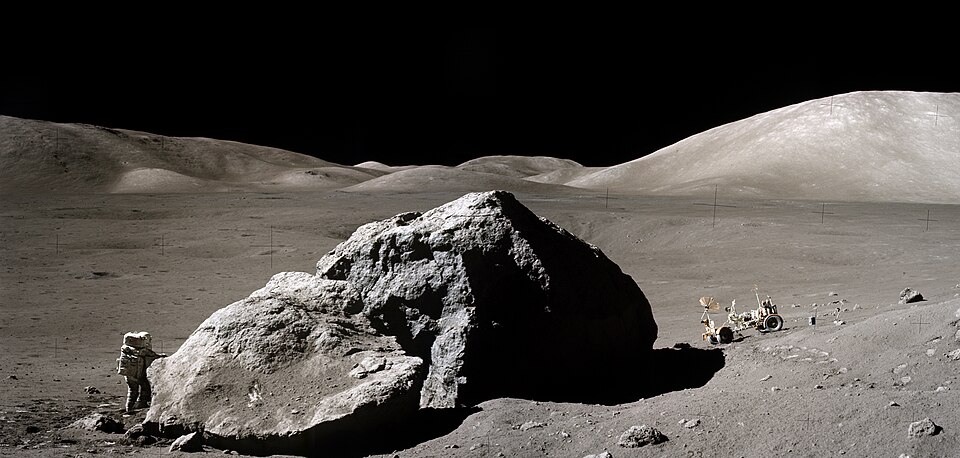
A newly released government document is drawing attention to a decades-old scientific puzzle from the Apollo 17 mission, raising questions about the nature of ultraviolet radiation detected beyond the Moon. The document, obtained through the U.S. Department of War’s PURSUE program and declassified on May 8, 2026, contains a transcript of a January 8, 1973 debriefing with the Apollo 17 crew.
During the mission, which took place in December 1972 and included the sixth lunar landing, astronauts conducted an ultraviolet experiment. Their instruments recorded a spectrum that matched the signature of a hot star. The anomaly: no such stars were present in the observed field of view.
The document, classified for 53 years, does not indicate any instrument malfunction. Dick Henry, the co-investigator for the ultraviolet experiment, addressed the finding during the debriefing.
He told the panel that the spectrum’s characteristics did not align with the prevailing theory that the radiation originated from hot stars within the galactic plane. Henry proposed a potential explanation: the radiation could be extragalactic in origin. He stated his intention to conduct a detailed computer study to investigate the phenomenon, acknowledging that such an analysis would require a significant investment of time.
The document does not reveal whether that computer study was ever completed. The release of the debriefing transcript more than half a century later reopens the question of what the Apollo 17 crew detected.
The stakes involve fundamental assumptions about the universe. If the crew’s instruments accurately detected extragalactic ultraviolet radiation that mimics a hot star but comes from no known stellar source, it would suggest the existence of an unexplained energy-producing phenomenon. Possibilities range from a previously unknown class of astrophysical object to a gap in current models of cosmic energy output. The document does not speculate on these possibilities.
It establishes a factual record: the Apollo 17 crew collected data that their own lead scientist could not immediately reconcile with available theory. Henry did not rule out instrument error but did not assert it.
He identified the extragalactic hypothesis as a viable avenue for further research and proposed a specific path forward—the computer study—to resolve the discrepancy. For researchers studying the ultraviolet background of the cosmos, the Apollo 17 data has long been a known but frustratingly incomplete data point. The declassification provides a primary source document and a timeline: Henry indicated the computer study would be time-consuming.
Whether that study was conducted and what it found remains outside the document’s scope. What the document contains is a single observation: a spectrum that looks like a hot star, with no hot stars in view, and a scientist who considered it worthy of years of computer time to determine what the crew actually saw.




