
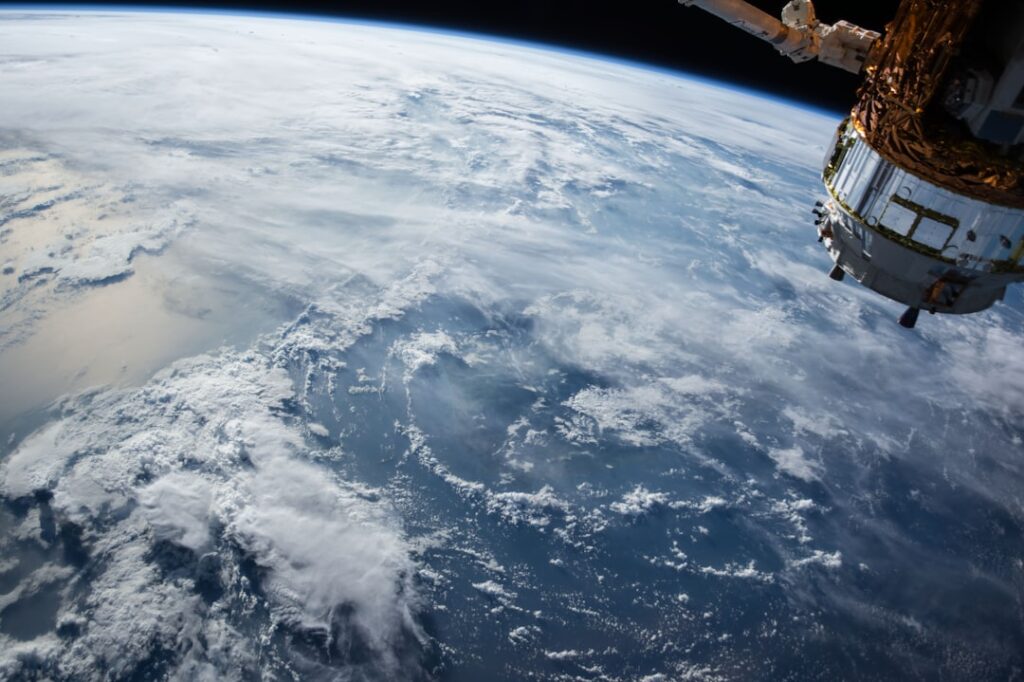
The International Space Station, a 420‑ton laboratory that has circled Earth for a quarter of a century, relies on periodic reboosts to stay aloft. Those altitude‑adjusting burns are performed by Russian Progress cargo ships that dock with the Zvezda service module, firing thrusters that raise the station’s orbit. Without this propulsion, the station would gradually descend. Roscosmos head Dmitry Rogozin told state television on Saturday that his agency is preparing a “cooperation outlook” for the Russian government.
The document may recommend that Russia cease all support for the ISS. The move would be a direct response to Western sanctions that froze assets of Russian state enterprises and barred the export of dual‑use electronics needed for spacecraft guidance and docking systems.
Those sanctions were imposed in late February after Russia’s invasion of Ukraine. Rogozin set a March 31 deadline, demanding that the United States, the European Union and Canada lift the restrictions. The deadline passed without any change, prompting Rogozin to say the ISS program can no longer operate under “the old principles.” Roscosmos is now modelling the consequences of an abrupt withdrawal.
The analysis will examine how the loss of Russian modules, cargo flights and crew‑rotation capability would affect the station’s operations. The report is slated to reach Deputy Prime Minister Yury Borisov within days.
Western officials have dismissed the deadline as political theatre. A U.S. State Department spokesperson reiterated on April 2 that export controls are “not negotiable” and that any easing would be tied to a cease‑fire and the withdrawal of Russian troops. Canada’s Space Agency issued a matching statement, while the European Space Agency said operational safety remains a priority but gave no indication of changing its stance.
Rogozin’s argument centres on the mechanical reality of reboosts. The Progress vehicles attached to Zvezda are currently the only active means of raising the ISS’s orbit.
The United States lacks an independent reboost capability; Europe’s Automated Transfer Vehicle has been retired, and Japan’s HTV does not perform altitude adjustments. A sudden Russian exit would therefore leave the U.S. and its partners without a primary means of maintaining the station’s altitude. The modelling being undertaken by Roscosmos is concrete, not hypothetical.
It seeks answers to questions such as: how long could the ISS remain in orbit without Russian thrusters; what would happen if Russian modules were detached; and how crew rotations would be managed if Soyuz capsules were no longer available. For the moment, the station continues its routine.
Progress cargo ships remain docked, and their thrusters keep firing. However, Rogozin has made clear that the future of the ISS is now linked to the removal of sanctions, a condition the West has so far refused to meet. The situation creates a new kind of orbital uncertainty—one driven not by technical failure but by geopolitical stalemate.




