
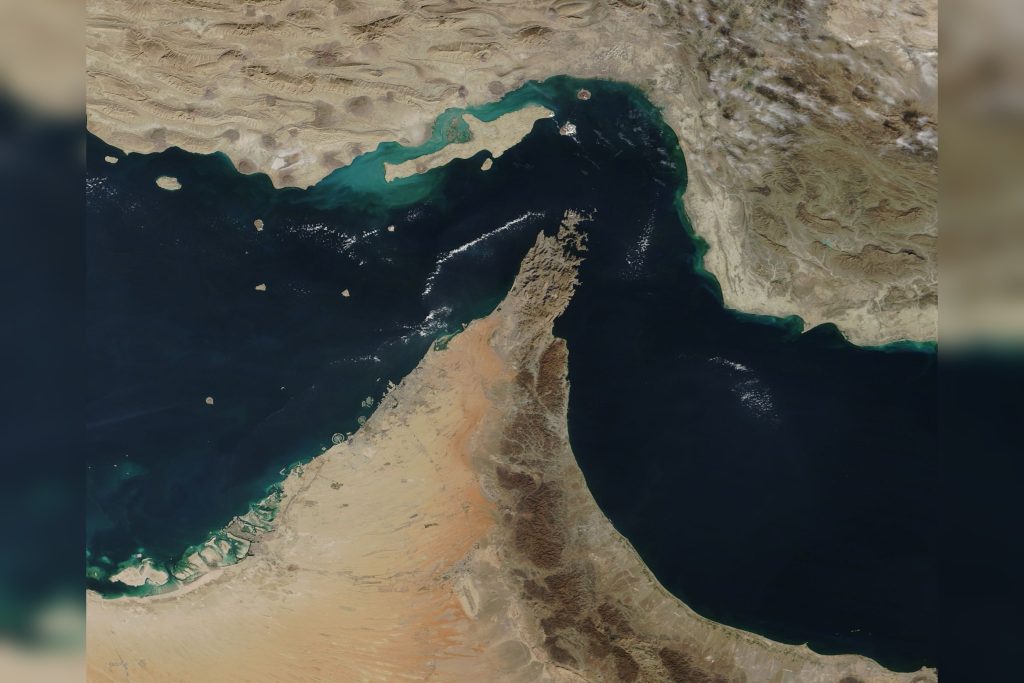
Every day, roughly one-fifth of the world’s oil moves through a single, narrow stretch of water between Iran and Oman. The Strait of Hormuz, at its narrowest point just 21 miles wide, carries about 17 million barrels of crude oil and petroleum products – more than any other maritime chokepoint on Earth. It also handles nearly a quarter of the global liquefied natural gas trade, mostly from Qatar. For the global economy, this 21-mile corridor is not just a shipping lane; it is the jugular of the world’s energy system.
The numbers are stark. According to the U.S. Energy Information Administration, about 20 percent of all petroleum consumed on the planet passes through Hormuz. The bulk of that flows to Asian markets – China, Japan, India, South Korea, Singapore – which together buy more than 80 percent of the oil that transits the strait. Smaller amounts head to Europe and the United States. If that flow stops, the effects would be immediate and global, not regional.
Economists and energy analysts have modeled the scenario for decades. A full closure of the Strait of Hormuz would likely send oil prices soaring past $150 a barrel, possibly to $200 or more, depending on the duration. The last time the world saw a sustained price spike of that magnitude was in 2008, when oil hit $147 a barrel and helped tip the global economy into recession. But that spike was driven by demand and speculation; a Hormuz closure would be a physical supply shock, far harder to absorb. The International Energy Agency estimates that strategic petroleum reserves held by member countries could cover only about 90 days of lost supply from the strait – and that assumes no other disruptions.
Natural gas would be hit even harder. About 75 percent of the LNG that passes through Hormuz comes from Qatar, the world’s largest LNG exporter. Japan, South Korea, and China are the top buyers. Unlike oil, which can be rerouted via longer sea routes or replaced by other producers, LNG is more dependent on specialized tankers and regasification terminals. A closure would not just raise prices; it would physically strand cargoes, forcing some countries to ration gas for power generation and heating within weeks.
But here is the paradox: the Strait of Hormuz has been threatened, blockaded, and mined many times – yet it has never been fully closed. Not during the Iran-Iraq War in the 1980s, when both sides attacked tankers and Iran laid mines. Not during the 1990-91 Gulf War, when Iraq invaded Kuwait and U.S. forces deployed to protect Saudi oil fields. Not after the U.S. invasion of Iraq in 2003. Not during the escalating tensions of the 2010s, when Iran seized tankers and the U.S. sent aircraft carriers to the region. The threat is invoked far more often than it is carried out, and that pattern tells a story of its own.
The reason is simple: closing the strait would be an act of war, and Iran knows it. The United States Fifth Fleet, based in Bahrain, maintains a permanent presence in the region. Any attempt to block the strait would trigger a military response that would quickly destroy Iran’s navy, its coastal missile batteries, and its ability to mine the waterway. Iran’s leaders understand that a closure would also devastate their own economy: the strait is Iran’s only practical export route for its oil and gas, which account for about 60 percent of government revenue. Blocking the strait would be like cutting off one’s own oxygen supply to hold the world hostage.
Instead, Iran has used the threat as a bargaining chip. In 2012, when the U.S. and Europe imposed sanctions on Iranian oil exports, Iranian officials repeatedly warned they could close the strait. The warnings were enough to push oil prices higher, complicating the West’s strategy. In 2018-2019, after the U.S. withdrew from the nuclear deal and reimposed sanctions, Iran began seizing tankers and attacking Saudi oil facilities – but never attempted a full blockade. Each time, the message was the same: we can hurt you, but we won’t destroy ourselves.
The human and geopolitical impact of a real closure would be catastrophic. Beyond the immediate price spikes, the global economy would face cascading disruptions. Insurance rates for ships would skyrocket, as they did during the 1980s Tanker War, when premiums rose tenfold. Many vessels would simply refuse to transit, forcing reroutes around the Cape of Good Hope – adding weeks to voyages and billions to costs. Countries like India, which imports about 80 percent of its oil and nearly half of that via Hormuz, would face fuel shortages within days. The resulting inflation would hit the poorest hardest, as food prices rise with transport costs.
For the Gulf states themselves, the calculation is even more complex. Saudi Arabia, the UAE, and Kuwait all rely on the strait to export their own oil. They also have pipelines that bypass Hormuz – Saudi Arabia’s Petroline can carry about 5 million barrels per day to the Red Sea, and the UAE’s Habshan-Fujairah pipeline can move about 1.5 million barrels – but these are not enough to replace the full flow. A closure would hurt the Gulf monarchies almost as much as it would hurt Iran, creating an odd alignment of interests. None of them want the strait closed.
So the Strait of Hormuz remains what it has always been: a chokepoint of immense economic vulnerability, but also of strategic restraint. The threat is real, but the act is rare. Every time tensions spike – whether over Iran’s nuclear program, a tanker seizure, or a U.S. military deployment – the world holds its breath. Analysts run the models, markets tremble, and headlines blare. But then, almost always, the crisis passes. The strait stays open. The oil keeps flowing. And the world moves on, knowing that the next threat is only a matter of time.




