
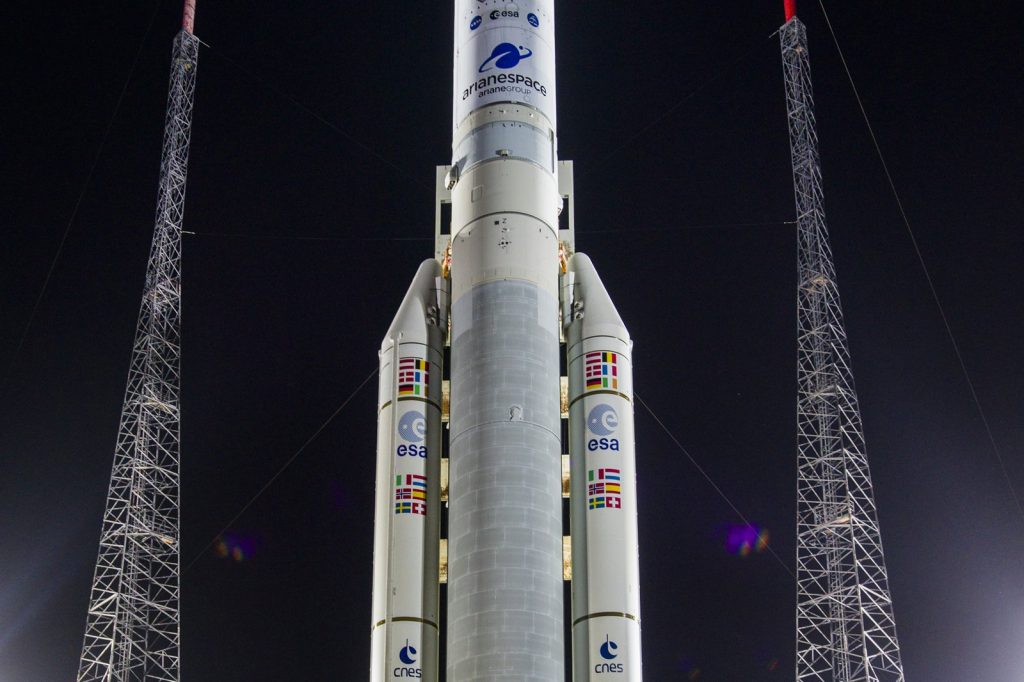
On July 5, 2023, the European spaceworkhorse, the Ariane 5, ascended from Kourou, French Guiana, for the last time. Marking the end of a 27-year journey and 117 launches, this mission carried two military satellites – one French and one German – into orbit. Yet, this departure is not a celebration, but a transition, and transitions carry inherent risks. Europe now finds itself in a vacancy.
The Ariane 5 was more than just a rocket; it was a guarantee of reliability that governments and private companies were willing to pay a premium for. With 117 successful flights under its belt and only two failures in its entire career, the last one occurring in 2002, such a record is not built overnight.
It is the culmination of years of engineering, the collective efforts of thousands at Arianespace and its suppliers, and a supply chain that spans the continent. This chain is now being reconfigured for the next generation, the Ariane 6. However, the Ariane 6 has yet to fly.
The stakes are high. Europe’s independence in space travel relies on a functioning heavy-lift rocket, and the Ariane 5 was the sole contender.
The Russian Soyuz, previously available from Kourou, is no longer an option due to sanctions. The smaller Vega rocket is capable of handling light payloads but is unable to launch a military communications satellite. If the Ariane 6 encounters delays – a common occurrence in development programs – European governments will be compelled to purchase launches from SpaceX or other providers.
This comes with costs, both financial and sovereign. A military satellite is not cargo one would want on a foreign rocket.
The Ariane 5 was designed for versatility. It launched commercial telecom satellites, scientific probes, and the James Webb Space Telescope. It sent probes to Mars and comets.
It was a machine that did as it was told. The final payloads, the French Syracuse 4B and the German Heinrich Hertz, are both secure communications satellites for military use.
This intentional choice speaks to Europe’s need to protect its own communications. The aerospace industry is a high-tech sector, with companies like Arianespace investing heavily in research and development. They design, build, and maintain spacecraft, supporting civil and military aviation.
This sector has seen significant growth recently. Yet, growth does not eliminate gaps.
The Ariane 5 was a reliable product. The Ariane 6 is a promise. Promises are not the same as hardware on the pad. What is at risk is continuity.
The Ariane 5 launched 117 times, each launch providing a data point, refining procedures, quality checks, and the ground crew’s instincts. This institutional knowledge does not transfer automatically to a new vehicle.
It needs to be rebuilt. The Ariane 6 is designed to be cheaper and more flexible, with a modular design capable of handling different payload sizes. However, cheaper and flexible mean nothing if the rocket does not fly reliably from the start.
Arianespace is now turning the page. The final launch paves the way for the next generation.
The company aims to meet changing industry needs and push the boundaries of space exploration. This transition, however, will be a test. Europe must prove it can still launch its own satellites on its own rockets.
If the Ariane 6 works, the handover will be remembered as smooth. If it falters, the Ariane 5’s retirement will look less like an ending and more like a gamble.
Related Stories
Samsung Galaxy S24 Launch Targets US, Europe First




