
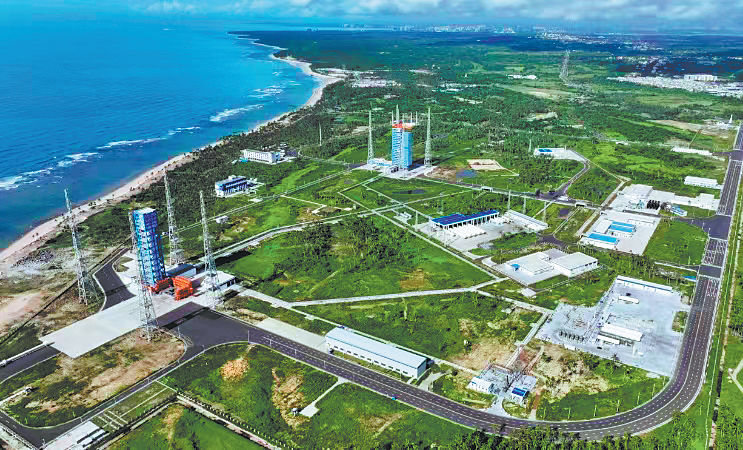
A third launch pad is taking shape at China’s Wenchang Space Launch Site, the country’s southernmost and newest spaceport, signaling an ambitious push toward crewed lunar missions. The facility’s coastal location on Hainan Island already gives it a critical edge over inland sites: the Earth’s rotation at 19.6° north latitude provides a natural boost for rockets heading to geostationary orbit or the Moon, saving fuel and allowing heavier payloads to be carried.
With two operational pads and a third under construction specifically for the Long March 10 rocket, Wenchang is positioned to become the primary hub for China’s most demanding space endeavors.
Strategic Location and Infrastructure
Completed in 2014, Wenchang is the newest of China’s launch facilities. Its construction ended that year, though the first liftoff did not occur until 2016.
The site was chosen deliberately for its proximity to the equator. That latitude, combined with sea access, enables larger payloads and easier insertion into geosynchronous orbit compared to inland launch sites. Unlike China’s other spaceports, Wenchang uses a seaport to deliver rockets and equipment, a logistical convenience that simplifies transport of heavy hardware.
Launch trajectories from the site arc over the open ocean, reducing the risk of debris falling on populated areas. The China National Space Administration runs the facility, which includes facilities for rocket assembly, fueling, and payload integration.
The site originally began as a suborbital test center before evolving into the country’s southernmost spaceport.
Major Launches and Capabilities
Wenchang has hosted launches of the Long March 5, 7, and 8 families of rockets. The heaviest Chinese rocket, the Long March 5, flies from this site, and it has supported the Tiangong space station by launching modules and cargo resupply craft.
On June 23, 2024, the Long March 10B made its maiden flight from Launch Pad 2. That rocket later demonstrated a sea-based recovery, landing in the South China Sea. The coastal position of Wenchang makes such recovery attempts feasible, a capability that suggests China is thinking seriously about reusability in its launch operations. The two existing pads have handled a steady cadence of missions.
Wenchang remains the country’s primary gateway for its most significant launches, and the infrastructure continues to expand to meet future demands.
Future Lunar Ambitions and Public Appeal
The third pad under construction is designed for the Long March 10 rocket, a vehicle intended for crewed lunar missions. With its latitude and sea access, Wenchang is the logical home for these heavy-lift attempts. The site is expected to become the center of the China Manned Space Program, supporting the transition to new crewed craft and lunar missions.
That infrastructure buildup parallels a growing public dimension: Wenchang has become a tourist attraction, drawing crowds for public launch viewings. The crowds keep coming as the rockets keep flying, and the third pad points to a future where China’s lunar ambitions rely on this coastal hub.
The demonstrated coastal recovery, achieved once, signals long-term interest in reusing boosters, a technique that could reduce costs and increase launch frequency. For now, the pads are there, the rockets are flying, and Wenchang continues to serve as the southern anchor of China’s expanding space infrastructure.




