
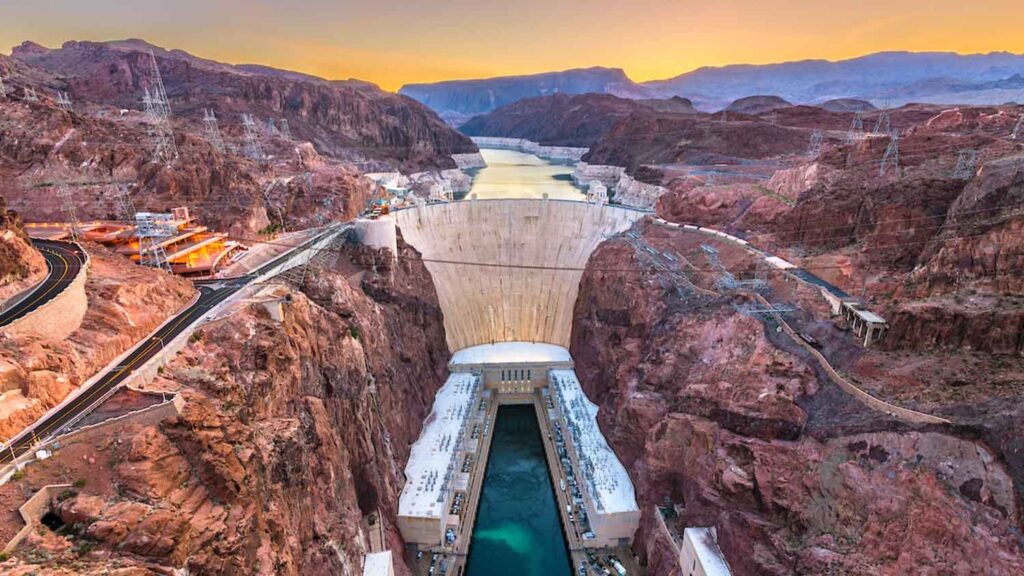
BOULDER CITY, September 15 — The economic stake in the world’s big dams is being recalculated, and the numbers behind the Hoover Dam show why. Built on the Colorado River between Nevada and Arizona from 1931 to 1936, the dam rises 726 feet (221 meters) — the tallest in the world when it was completed — and its 17 turbines generate up to 2,080 megawatts for Arizona, Nevada and California. That output is the reason the project mattered far beyond the Depression-era jobs it created.
Construction, overseen by the Bureau of Reclamation, employed thousands and led to the creation of Boulder City, Nevada. The dam also created Lake Mead, the largest reservoir in the United States by volume, and formalized water allocation among seven western states through the Colorado River Compact of 1922 — an agreement that remains contentious as drought and climate change shrink the river’s flow.
Water rights under strain
The allocation side is where the pressure now sits. The Bureau of Reclamation declared a Tier 1 shortage in 2021 for the first time, a signal that the Colorado is over-allocated. Hoover’s legacy includes the transformation of the American Southwest, enabling cities like Las Vegas and Phoenix to grow.
Those same cities now depend on a river that no longer delivers what the compact assumed. Half a world away, the Aswan High Dam on the Nile tells a parallel story.
Completed in 1970 with Soviet financing and engineering assistance, it was designed to control the Nile’s annual floods, provide year-round irrigation and generate hydroelectric power. At 364 feet (111 meters) high and 12,565 feet (3,830 meters) long, it created Lake Nasser, one of the world’s largest man-made reservoirs, and its 12 turbines produce 2,100 megawatts — a significant share of Egypt’s electricity. The costs were social and environmental.
The dam displaced over 100,000 Nubians and submerged ancient monuments, including Abu Simbel, which was relocated in a UNESCO-led operation between 1964 and 1968. It also ended the natural deposition of nutrient-rich silt downstream, forcing Egypt to rely on chemical fertilizers and contributing to soil salinization and coastal erosion in the Nile Delta.
Egypt gained food security and lost an ecosystem function it cannot easily replace.
China’s scale, and the bill
In China, the Three Gorges Dam on the Yangtze River, completed in 2012, is the world’s largest power station by installed capacity. Its 32 main turbines generate 22,500 megawatts, and the reservoir stretches 410 miles (660 kilometers). The project, first proposed by Sun Yat-sen in 1919 and revived in the 1990s, displaced over 1.3 million people and submerged hundreds of towns and archaeological sites.
It was designed primarily for flood control, but its effectiveness has been debated, with critics pointing to increased landslide risks and ecological disruption. The dam’s ship lift, completed in 2016, allows vessels to navigate the reservoir.
The Yangtze river dolphin was declared functionally extinct in 2006, and the dam has been linked to increased seismic activity. For Asia, the read-across is direct. The region hosts a large share of the world’s hydropower capacity, and the same trade-offs — irrigation and electricity against displacement, silt loss and fishery decline — recur from the Mekong to the Himalayan rivers.
The Three Gorges experience is the reference case governments cite when weighing new projects.
What to watch
The era of big dams is being reevaluated. Some advocates now push for dam removal to restore river health, as seen in the ongoing removal of four dams on the Klamath River in California and Oregon, slated for completion in 2024. The story of these engineering feats is one of both triumph and unintended consequence, a reminder that reshaping nature comes with lasting trade-offs.
Watch the Colorado Compact renegotiation and the Bureau of Reclamation’s shortage tiers, Egypt’s fertilizer import bill as Delta soils degrade, and whether Asian planners treat Three Gorges as a template or a warning. The next decisions on the Mekong and Himalayan rivers will answer that.




