
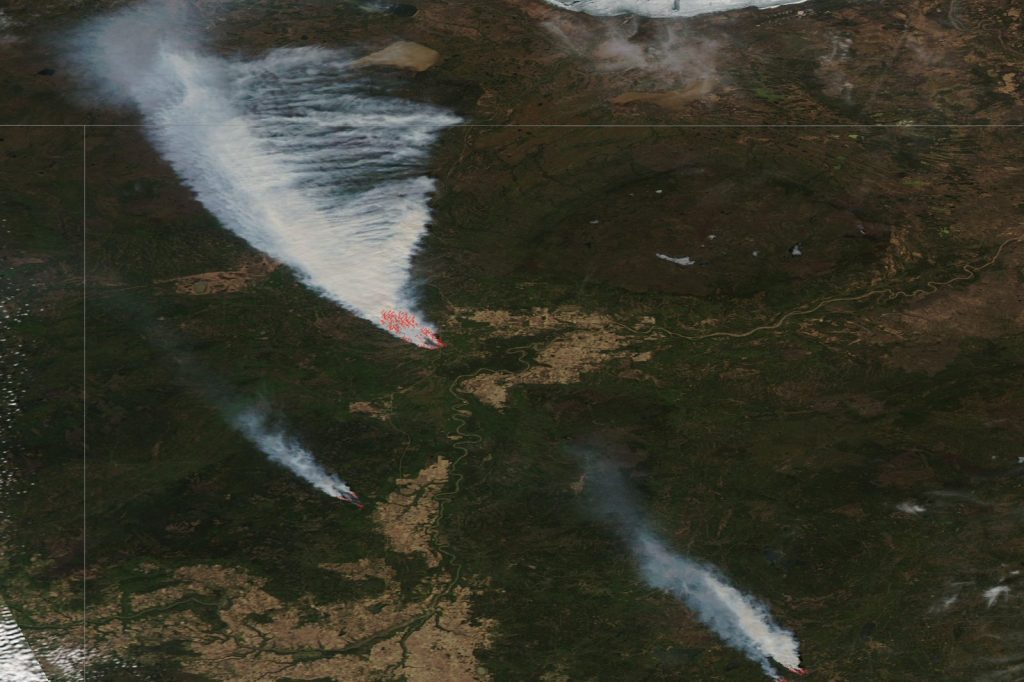
FORT MCMURRAY, Alberta — The grey-brown pall that hangs over this region is not one thing, and it did not arrive alone. It is smoke from fires that have already shut in 344,000 barrels of daily crude production. It is also the dust settling over a cobalt refinery gone idle, a casualty of sanctions written in Washington for reasons that have nothing to do with Alberta’s soil or its workers.
Two crises, one sky. That is the picture in Western Canada’s energy heartland as June draws to a close.
The wildfires are the immediate, visible threat. They have pushed within reach of sites producing 470,000 barrels per day. That is capacity that could be lost if the flames keep moving.
Major operators — Cenovus, MEG Energy, Canadian Natural — have all pulled back crews and halted output. Shell has already declared force majeure at its Scotford upgrader, a 300,000 barrel per day facility, after a unit tripped.
March deliveries from that plant are down roughly 20 percent. Inside the facility, crews are working damage assessments under the constant pressure of a fire danger that forces precautionary shutdowns across the region. Seven percent of Canada’s total crude output is now offline.
That number matters because U.S. refineries depend on Canadian imports for 60 percent of their crude supply. A prolonged disruption in Alberta means refinery problems in the Midwest and along the Gulf Coast. Those problems do not stay local.
They show up at the pump. But the fires are only half the story, and possibly not the half that lasts longest.
Sherritt International has permanently shut down its Fort Saskatchewan cobalt refinery. The reason is not fire or flood or any natural disaster. It is U.S. sanctions on Cuba, expanded in a way that cut off the refinery’s feedstock supply.
The plant is idle until mining in Cuba resumes — a timeline nobody can predict. Cobalt is not oil.
It is a metal essential to batteries, to electric vehicles, to the energy transition that Canadian policymakers talk about constantly. The Fort Saskatchewan refinery was the nation’s only facility of its kind. Now it is gone, a supply chain vulnerability made real.
The two events are causally unrelated. A forest fire and a sanctions regime do not share a root cause. But they share a moment, and that moment is hitting Canadian energy from two directions at once.
One crisis is natural, seasonal, and familiar to anyone who has lived through an Alberta summer. The other is geopolitical, deliberate, and the product of a foreign government’s foreign policy choices.
Neither is easy to fix quickly. Fires will burn until the weather changes. Sanctions will remain until Washington decides otherwise.
In the meantime, production is off, a refinery is dark, and the smoke drifting over Fort McMurray carries the smell of both. The boreal forest has burned before.
It will burn again. But the cobalt refinery was the only one Canada had. Its shutdown is not a seasonal inconvenience.
It is a structural loss, one that leaves the country dependent on foreign processors for a material it needs for the technologies it says will define the next economy. Two crises, one sky. The air is thick.
It stings the eyes. By nightfall, the glow on the horizon comes from two sources, and neither is the sun.




