
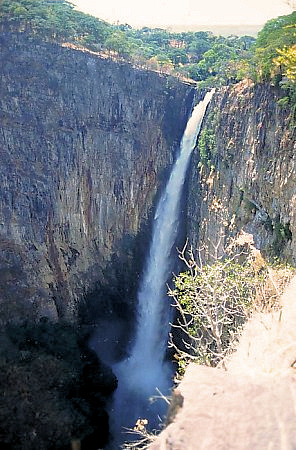
At the spectacular Kalambo Falls, a 235‑metre single‑drop waterfall that straddles the Zambia‑Tanzania border, researchers have uncovered what is now recognized as the oldest known wooden construction. The structure, consisting of interlocking logs, has been dated to approximately 476,000 years ago. This age places it far earlier than any previously identified timber work and was reported in the peer‑reviewed journal Nature.
Setting and Significance of the Site
The falls plunge into a deep gorge that stretches about five kilometres before opening onto the Lake Tanganyika rift valley, a region noted for both its geological activity and rich biodiversity. The constant spray from the waterfall creates a permanent mist that rises high above the cliff face, contributing to the unique micro‑environment that has helped preserve the ancient wood for millennia.
Details of the Discovery
The recovered timber assemblage is described as a log structure, though its exact function remains unclear. No tools or artifacts were found directly associated with the piece, leaving its purpose open to interpretation. What is certain is that the wood has survived in situ for nearly half a million years, a testament to the protective conditions of the gorge and the durability of the material.
Research Methods and Implications
Using advanced dating techniques and microscopic analysis, the research team established the age of the logs and examined their placement within the sedimentary layers. The results indicate that early hominins were capable of shaping and joining large timber elements with the limited technology available to them at that time. This challenges earlier assumptions about the sophistication of prehistoric building practices and highlights a level of planning and adaptability not previously attributed to populations of that era.
Historical Exploration of Kalambo Falls
The scientific interest in Kalambo Falls is not new. In 1928, an expedition led by Enid Gordon‑Gallien first surveyed the waterfall and its surrounding terrain, producing detailed maps and geological notes. That early work laid a foundation for later investigations but could not have anticipated the discovery of such an ancient wooden feature. The legacy of those initial observations continues to inform current studies.
Broader Impact on Understanding Human History
Beyond the immediate fascination of the find, the timber structure offers a window into the cognitive and social capacities of early humans. The ability to procure, transport, and assemble sizable logs suggests cooperative behavior, foresight, and an understanding of material properties. As researchers continue to analyze the site, they hope to uncover more clues about the daily lives, technological innovations, and environmental interactions of these ancient communities.
Future Prospects and Continuing Research
The announcement has already sparked excitement within academic circles and beyond, with many anticipating further investigations at Kalambo Falls and comparable locations. Experts emphasize that interdisciplinary collaboration—bringing together archaeology, anthropology, geology, and related fields—will be essential to fully interpret the discovery. Ongoing work promises to refine our picture of human evolution and may reveal additional secrets hidden within the falls’ ancient sediments.




