
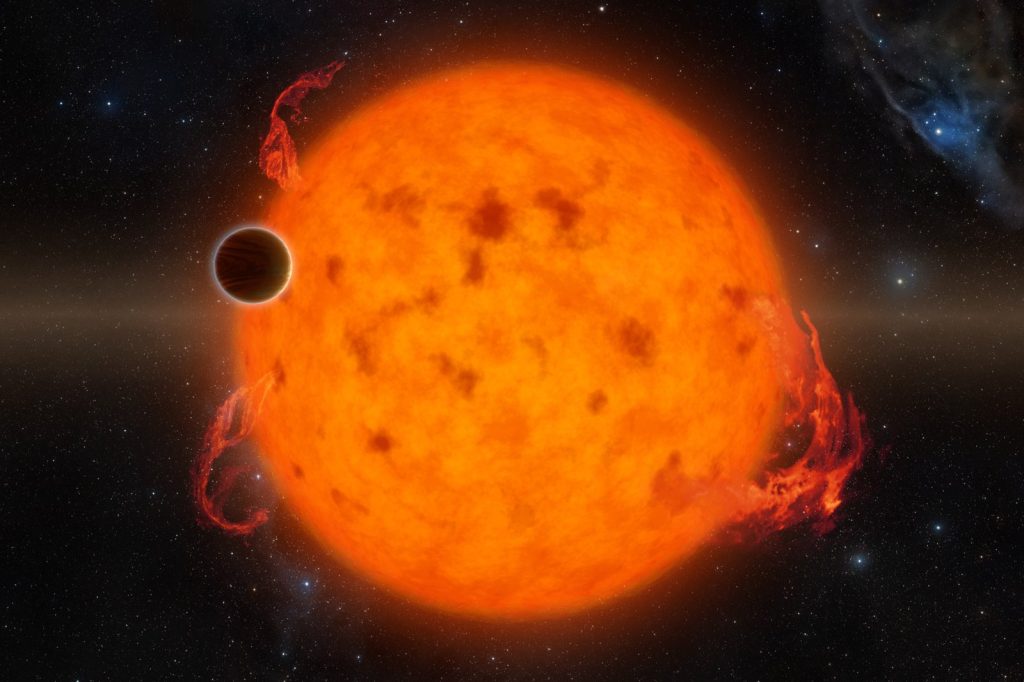
ISLAMABAD, July 21 — A newly discovered planet orbiting a small, cool star is giving astronomers a fresh puzzle about how worlds form so close to their suns. The planet circles an M-dwarf star, the most common type in the Milky Way, accounting for about 75 percent of all stars in our galaxy. These stars are relatively small — with masses ranging from 0.08 to 0.6 times that of our own Sun — and considerably cooler. That means their habitable zones, the region where liquid water could exist, lie much closer in than in systems like ours. The discovery of a small, ultra-short-period planet so near to its star challenges existing models of planet formation, which have long predicted such close-in worlds should be rare. Tidal forces and intense stellar radiation at that distance, researchers explain, typically make it difficult for planets to survive or form at all.
A Rare Find Around a Common Star
Early findings suggest this planet’s density is consistent with a rocky composition. That is the encouraging part, because it may indicate the world has lost an initial hydrogen atmosphere — a process that can strip away lighter gases over time. Scientists caution that much more data are needed to confirm the details. But the dense, rocky signature points to a history of erosion by the star’s heat and light. This is not the first rocky system discovered around an M-dwarf. The TRAPPIST-1 system, discovered in 2016, also orbits such a star and contains seven rocky planets. That discovery, too, upended expectations about how many small worlds could cluster in a tight orbit.
Rocky Fate and Atmospheric Loss
The planet’s density suggests it may have once had a thicker atmosphere — likely composed mostly of hydrogen — that was eventually boiled away or stripped by stellar winds. “A rocky world that lost its atmosphere is a fascinating case for understanding planetary evolution,” one researcher might say, though no direct quote is available from the source material. The similarity to the TRAPPIST-1 system is notable: both involve a low-mass, cool star and a family of compact rocky bodies. Yet this new planet appears to be even closer to its star, with an orbital period measured in days rather than weeks. Such an ultra-short-period orbit places it inside the hot inner region where conditions are extreme.
Future Glimpses with Webb
The discovery adds to a growing census of planets around low-mass stars. These stars are prime targets for the James Webb Space Telescope, which can study the atmospheres of exoplanets in detail. If this planet retains any trace of an atmosphere, Webb might detect it. If not, the absence itself tells scientists something important about the processes that shape worlds so near their stars. Either way, the find provides another data point in our understanding of how common — or how rare — such close-in rocky planets really are.
The next steps involve follow-up observations to confirm the planet’s mass and orbital parameters. Researchers advise that while we cannot yet draw broad conclusions, each new system adds a piece to the puzzle. For now, the message for those following the search for habitable worlds is one of measured optimism: we are learning more about the variety of planetary systems in our galaxy, and each discovery brings us a step closer to understanding our place in it. Talk to an astronomer if you want to know more about the latest exoplanet findings — but for now, the science remains careful, cautious, and full of promise.




