
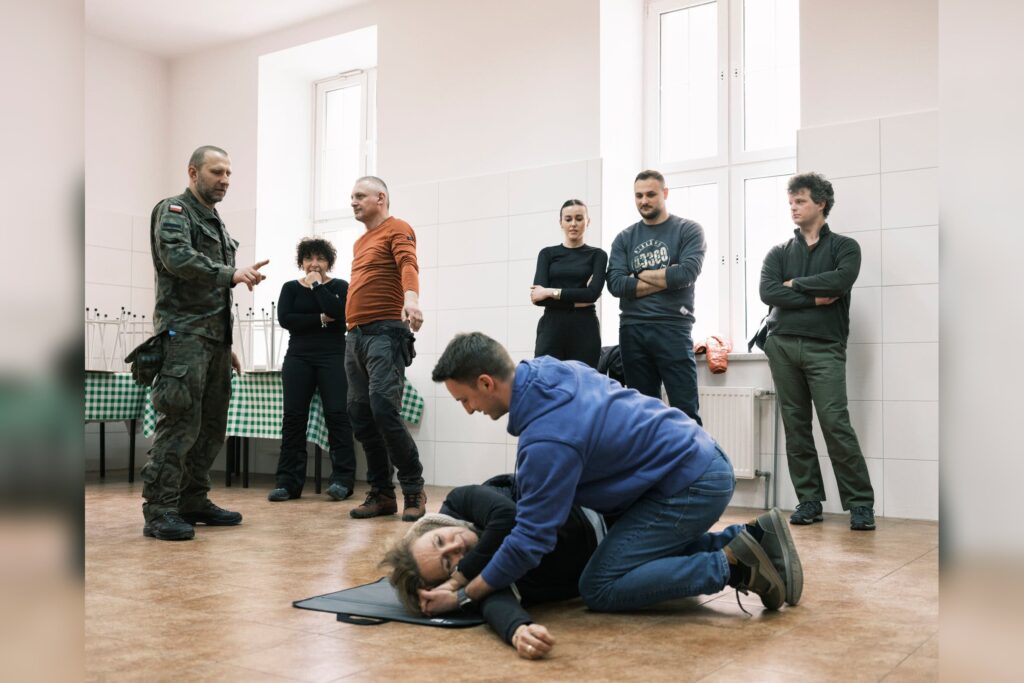
Across Europe this autumn, governments are doing something they have avoided for a generation: openly preparing their populations for the possibility of war. The measures are practical rather than rhetorical, and taken together they mark the most visible shift to a defensive war footing on the continent since the Cold War.
In Germany, the military has begun readying the country’s hospital system for a large-scale conflict. According to reporting by Bloomberg in mid-September 2026, a Bundeswehr planning study modeled a scenario in which Germany could receive as many as 1,000 wounded service members a day in the event of a Russian attack on NATO territory. The country’s five military hospitals would be overwhelmed almost immediately, forcing civilian hospitals into a wartime role. In March, the Bundeswehr ran “Medic Quadriga 2026,” its largest medical exercise since Russia’s full-scale invasion of Ukraine, rehearsing the evacuation of casualties from Lithuania back to German civilian care.
Civil defense returns to the north
The Nordic and Baltic states have moved furthest. Finland’s president, Alexander Stubb, urged citizens in a September interview to “mentally prepare” for Russian hybrid attacks and drone incursions, noting that four drones had already fallen on Finnish soil this year. He was careful to add that there was “no reason to panic” and that Finland’s defense forces had stepped up countermeasures.
Lithuania, which borders both Russia’s Kaliningrad exclave and Belarus, has been updating evacuation plans and taking part in military exercises across the Baltics — a response, in part, to Russian drills near its frontier. Poland’s prime minister, Donald Tusk, went further still, warning on September 17 that intelligence shared by NATO, Ukrainian and U.S. services indicated Russia was preparing “accidental” drone and rocket strikes on countries that support Ukraine. The aim, Tusk argued, would be to intimidate NATO members without triggering a full collective-defense response. Moscow’s foreign ministry dismissed the claim as “contrived.”
What is driving the shift
The immediate trigger is a series of drone and airspace incidents along NATO’s eastern flank over the past year, combined with Russian military exercises close to alliance borders. European planners say the preparations are precautionary — the logic of deterrence is to be visibly ready so that an attack never comes. Critics of the buildup counter that the steady stream of warnings risks becoming self-fulfilling, hardening the standoff rather than defusing it.
Russian officials, for their part, insist they have no intention of attacking NATO. Foreign Minister Sergey Lavrov said in September that Moscow had “no interest” in a war with Europe, while warning that any European attack on Russia would produce a conflict that was “completely different” and “very short.” That combination — denial of aggressive intent paired with a sharp deterrent threat — has become the standard Kremlin message.
A continent hedging its bets
Not every European government is comfortable with the direction of travel. Slovakia’s prime minister, Robert Fico, has said he will do “everything” to keep his country out of a wider war and accused parts of the West of pouring “fuel on the fire.” His stance is a reminder that European opinion is not monolithic, even as the institutional momentum runs toward greater readiness.
For ordinary Europeans, the practical signals are hard to miss: hospital drills, updated shelter and evacuation guidance, and public appeals to keep emergency supplies. None of it means war is imminent. It does mean that the possibility, long treated as unthinkable on European soil, is now being planned for in the open. Whether that planning ultimately deters a conflict or entrenches the conditions for one is the question hanging over the continent as 2026 draws to a close.




