
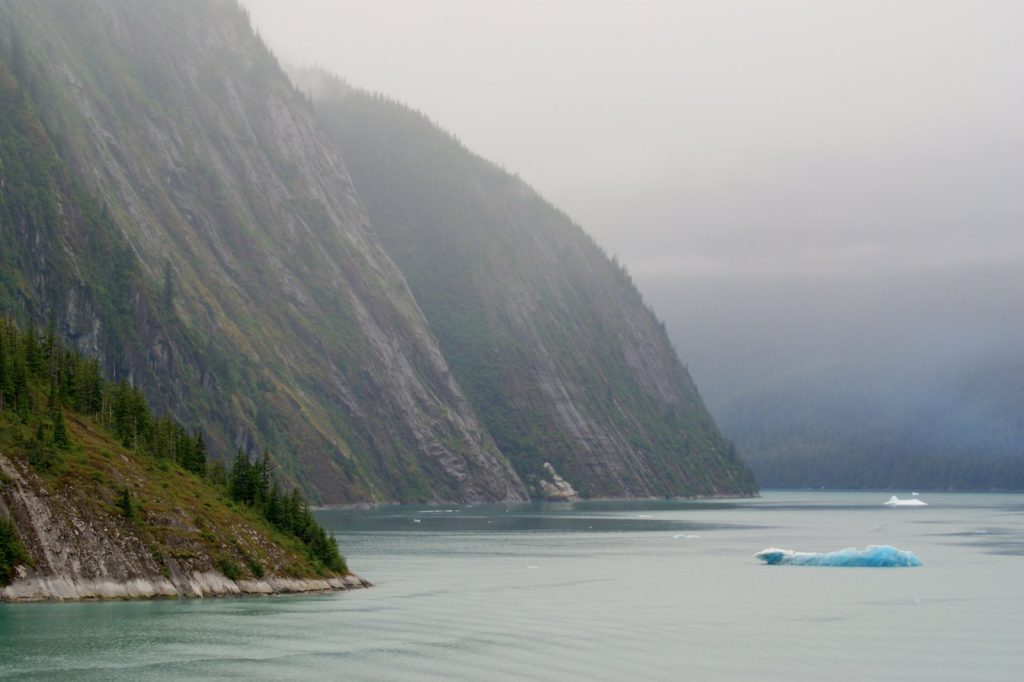
YAKUTAT, ALASKA, October 17, 2026 — Climate change is destabilizing steep slopes above Alaska’s fjords, turning them into ticking time bombs for cruise ships and fishermen—yet no warning system exists.
The 2025 Tracy Arm Tsunami—A Near-Miss That Woke Up Alaska’s Cruise Industry
On a fair mid-July evening, Melenda Lekanof rode in a helicopter over a glacier-ringed inlet north of Yakutat. A 2,000-passenger cruise ship sat in the middle of the bay, but Lekanof was focused on something else. As the helicopter veered east, she pointed out a ridge marked with deep, vertical gashes. Scientists say the slope has started to destabilize and creep toward the water below. “That cruise ship is right there. And that mountain, that cliffside, is right there,” said Lekanof, who is Tlingit and Aleut, from Yakutat. “If that slid, the cruise ship is toast.” Public awareness of landslide tsunamis has surged since August of 2025, when the second-tallest tsunami on record hit Tracy Arm, a fjord south of Juneau frequented by cruise ships. It was early, and no boats had arrived for the day, so no one was hurt. But experts say the near miss highlighted a threat that appears to be intensifying with climate change.
Why Climate Change Is Accelerating Landslides in Fjords: Melting Glaciers, Rising Water, and Crumbling Cliffs
The risk from landslide tsunamis is intensifying in busy Alaska fjords, with no plan in place. Much of Alaska’s southern coast is made up of steep, crumbling slopes above deep, narrow fjords — the perfect recipe for deep-seated landslides so large they can generate waves hundreds of feet high. Gravity is the primary driving force for a landslide to occur, but there are other factors affecting slope stability that produce specific conditions that make a slope prone to failure. In many cases, the landslide is triggered by a specific event (such as heavy rainfall, an earthquake, a slope cut to build a road, and many others), although this is not always identifiable. Landslides are frequently made worse by human development (such as urban sprawl) and resource exploitation (such as mining and deforestation). Land degradation frequently leads to less stabilization of soil by vegetation. Additionally, global warming caused by climate change and other human impact on the environment, can increase the frequency of natural events (such as extreme weather) which trigger landslides. Climate change is worsening the risk: melting glaciers reduce slope stability, while rising sea levels and extreme weather increase saturation and erosion.
The Science Gap: Why Experts Can’t Predict When a Slope Will Fail—or How to Warn Ships in Time
Scientists working on the problem face a long list of challenges. Funding is limited, and Alaska’s sprawling, remote coastline makes identifying and monitoring dangerous slopes an enormous undertaking. On top of that, there is no sure way yet to tell if a slope is about to fail, or to warn people if it does. Chad Hults, a geologist formerly with the National Park Service who now consults with the agency, said the problem could result in a major loss of life and an environmental catastrophe. “There’s 4,000 people in the way of an obvious hazard every single day, in multiple fjords across Alaska,” he said. “The likelihood of another event happening, and a cruise ship being in a fjord, is really high.” Meanwhile, residents and emergency management officials in places like Yakutat worry that there are no clear plans for what to do if a tsunami does take out a cruise ship. “We don’t have enough people, in every skiff in town, to get up there and help,” said Casey Mapes, who served as chief of the community’s volunteer fire department for 12 years. “You’re going to have a massive loss of life.”
Numbers: 1.7 Million Annual Cruise Passengers, 4,000 People Daily in Harm’s Way, and Zero Evacuation Plans
Those landslide-generated tsunamis could be catastrophic for people in nearby vessels, including commercial fishermen, tour operators, and passengers in the giant cruise ships that bring about 1.7 million people to Alaska every year. The most sought after ice is in Glacier Bay National Park, but a strict permit system limits entry there to two large ships per day. That leaves other ships to seek ice in fjords like Tracy Arm and Disenchantment Bay, increasing exposure. Alaska’s fjords host 1.7 million annual cruise passengers, plus commercial fishermen and tour operators—4,000 people daily are in the path of known hazards. There is no operational warning system for landslide tsunamis in Alaska, and no clear evacuation plans for communities or ships.
The Human Cost: Yakutat’s Fire Chief on Why ‘Massive Loss of Life’ Is Inevitable Without Action
Casey Mapes, who served as chief of the community’s volunteer fire department for 12 years, said the town lacks the resources to rescue survivors if a tsunami hits a cruise ship. “We don’t have enough people, in every skiff in town, to get up there and help,” said Casey Mapes. “You’re going to have a massive loss of life.” Chad Hults, a geologist formerly with the National Park Service who now consults with the agency, said the problem could result in a major loss of life and an environmental catastrophe. “There’s 4,000 people in the way of an obvious hazard every single day, in multiple fjords across Alaska,” he said. “The likelihood of another event happening, and a cruise ship being in a fjord, is really high.” Officials report five landslides in McDowell County, North Carolina, on October 11, 2026, triggered by 5–6 inches of rain, showing how even smaller events can cause cascading failures. This demonstrates that landslide risks are not confined to remote regions and can emerge rapidly under extreme weather conditions, reinforcing the urgency for monitoring and preparedness in Alaska’s fjords.
Sources
- The risk from landslide tsunamis is intensifying in busy Alaska fjords, with no plan in place
- Landslide
- Officials report five landslides in McDowell County
Photo: Randy Roach from Fate, TX, United States (CC BY-SA 2.0)




