
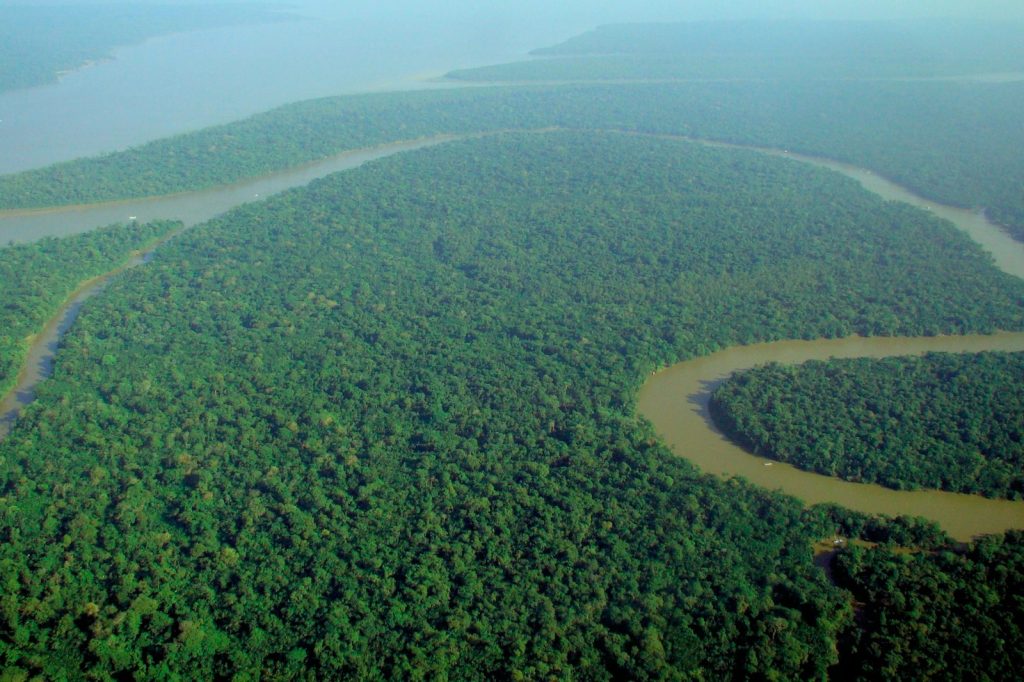
“We were surprised that we found about 10 times more of the geoglyphs than we ever thought,” said Martti Pärssinen, an emeritus professor at the University of Helsinki. He led a team that flew a plane carrying remote sensing instruments over about 4,497 square kilometers of Brazilian forest near the borders with Bolivia and Peru. Their laser scans, published on a Wednesday in Nature, turned up 396 earthworks nobody had recorded.
Lidar is the tool that makes this possible. It fires laser pulses at the ground, and enough of them slip through gaps in the canopy to reveal the shape of the surface underneath. Banks, ditches and enclosures that are invisible from the forest floor show up clearly.
Squares, circles and a lost people
Many of the new finds are geoglyphs, geometric shapes cut into the ground, some of them stretching across several football fields. They are a signature of the Aquiry civilization, which lived in this part of the Amazon between 600 B.C.E. and C.E. 850. Archaeologists think the enclosures hosted ceremonies or gatherings, though their exact purpose is still argued over. Vice, summarizing the paper, described squares, circles and rectangles surrounded by longhouses where farming families grew maize and squash, plus roads and embankments, and one elaborate site of nested rectangular enclosures joined by wide avenues.
The Aquiry vanish from the record quickly. According to Vice, their civilization declined between A.D. 850 and 950, a stretch that roughly matches the fall of other pre-Columbian societies across the Americas. Researchers still do not know why.
Counting the people
From the number and spread of the geoglyphs, Pärssinen and his colleagues estimate the Aquiry may have numbered up to three million at their apparent peak, around C.E. 100 to 300. Vice gave a range of 1.25 million to 3 million. They also reckon the civilization covered 183,000 square kilometers, roughly the area of North Dakota, and that the southwest Amazon may hold between 24,000 and 30,000 such earthworks in all.
If confirmed, the authors write, the results could force archaeologists to revisit the total population of the Amazon before Spanish and Portuguese colonization. Pärssinen went further. What his team studied is “less than 3 percent of the whole Amazonia,” he said, and it is “probable” that other places held similar densities, which would point to a precolonial population of possibly tens of millions. “That’s something amazing and something new,” he said.
Caution from outside the team
Not everyone is ready to sign off on the numbers. Heiko Prümers of the German Archaeological Institute, who has studied ancient Amazon settlements but was not part of the work, called the study “really fascinating.” He noted it is unclear whether structures found close together were counted as separate sites or merged, which could skew the totals. He also suggested that the many sites might reflect “frequent relocations” by the Aquiry rather than a crowded landscape.
Both researchers agree the work undercuts the idea of the Amazon as untouched nature. Pärssinen sees a lesson for the present: about a third of the forest has been damaged by modern human activity, and about 17 percent is fully deforested, while two thousand years ago people shaped the land and still lived in balance with it. “We could learn something about how they managed the forest in the past,” he said.
Sources
- Archaeologists Used Lasers to Reveal Hundreds of Ancient Structures Hidden Beneath the Amazon Rainforest
- Hundreds of ancient, never-before-seen ‘earthworks’ discovered in the Amazon | Scientific American




