
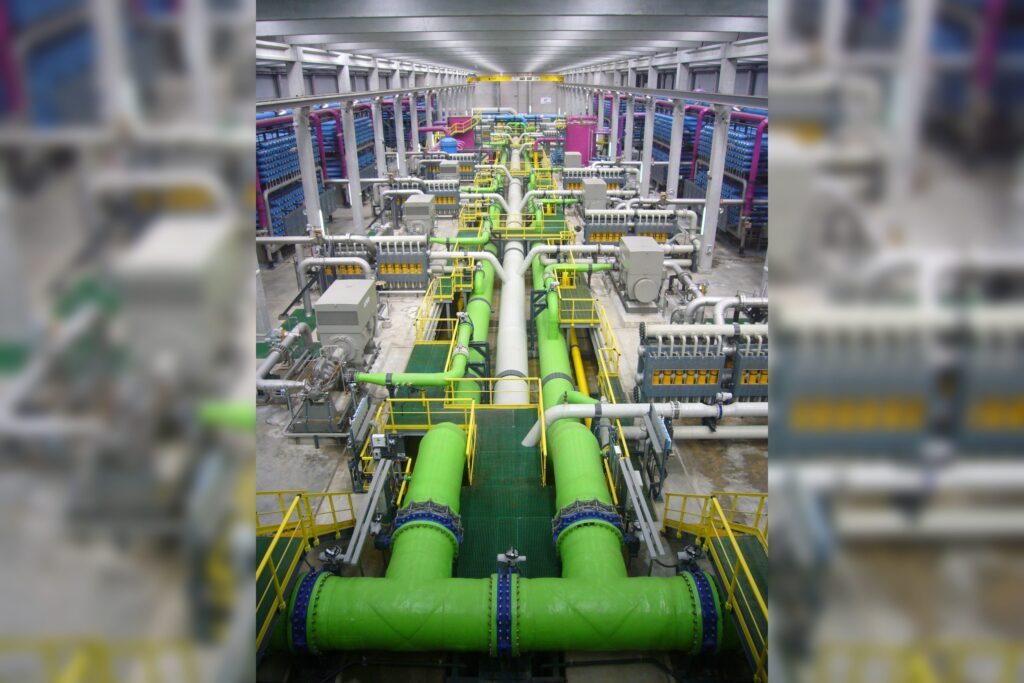
Ras Al-Khair sits on the Persian Gulf coast, a hybrid power and water plant producing 1,036,000 cubic meters of fresh water every day. Commissioned in April 2014, it cost about $7.2 billion and remains the largest desalination plant in the world, according to Blackridge Research.
Strategically, the plant matters more than its size. Saudi Arabia has no permanent rivers or lakes. Rainfall is negligible. Groundwater aquifers are not renewable. Vision Constructors, an engineering industry publication, calls the kingdom one of the most water-stressed countries on Earth. Across the country, 30 desalination plants operate in 17 locations, Blackridge found. They supply Riyadh, Jeddah, Dammam and industrial users, and they underpin the infrastructure that Vision 2030 depends on.
How the water is made
Most modern Saudi capacity uses reverse osmosis. Seawater passes through screens and pretreatment, then high-pressure pumps force it through semi-permeable membranes that separate salt from water. The energy cost has fallen sharply: reverse osmosis now uses 3 to 4 kilowatt-hours per cubic meter, compared with 10 to 16 for older multi-stage flash systems and 5.5 to 9 for multi-effect distillation.
After treatment, the water is remineralized, corrected for pH and disinfected. Then it enters reservoirs and pumping stations. For Riyadh, the route is long. The city is nearly 400 kilometers from the Arabian Gulf and more than 600 meters above sea level. Twin 60-inch pipelines move Ras Al-Khair water more than 450 kilometers inland.
The plant portfolio
Ras Al-Khair is not Riyadh’s only option. JWAP at Jubail, commissioned in 2010, produces 800,000 cubic meters per day, using 27 multi-effect distillation units. Jubail 3A adds another 600,000 cubic meters daily, commissioned in 2023 at a cost of about $658 million. Al Khobar 2, on the eastern coast, runs 630,000 cubic meters a day with reverse osmosis, built by Acciona and RTCC and commissioned in 2018. Yanbu 4 near Al Rayis produces 450,000 cubic meters per day, commissioned in 2023 by ENGIE, Mowah and Nesma.
Shuaiba 3, still under construction, is planned for 2,998,000 cubic meters a day, with a price tag of $821 million, built by ACWA Power and WEHC.
The broader stakes
Water security feeds directly into Saudi economic planning. Vision 2030 calls for new cities and tourism zones, including NEOM and Red Sea Global. Some Red Sea projects pair desalination with solar power and use advanced brine discharge to protect coral reefs, according to Vision Constructors. The kingdom is also pushing into smart water networks, AI leak detection and digital twins.
Ras Al-Khair alone generates 2,400 megawatts of electricity alongside its water output, Blackridge reported.
Sources
- Latest List of Top 5 Desalination Plants in Saudi Arabia [2026]
- Saudi Arabia Desalination Project: From Seawater Intake to Final Use




