
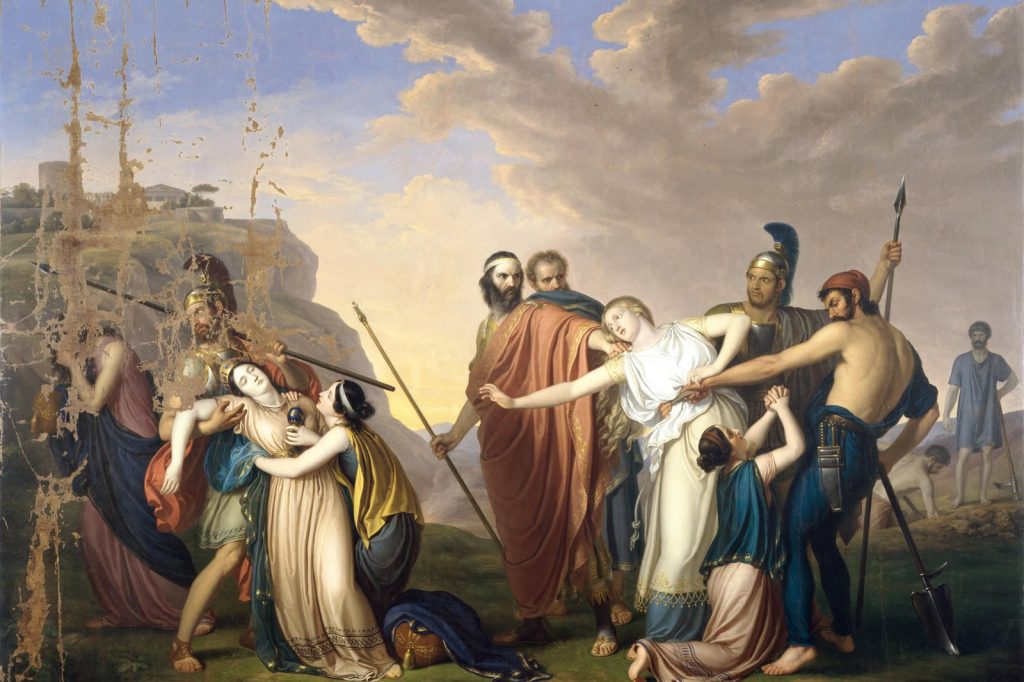
THEBES, IN SOPHOCLES’ THEATRE — The war for the throne is over, and two brothers lie dead by each other’s hands. Against this backdrop the new king issues his first decree: Eteocles shall be honored, but Polyneices, who marched against the city, is to lie unburied, and anyone who covers the body will be stoned. A young woman walks out to the plain anyway, carrying dust.
That opening collision drives Antigone, the sequel to Oedipus Rex and one of the most staged arguments in world drama: what happens when a ruler’s law and a family’s sacred duty point in opposite directions.
Antigone asks her sister Ismene for help and is refused. Ismene wants the old burial rites kept, but she is not willing to die for them; she stands for everyone torn between reverence and self-preservation. Antigone, devoted to the gods and loyal to her dead, sees no such gap. For her the gods’ will outranks any man’s words, and a king’s order weighs little against it. Caught in the act, she does not deny it. She admits what she did and calls it right.
Creon is not written as a simple tyrant. He believes political order holds the city together: if his rules are obeyed, Thebes has peace. The harsh penalty is meant to secure his shaky throne. The trouble is that he rates his word as high as divine law, and the gods answer by refusing the city’s sacrifices and prayers, leaving the offerings unconsumed, a sign of a rottenness at the center of the state.
The price is then counted out body by body. Antigone is sealed in a tomb to await death. Haemon, her fiance and Creon’s own son, pleads for her release and is refused. The blind prophet Tiresias warns the king, from dream-symbols of divine wrath, of the death awaiting his house. Creon relents and rushes to the cave, but he is late: Antigone has hanged herself, Haemon dies beside her, and when the news reaches the palace, Queen Eurydice follows. Creon, frozen in grief, carries his son’s body home and lives on miserably.
The play leaves the readings deliberately open. The chorus hails Antigone’s courage in seizing the reins of her fate and defying her family’s curse, even though it cannot save her. The people of Thebes come to see her as a martyr who fought their tyrannical ruler for their beliefs as much as her own. And in ending her life by her own hand she keeps, on one reading, both morality and pride intact, a death chosen rather than a death submitted to.
The wider picture is the family curse that hangs over all of it. Her father Oedipus, fated to kill his father and marry his mother, blinded himself when the truth surfaced; his sons then fought a war over the shared throne and killed each other. By refusing burial to one of them, Creon carries the curse to its last victims, and only Ismene survives of Oedipus’ line.
What is at stake in the play, finally, is the question Creon cannot hear: which law binds deeper, the one a state can enforce, or the one no state can repeal. Sophocles lets the bodies answer.
Sources
- Antigone – Greek Heroine Who Buried Polynices & Defied Creon
- What Motivates Antigone to Defy Creon's Decree by Burying Her Brother?




