
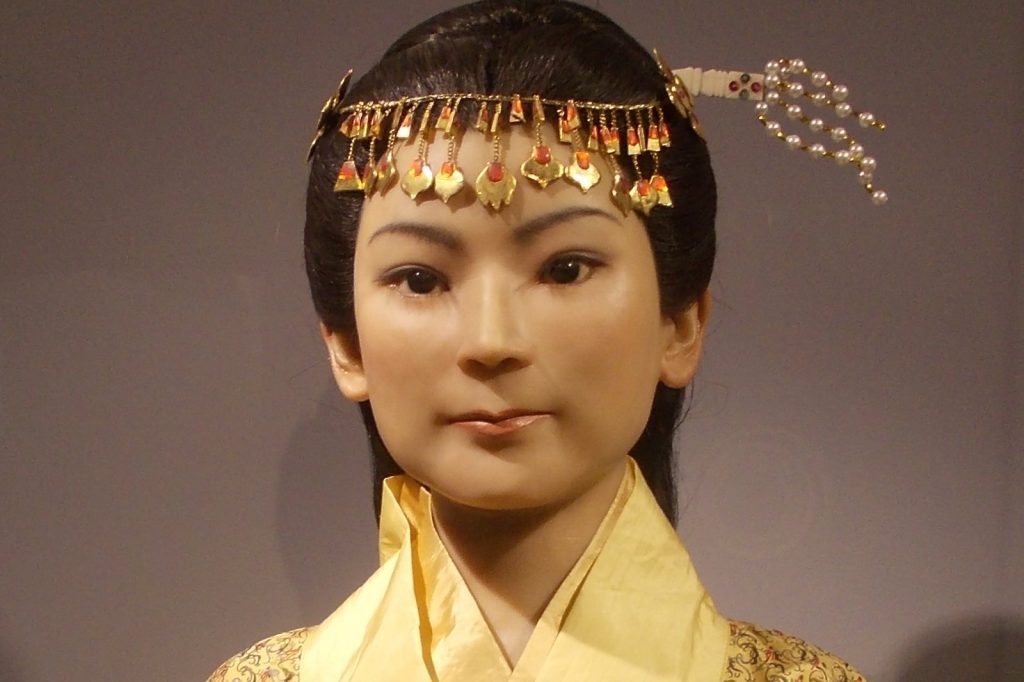
CHANGSHA — The woman ate her last meal, then died. That much is certain. What is not certain, and may never be, is how her body survived 2,140 years without decaying into bone and dust.
Hospital workers digging an air raid shelter in 1971 broke through into a sealed wooden burial chamber on a hillside called Mawangdui — “Horse King Mound.” They found three tombs. The excavation that followed, directed by the Hunan Provincial Museum with 1,500 high school students helping, opened the innermost of four nested coffins in January 1972.
Inside was Xin Zhui, a noblewoman of the Western Han dynasty. Her skin was soft. Her joints still bent.
Her stomach held 138 melon seeds. The preservation is not partial.
It is total. No other ancient body comes close. Egyptian mummies are dried husks.
Bog bodies are leathery. Xin Zhui looks like a woman who died last week. The find forces a hard question: What did the people who buried her know that we do not?
The tomb itself was sealed tight. Multiple coffins, one inside the next.
Layers of charcoal and clay packed around the chamber. The air inside had no oxygen. That stopped bacteria.
But oxygen deprivation alone does not explain soft tissue, movable joints, internal organs intact. Something else was at work.
The burial was a deliberate act of engineering. The people who built it had no microscopes, no knowledge of microbiology. They had observation and tradition.
They observed that bodies rot. They observed that certain conditions stopped rot. They reproduced those conditions at enormous effort.
Four coffins. A hillside dug out and refilled.
Charcoal brought from somewhere. Clay from somewhere else. All of it done for one woman.
Xin Zhui was not a queen. She was a noblewoman, the wife of a marquis.
The marquis himself was buried in the same complex. His body did not survive as well. Neither did the body of their son, buried in the third tomb.
Only Xin Zhui remained perfect. That suggests the preservation was not a general family practice but something specific to her, or to her burial preparation. The melon seeds are the strangest detail.
She ate them, swallowed them, died with them still in her stomach. That means she died within hours of eating.
No digestion occurred beyond the initial breakdown. The meal was her last. The seeds give a precise snapshot of a moment in time — a woman eating melon, then dead.
The cause of death is not recorded. It may have been sudden.
For the archaeologists who opened that innermost coffin, the experience must have been disturbing. They were not handling a skeleton or a mummy. They were handling a body that still felt like a person.
The line between archaeology and crime scene blurred. That reaction is not sentimental. It is the natural response to seeing death reversed, or at least suspended, in a way that makes no sense.
What comes next is the same thing that has been happening since 1972. Study.
Preservation. More study. The body is kept in controlled conditions.
Scientists examine it with tools the original embalmers could not have imagined. CT scans.
DNA analysis. Chemical testing of the tomb fluids. Each new technique reveals another layer of the puzzle.
None has fully solved it. The find remains a singularity. No other ancient body has been found in this condition.
No other culture achieved this level of preservation. The techniques used at Mawangdui may have been lost, or they may have been unique to that time, that place, that woman.
Either way, Xin Zhui sits outside every category. She is not a mummy. She is not a fossil.
She is a 2,140-year-old woman who still has soft skin and melon seeds in her stomach.




