
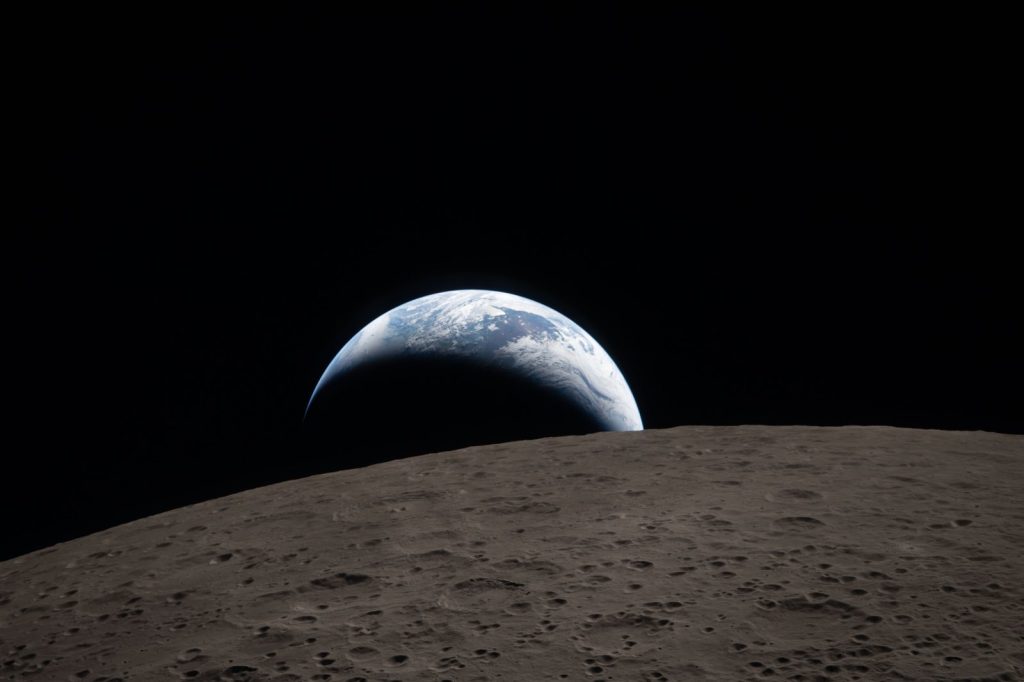
The moon filled their windows, and the crew had a name ready. As the Artemis II astronauts prepared to swing around the far side on Monday, they asked Mission Control for permission to name two fresh lunar craters: Integrity, after their capsule, and Carroll, after commander Reid Wiseman’s wife, who died in 2020 of cancer.
Wiseman wept while fellow astronaut Jeremy Hansen made the request, and all four crew members embraced in tears. “Such a majestic view out here,” Wiseman said.
Less than an hour before the fly-around began, the three Americans and one Canadian had already claimed a bigger prize, passing the old mark of 248,655 miles (400,171 kilometers) that Apollo 13 set in April 1970 and becoming the farthest humans from Earth. Mission Control expected them to beat Apollo 13’s figure by over 4,100 miles (6,600 kilometers) before turning for home.
“It is blowing my mind what you can see with the naked eye from the moon right now. It is just unbelievable,” Hansen radioed. He urged “this generation and the next to make sure this record is not long-lived.”
The day began with a voice from history. Apollo 13 commander Jim Lovell, who died last August, had recorded a wake-up message two months earlier. “Welcome to my old neighborhood,” he said, adding that the crew should not forget to enjoy the view. The astronauts carried the Apollo 8 silk patch that had accompanied Lovell to the moon.
Artemis II flew the same free-return lunar trajectory Apollo 13 used after its oxygen tank explosion, a figure-eight route that leans on the gravity of Earth and the moon to cut fuel use. The capsule, with Wiseman and Hansen joined by pilot Victor Glover and Christina Koch, was due to pass within about 4,070 miles (6,550 kilometers) of the lunar surface at 3,139 mph (5,052 kph), then take four days to reach a Pacific splashdown on Friday.
The flyby doubled as sightseeing. A total solar eclipse greeted the crew, and their target list included the Orientale Basin, a 600-mile-wide impact basin with three concentric rings, along with the Apollo 12 and 14 landing sites. Mercury, Venus, Mars and Saturn were all visible. NASA geologist Kelsey Young, the crew’s moon mentor, expected thousands of pictures.
It was the agency’s first crewed trip to the moon since the Apollo 17 mission of 1972, and a step toward Artemis III next year and a two-astronaut lunar landing on Artemis IV in 2028. President Donald Trump phoned the crew after the flyby to call them “modern-day pioneers” and tell them they had made America proud.
Sources
- Artemis II breaks Apollo 13’s distance record as humans travel farther from Earth than ever before – East Idaho News
- Artemis II breaks Apollo 13’s distance record with daring moon flyby that included a solar eclipse




