
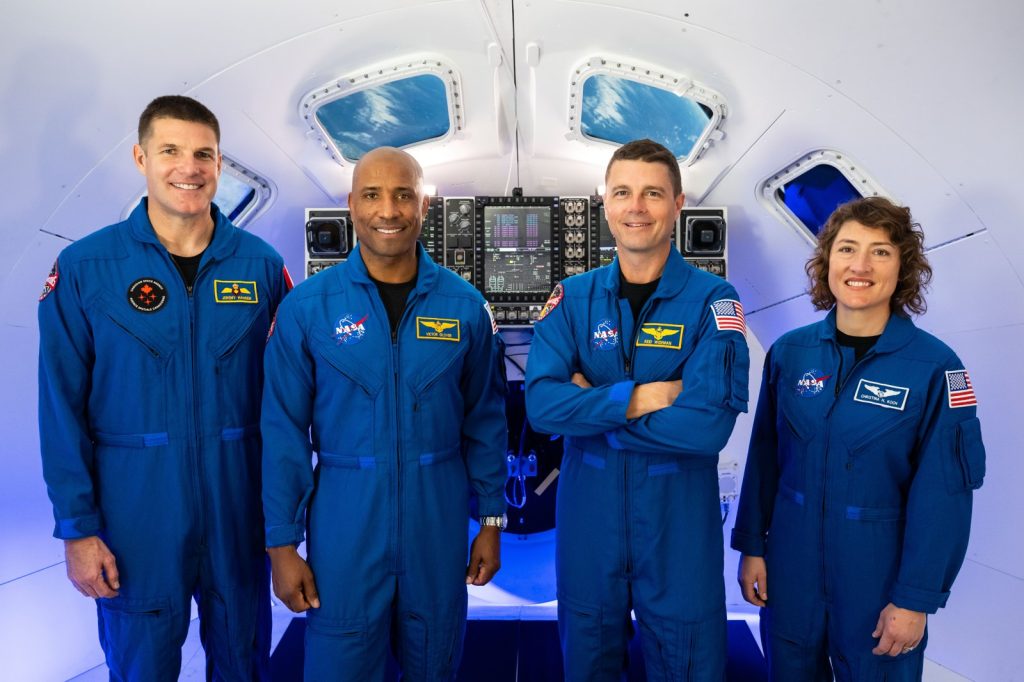
NASA’s Orion capsule carried four astronauts about 252,756 miles from Earth on Monday, the farthest any humans have travelled. The crew passed the old mark of 248,655 miles, set by Apollo 13 in 1970, at 1:56 p.m. EDT, then kept going as Orion looped behind the Moon.
It was day six of Artemis II, the first crewed flight of the Artemis program and the first to send people around the Moon in decades. NASA astronauts Reid Wiseman, Victor Glover and Christina Koch are aboard with Jeremy Hansen of the Canadian Space Agency.
The rocket left Launch Complex 39B at Kennedy Space Center in Florida on April 1, a Space Launch System lifting Orion into a 10-day mission. Orion is not landing anywhere. It uses lunar gravity to bend its path around the far side and send it back toward home. For the capsule, this is the first trip with people inside. Artemis I, the uncrewed test, flew in 2022.
Behind the Moon
At its closest, Orion passed about 4,067 miles above the surface, moving roughly 60,863 miles an hour relative to Earth, according to NASA mission updates. Then it slipped behind the Moon. Communication with ground controllers dropped out for a short stretch, as planned, and came back when the capsule reappeared.
The crew spent that time photographing and describing craters, lava plains, fractures and ridges. They logged how the Moon’s color, texture and brightness change across the terrain they could see.
They also watched an Earthrise as Orion came out from behind the Moon. Later the Moon, Sun and spacecraft lined up, giving them a solar eclipse. NASA said the astronauts used it to study the solar corona and look for flashes from meteoroids hitting the lunar surface.
The way home
With the flyby done, Orion left the Moon’s sphere of influence on Tuesday and settled onto a free-return trajectory. The distance record is a marker, but NASA says the point of the flight is technical: verifying the spacecraft and the operations that later crewed missions beyond low Earth orbit will depend on. The trip home puts navigation, communications and reentry under test across the full length of a crewed deep-space flight.
Splashdown is scheduled for Friday, April 10, off the coast of San Diego, where recovery teams will retrieve the capsule.




