
At 12:56 p.m. CDT on Monday, April 6, the four astronauts inside NASA’s Orion capsule passed 248,655 miles from Earth. No human had gone that far before. The old mark belonged to Apollo 13, set in 1970.
The crew will push the record further still. NASA’s figure for their farthest point is about 252,756 miles, after which Orion loops back toward home. The agency revised that number, and the closest-approach distance to the Moon, in an update later that day.
Artemis II is the first crewed flight of the Artemis program. NASA astronauts Reid Wiseman, Victor Glover and Christina Koch are aboard with Jeremy Hansen of the Canadian Space Agency. Orion left Kennedy Space Center in Florida on April 1 atop a Space Launch System rocket, and a series of burns the next day pulled it out of Earth orbit and set its course for the Moon. By Monday the crew was six days in, still taking pictures of the Moon as they flew away from Earth.
Words from the cabin
Hansen spoke for the crew once the record fell. “From the cabin of Integrity here, as we surpass the furthest distance humans have ever traveled from planet Earth, we do so in honoring the extraordinary efforts and feats of our predecessors,” he said. Then he turned to those who come next: “we most importantly choose this moment to challenge this generation and the next to make sure this record is not long-lived.”
Lori Glaze, NASA’s acting associate administrator for the Exploration Systems Development Mission Directorate, said the astronauts are “charting new frontiers for all humanity.” She added that their mission carries a promise “to return to the Moon’s surface, this time to stay as we establish a Moon Base.”
Two craters, one flyby
During the flight the crew proposed names for two lunar craters. One honors their spacecraft, Integrity. The other honors Carroll, Wiseman’s late wife. NASA will send both proposals to the International Astronomical Union, which governs the naming of celestial bodies and their surface features, after the mission ends.
The Moon flyby comes next. At closest approach Orion will pass within about 4,067 miles of the surface. The crew will be the first people to see parts of the far side with their own eyes, and they will watch the Moon move across the Sun in a solar eclipse. Cameras on the spacecraft and handheld digital cameras will record high-resolution images, including terrain no human has directly seen.
Behind the Moon, communication will drop for about 40 minutes, because the Moon blocks signals between the spacecraft and the Deep Space Network. Orion is expected to regain contact quickly with flight controllers at Johnson Space Center in Houston once it emerges.
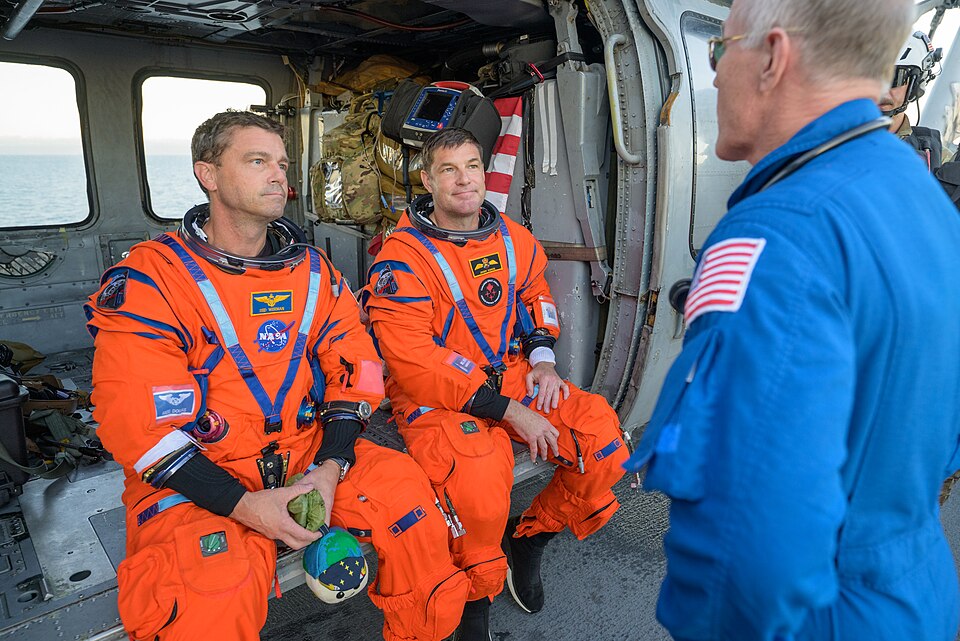
Splashdown is set for about 8:07 p.m. EDT on Friday, April 10, off the coast of San Diego. Helicopters will lift the crew from the water to the USS John P. Murtha for post-flight medical checks before they head ashore.




