
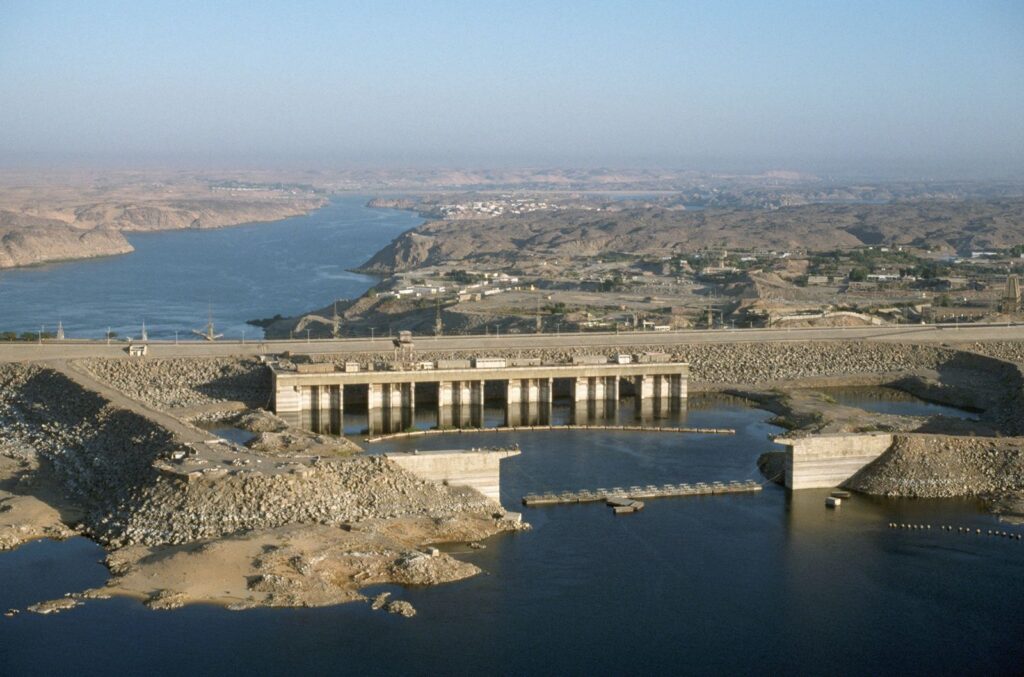
Before the dam, the Nile at Aswan flooded every August to October. Now it moves north at a steady, regulated rate all year. That change, made by the Aswan High Dam, touches farmers, electricity users and Nubian families across Egypt.
The dam is an embankment across the Nile, built between 1960 and 1970 to hold back the annual flood, generate hydroelectric power for southern Egypt and create the reservoir now known as Lake Nasser. It stands 111 metres tall and 3,830 metres wide. Its core is sand and clay, faced with stone, and it holds 17 times more material than the Great Pyramid of Khufu. President Sadat inaugurated it in 1971.
Why Egypt built it
A British-built Low Dam from 1902 had been the first try at taming the river. By the 1950s it was clearly too small for a growing population. President Gamal Abdel Nasser ordered a much larger replacement upstream and made it a centrepiece of national modernisation after the revolution.
The money came from an unexpected place. The United States and Britain first offered to finance the High Dam in the early 1950s, then pulled out in 1956 over Egypt’s diplomatic ties with the Soviet Union and its recognition of Communist China. Nasser answered by nationalising the Suez Canal, which set off the 1956 Suez Crisis. The Soviet Union stepped in to pay for the dam. Around 25,000 Russian engineers and technicians worked on site with 30,000 Egyptian workers.
What it delivered
The dam has stopped the annual flood, doubled Egypt’s electricity supply for the period after it opened, and added roughly 800,000 hectares of irrigated farmland. Twelve generators produce around 2,100 megawatts when the lake is at full capacity.
The power share has shrunk as the rest of the grid has grown. The station supplies about 10 percent of Egypt’s electricity now, down from 50 percent when the dam opened.
Lake Nasser stretches 550 km south into Sudan and stores around 132 cubic kilometres of water. The southern third, inside Sudan, is called Lake Nubia.
What it cost
Around 100,000 Nubians were relocated from the flooded river valley. Dozens of ancient sites would have gone under water as well, including the original Philae Temple, Abu Simbel and Kalabsha.
UNESCO led an international rescue from 1960 to 1980. Abu Simbel, Philae and Kalabsha were each dismantled and rebuilt on higher ground, while other sites were moved or recorded.
The river itself changed too. With the flood gone, the silt that once renewed farm soil no longer settles on the fields downstream. Egyptian farmers feel the difference at planting time, and the guide’s writers call the loss of silt deposition the main negative of the year-round flow.
Visiting
The dam sits 13 km south of Aswan city. Most visitors spend 45 minutes to an hour on the 3,830-metre crest, at the lookouts and at the 70-metre Egyptian-Soviet Friendship Monument, a concrete lotus-flower obelisk built in 1971 with bronze reliefs of Egyptian and Soviet workers at its base. Foreign adults pay approximately 120 EGP, around $2.50 USD. Drones are prohibited, and photography is restricted on the crest.




