
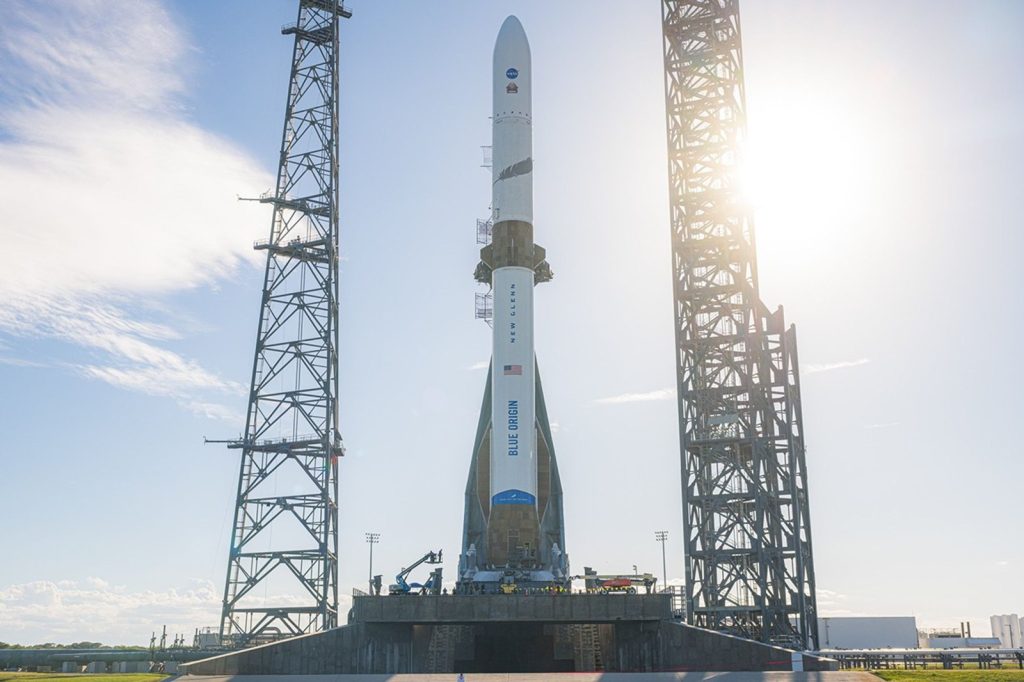
The price of reaching orbit just got a little cheaper. Blue Origin’s launch of a reused New Glenn booster last week isn’t just a technical trophy for the company Jeff Bezos founded in 2000. It is a direct challenge to the economics that have governed heavy-lift spaceflight for decades.
Reusing the booster cuts one of the biggest single costs in any launch: building a new first stage from scratch. The New Glenn is a heavy-lift vehicle, designed to haul substantial payloads into orbit.
If Blue Origin can fly that booster again and again, the per-mission price drops. That changes the math for everyone who wants to put something in space — satellite operators, research institutions, even military customers. The launch happened recently, and the company has not yet disclosed how much it saved on this particular flight.
But the logic is simple. A rocket that flies ten times costs a fraction of ten separate rockets.
SpaceX proved that with its Falcon 9. Blue Origin is now showing it can do the same with a much larger vehicle. The New Glenn is not Blue Origin’s only project.
The company is also working on the suborbital New Shepard rocket, the Blue Moon human lunar lander for NASA’s Artemis program, and the Orbital Reef space station in partnership with other organizations. Each of those projects needs reliable, affordable access to space. A reusable New Glenn gives them that.
The lunar lander, for instance, will require multiple heavy cargo runs to the Moon. Every launch that uses a paid-for booster instead of a new one frees up budget for the lander itself.
Orbital Reef, the planned commercial space station, faces the same equation. The station will need supplies, modules, and crew rotations. Blue Origin wants to be its own delivery service.
A reusable New Glenn makes that service sustainable over the long haul, not just a series of expensive one-off missions. There is also the competitive pressure this puts on other launch providers.
United Launch Alliance’s Vulcan Centaur and SpaceX’s Falcon Heavy are the main rivals in the heavy-lift market. Falcon Heavy already flies reused side boosters, but its core stage is expended. New Glenn is designed to reuse its entire first stage.
If Blue Origin can match or beat the per-flight cost of those competitors, it will win contracts. That means more business for Blue Origin, and less for everyone else. The broader effect on the space industry is hard to overstate.
Cheaper launch costs open up missions that were previously too expensive. A university could afford to fly a research satellite.
A startup could test a new communications payload. A government could launch a constellation of small weather satellites instead of one large, expensive one. The barrier to entry drops.
Blue Origin was founded in 2000 with the long-term goal of making space travel routine. That goal has always sounded abstract.
But a reused New Glenn booster makes it concrete. The company has now demonstrated that it can recover and reuse a heavy-lift rocket. The next step is proving it can do it consistently, launch after launch.
That is the real test. One successful reuse is a milestone. A dozen reuses is a revolution.
Blue Origin has taken the first step. The industry is watching to see if it takes the next one.
{“@context”: “https://schema.org”, “@type”: “NewsArticle”, “headline”: “Blue Origin Reused Booster Cuts Cost of Heavy-Lift Spaceflight”, “description”: “The price of reaching orbit just got a little cheaper. Blue Originu2019s launch of a reused New Glenn booster last week isnu2019t just a technical trophy for the compan”, “datePublished”: “2026-04-19T15:00:00+00:00”, “author”: {“@type”: “Person”, “name”: “InfoPulse Today”}, “publisher”: {“@type”: “Organization”, “name”: “InfoPulse Today”}}




