
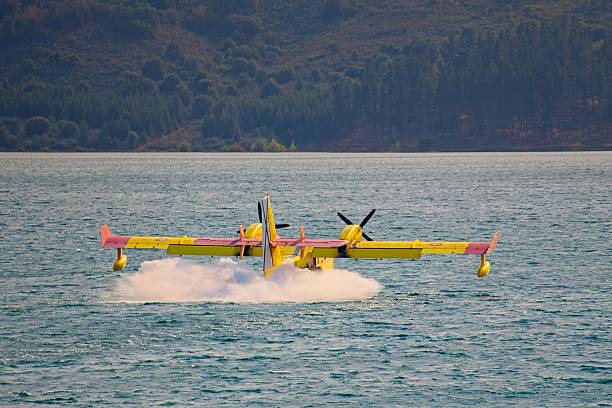
VICTORIA, July 19 — 95. That is the figure that matters for the Canadair CL-415 – the total number of these amphibious firefighting aircraft built between 2003 and October 2015. The bottom line: a proven fleet, now under new ownership and facing a planned production restart in Canada.
By the Numbers
The CL-415 first flew on December 6, 1993, with deliveries starting in November 1994. Production ran for 12 years before ending in October 2015, yielding 95 units. Investors will note that this series is the turboprop successor to the CL-215, which first entered service in 1966 and saw 125 units built.
The upgrade is significant: the CL-415 uses Pratt & Whitney Canada PW123AF turboprop engines, delivering 15 percent more power than the CL-215’s piston engines, alongside improved reliability and safety. The cockpit and aerodynamics were also modernized.
The CL-415’s primary role is aerial firefighting, but it can also perform search and rescue and utility transport. Its ability to scoop water directly from lakes and rivers makes it vital for combating wildfires, including those that cross the U.S.-Canada border — though the United States is not listed as an operator in available records. Operating nations are Canada, France, Italy, and Spain.
Ownership Shift and a New Variant
In October 2016, the Viking Air program acquired the CL-415 program. Viking Air now plans to produce an updated version, the De Havilland Canadair DHC-515, with manufacturing sites in Victoria and Calgary. The DHC-515 is the latest iteration of a lineage that began with the CL-215, which remains in service with some operators.
The CL-415 itself is sometimes referred to as the Bombardier 415, reflecting its period under Bombardier ownership before the Viking Air acquisition. The figure that matters for the original CL-215: 125 units built, a larger fleet than its successor.
But the CL-415 brought a step change in power and cockpit technology, factors that likely influenced Viking Air’s decision to launch the DHC-515 rather than restart the earlier model. As of mid-2026, the DHC-515 remains in the planning stage, with production not yet announced.
Cross-Border Relevance
While the U.S. does not operate the CL-415, the aircraft’s ability to scoop water from lakes and rivers makes it a critical asset for Canada, France, Italy, and Spain in tackling wildfires that often ignore national boundaries. The CL-415 can refill in minutes on any open water, a capability that has driven its adoption by firefighting agencies in those countries.
For U.S. officials watching Canadian wildfires approach the border, the absence of this specific platform in American fleets is a notable gap — though source materials do not detail any cooperative agreements or lease arrangements. The DHC-515, if produced as planned, would be built entirely in Canada.
Victoria and Calgary — cities named by Viking Air as production sites — would host the manufacturing lines for the amphibious aircraft. The move would keep the design and assembly within Canada, the home country of the aircraft’s original designer, Canadair, and its later stewards, Bombardier and De Havilland Canada. The CL-415’s production run of 95 aircraft, combined with the 125 CL-215s, means roughly 220 purpose-built amphibious firefighting aircraft have been built since the 1960s.
That is a niche but vital fleet for nations with large forested areas and limited road access in fire zones. The next chapter, under the De Havilland Canadair name, will determine whether that number grows.
Investors will be watching for an official production launch. The bottom line: the CL-415 line is not dead — it is waiting for a new assembly line.




